Pretty Little Liars

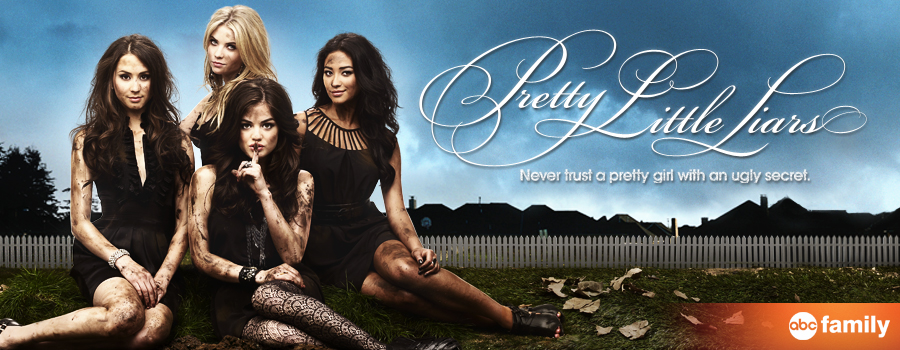
ABC Family is hyping the heck out of the Season 2 premiere of Pretty Little Liars in January, so time to catch up. This show that looks something like Desperate Housewives for teenagers has a slick look and sinister-sounding previews.

The pilot opens in full-on horror movie mode. A group of cute girls are sitting around a candle-lit barn while the wind howls against the creaky door. They’re creeped out by a sound from outside and stand, as a group, ready to face terror. It turns out to be just their friend sneaking up on them. We do a 180 into a much-too-quick scene of some slumber party chatter. (Is the fact that they like Beyonce important, or is this just an awkward attempt at natural-sounding teen banter?) Then they pass a big cup filled with some dark liquid. There’s a mention of the beverage making people share secrets, and one of them says, “Our secrets are what keep us close.” This last quote is imbued with a kind of weight cluing us into its importance.

In the morning the last girl to have arrived, Alison (Sasha Pieterse, who showed up in the later, less-watchable episodes of Heroes), has disappeared. Up to this point we have jumped from one situation to another with lightening speed and absolutely no chance for character development. So are we shocked that this girl is gone? Not really.

At last we start getting to know one of the girls, Aria (Lucy Hale of Privileged). One year has passed since the opening scenes, and Aria’s family has just moved back to town after her father’s sabbatical in Europe. Aria’s mother (Holly Marie Combs) encourages her to reconnect with her friends, but clearly things have changed. In fact, we are reminded at every turn how much things have changed. This is one example of how this show tells the audience things rather than showing them.

The town is Rosewood, Pennsylvania, the kind of pretty East Coast town with an air of evil reminiscent of Amityville. Aria’s return to school gives the opportunity for exposition and further character introductions. It’s the “Prodigal Son/Daughter” pilot formula. Although Aria’s mother points out for the audience that a year is a long time in the life of a 16-year-old, it feels like the passage of time is treated a little too seriously. “I almost didn’t recognize you,” says a classmate to Aria. “Last time I saw you, you had a pink streak in your hair.”

 The only point about the school social hierarchy that seems important to remember for now is that a formerly geeky girl, who our heroines picked on, is now popular and cute (translation, she got contacts). In scenes with each of the four remaining girls, Aria, Spencer, Hanna, and Bianca, we begin to see that honesty is not a virtue in Rosewood. They lie, they shoplift, and they flirt with sisters’ boyfriends. Each of the girls receives a mysterious message—either by text or note—warning her that someone is watching her unethical behavior, and signed “A.”

Alison’s body is discovered, and a funeral is held. At this point we’ve begun to suspect that one or more of the girls might know more than they’re saying about Alison’s death. Yet, from the cryptic conversation of the girls combined with the semi-anonymous messages, it seems she might not really be dead. Certainly these pretty little liars have a secret, but it turns out that their secret—one of them, anyway—concerns not Alison, but a girl named Jenna.

It’s clear there are a lot of layers here, and while the delivery may not be the most sophisticated, the show promises to ask for some loyalty on the part of the audience. It’s great when a pilot leaves you with no clue what’s going on, and this one does that.

The Walking Dead (in retrospect)

I always say that pilot can only be truly appreciated in retrospect. You can’t know how good it is until you see how the whole season—sometimes the whole series—plays out. So I’ve waited until now to blog about The Walking Dead.

This show, which had a 6-episode first season on AMC, has been reviewed and analyzed extensively, for the most part favorably (in places like these.) So I won’t bother raving about how entertaining, exciting and original it is. Though it is all of those things.

The thing to understand about this show is, it’s not a zombie show. It’s a suspenseful, end-of-the-world drama that just happens to have zombies. The pilot lets us know that, giving us rich character introductions and a bleak, ominous landscape.

The opening scene lets us know something isn’t right. A police officer, Rick Grimes (Andrew Lincoln), parks his squad car and makes his way through an intersection littered with overturned vehicles. Beyond that he finds an abandoned camp site where bodies rot in cars. Rick appears completely calm, as though he is finding only what he expected. And, while the sight of him putting a bullet in the forehead of a little girl with a teddy bear and half a face packs a punch to the audience, it doesn’t seem that out of the ordinary for Rick.

In hindsight this opening scene feels odd. Where are we? When are we? When Rick first leaves the hospital, trying desperately to figure out what happened to the world during his coma, he is understandably freaked out. He doesn’t know the ways of the new frontier until at least episode 2. Suddenly it’s not clear when in the timeline of the show this scene takes place; maybe we haven’t seen it yet? Why did the writers choose this point of attack? Just to shock us with Cindy Lou Who getting her head blown off? Rick shows much more emotion when, mid-way through the pilot, he shoots the half-woman crawling across the lawn.

A flashback is used to set up the relationship between Rick and his partner, Shane (John Bernthal). This relationship is crucial to the story arc, and its position in the script suggests that. The writers don’t miss a chance to also mention Lori (Sarah Wayne Callies), the woman who will represent the point in their love triangle. In the chase of a suspect, Rick and Shane are clearly the competent ones. More importantly, they’re both basically good guys. They have each other’s backs, and together they defend the public good. These characteristics will leave us torn as the story unfolds, unable to paint Shane as a hero or villain. This will prove especially true in the opening scene of episode 6, in a flashback to when the hospital was overrun with zombies. The relationship between the men is also a source of frustrating dramatic irony later in the pilot, when Rick radios through to the campsite having no idea Shane is there.

We don’t get to know any of the other characters in the campsite at this stage. We see just enough to see that a group of survivors is making the best of it on the outskirts of town.

The pilot spends a good chunk of its 66 minutes having us get to know the character Morgan (Lennie James); he has a big dramatic introduction and the possibility of a reunion with Rick for later on. There’s no payoff through, at least this season. Morgan, although a rich character, winds up being no more than a device for explaining the world to the viewing audience. (I, for one, want to know if he ever shoots his wife).

One of the questions running through this episode—for viewers, not the characters—was “how far will they go?” This is a horror show on basic cable. The opening with the little girl gives a pretty strong hint, but we wonder how gross, how shocking, how scary AMC will be. The show does not disappoint in this respect.  The pilot leaves us with a bizarre, gag-worthy gut feast that didn’t let us forget about the show until the following Sunday.

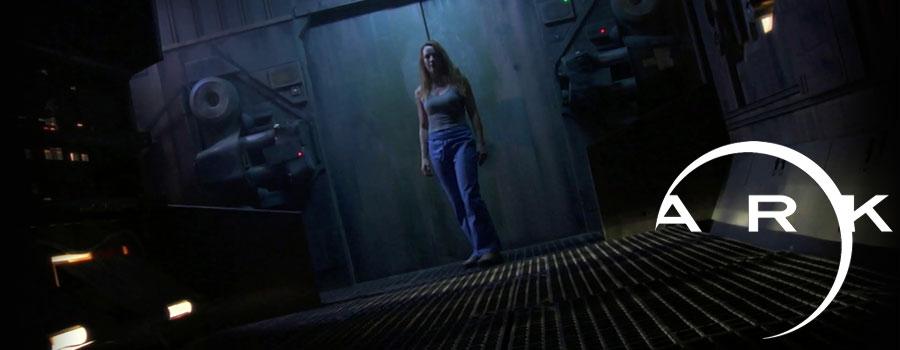
Ark

The pilot of this web series functions like a cold open would in a television series. You can barely call it a set-up. We see a character in a situation, and just as we get a wider angle—literally and figuratively—it’s over. The protagonist, whose name as far as we know, is “Mom,” is dozing on a couch in a messy living room. Her child is operating a handheld video camera while trying to wake her up, but she shoos him away. Then, somehow, she is inside a container not much bigger than a coffin. Saying any more would be a spoiler. As a pilot, this is light on exposition, big on suspense; great combo.

Raising Hope

This intent of this blog isn’t to give you reviews of all the latest shows, as there are many fine websites already doing just that. I like to look back at shows with the perspective of time, especially after they’ve been cancelled—it’s just more fun that way. That being said, with all the new shows premiering last week, only one stood out to me as not totally sucking so I figured the pilot deserved some discussion.

Anyone who has watched Fox in the past 6 weeks really didn’t need to watch this pilot for the premise, since the whole thing was spelled out in the previews. The “from the producers of My Name is Earl” angle was played up heavily and most of the great jokes were given away. So, this was one of those pilots you just want to get out of the way and start watching the show—because the show is freaking hilarious.

A quick rundown: a 25-year-old living with his parents and working a dead end job ends up solely responsible for his illegitimate daughter after the child’s mother gets the electric chair. Dark enough for you? Even without knowing about the “Earl” connection, the tone and look of the show give it away. It’s got this slightly dreary feeling, filled with objects so out of date, you can’t be sure of the time period at first. It could be 1980, or these people could just have really crappy furniture. It also has the loopiness that allows us not feel guilty as we watch a baby being flung around the backseat of a car. Yet, it retains a sweetness. It’s darker than, say, “Malcolm in the Middle,” but it’s not quite “It’s Always Sunny in Philadelphia.”

There are some unexpected moments in the pilot. After the main character, Jimmy (Lucas Neff) dramatically tells off his boss and quits his job, he comes home, where we learn that said boss is also Jimmy’s dad (Garrett Dillahunt). The other thing not seen coming in the previews is the flashback idea. Flashbacks can sometimes be used for lazy storytelling, but these are very effective, endearing us to the mother and father characters, and adding depth. The scene toward the end of the (grand)parents singing to the baby is very sweet amid all the crudeness. Not that the crudeness is bad… puking on a baby at the sight of a dirty diaper… that is some funny shznit. It’s too bad it was revealed in the preview. Here’s hoping that subsequent episodes are just as funny, and these characters will become as loveable as the Hickeys.

Hellcats

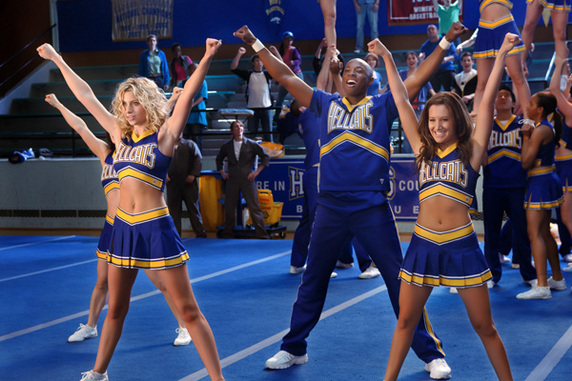
You might call it lazy to have the entire setting and premise of a show laid out via voiceover from the protagonist right at the start of your pilot, but it’s not as bad as having cheerleaders practice in front of a really obviously green screened college campus. Hellcats does these two things in its first minute. Not a good first impression. The protagonist in this case is a gorgeous blond law student who we should take seriously because she rides a bike everywhere and helps her mom make ends meet during these rough economics times. But we’re shown that she has a heart because she acts slightly concerned when a cheerleader eats it during practice.

Lest you think that I watched this pilot just to hate on it, know that I had hopes. I love cheerleader related stuff—Bring It On is one of my faves—and as a huge Veronica Mars fan, I do not believe that a low budget CW show can’t be great. Getting into the predictable story, Hotty McBicycle (still haven’t caught her name) is about to lose her scholarship and has to find a new one stat. She expresses her desperation to someone in the administrative office thus: “You know what gets me through? Hope.” It gets worse: “You kill my hope, you kill me.” The dialogue hurts. It hurts. But not as much as the way she teaches herself to cheer. Are you ready for this? She watches Bring It On. For the uninitiated, this underrated San Diego-filmed movie is all about how cheering should be taken seriously as a sport. Hotty must have fast forwarded to the cheering parts.

Hotty gets into it with the head cheerleader, Savannah (Ashley Tisdale) early. This gives the plot a conveniently-placed obstacle. But at the try-outs, Hotty, oh yeah, it’s Marti, wows the coach by ignoring the choreography and busting out her own routine. She doesn’t know gymnastics terminology but can tumble like Mary Lou Retton. She makes an offhanded reference to “training” since she was 16, but it’s not remotely believable that she gets put on a college cheerleading squad. Later it comes out that she did gymnastics in high school, but it’s too little too late.

Marti has to move into cheerleader housing called Cheer Town, leaving her devoted but obviously irresponsible mother behind. This sets up potential future mother-daughter strife story lines. We get to know the coach, her boyfriend, and her ex-lover who is also the new football coach. Their story holds some at least some possibility for being interesting.

Marti makes nice with the head cheerleader, and her real nemesis turns out to be the girl who got injured in the opening. So that’s kind of a twist. Marti attacks her with, “Do you invent your own catty metaphors, or is there like a book?” Ow. Ow, it hurts. At the other end of the spectrum, she catches the eye of strapping male cheerleader Lewis.

Glee has convinced us that cheerleaders live in their uniforms. The Hellcats wear their uniforms to practice. Why is this necessary? Yeah, they look good in them. But do the producers have to spoon feed us everything in the pilot? What’s even more annoying is that they spontaneously, somehow, know a complicated routine complete with lifts, at their first practice. Speaking of Glee, this show is its antithesis. Do we really think that a whole group of high school kids have the pipes of Broadway stars and can learn 3 or 4 songs a week, and always have appropriate costumes at the ready? Yes! Because Glee draws us in and convinces us that we’re watching a musical, where the joy of the moment overrides our skepticism. Hellcats is just plain contrived. I don’t care how plucky you are or how small your waist is, you can’t just be a cheerleader because you watch a movie. Gahhh!

Web Pilots

Web shows have become a genre unto themselves. And, like other shows, they need pilots that draw in the audience and set the stage for the series. They have some unique challenges, though. I’ve just started mulling this over, and am wondering if anyone else has any observations. (If so, hit me up!)

Web shows generally have short episodes, ranging from one to ten minutes or so. Perhaps because of our conditioning with YouTube and viral videos, we have limited patience with content designed to be viewed online (despite the fact that we’re now watching network and cable TV online as well). So it has to grab us and grab us fast. Also, it seems we haven’t grown a taste for dramas online. Generally, this stuff has to be funny.

Not only do web show have to accomplish more in a shorter time, there are expectations of edginess. Maybe it’s the medium that dictates it; the internet is younger than TV so it must be edgier. Or, perhaps it’s the audience. People who go digging online for new stuff to watch probably aren’t satisfied with the same old-same old.

Conversely, expectations are lower when it comes to production values. Because we love to see the Chad Vaders of the world make good, we are very forgiving of poor lighting or wonky edits. We still want good acting, though. (Or do we? Do you feel differently?) It’s not all unknowns trying to get noticed; big name actors are treading the pixels.

Stay tuned as I’ll be reviewing pilots of Ikea Heights, FCU: Fact Checkers Unit, and Web Therapy.

Rubicon

Rubicon, a new show on AMC has a cool title (a metaphor for a point of no return) and a cool tag line: “Not every conspiracy is a theory.” So I decided to see what they mean by that.

Things start off simply. A quote appears: “An invisible empire has been set up above the forms of democracy.” We’re asked to guess who said it, Ted Kacyzinski or Woodrow Wilson. Naturally the answer is the less obvious, and by extension, the more eerie, Wilson.

Next we see some kids running happily through the show. They’re shot from above, lending a starkness that says their happiness will be short-lived. A woman, we assume their mother (Miranda Richardson), joins in their game, while inside the stately manse, a man (their father? grandfather?) reads his morning newspaper. A four-leaf clover is pressed into the paper, giving him pause. He proceeds upstairs and blows his brains out.

The opening credits speak to anyone who is a fan of Dan Brown and the like. Numbers, symbols, words, and images are circled or connected, hinting at sinister hidden messages all around us. One of the images is of a freeway off/on-ramp “clover,” and immediately in the next scene people are sorting out a crossword clue about a four-leaf clover. So we’ve got a theme that is none too subtle.

Our protagonist is Will Travers (James Badge Dale), a moody academic. He is apathetic when a female co-worker reminds him it’s his birthday and offers to buy lunch. Will attends a staff meeting, which serves as an introduction to the other characters. Tanya, the most junior staff member, is chastised by Grant for forgetting the doughnuts. Grant is a jerk. Miles is a bearded version of Will. David, their boss (Peter Gerety), looks the part of esteemed university professor, complete with elbow patches. He gives each member of the team a cryptic assignment, starting with observing missile silos. It’s not entirely clear what this workplace is, or what the characters do. But that’s okay, because the real story seems to be Will’s obsession with a particular set of crossword puzzles.

Will brings the puzzles to David, for the elder gentleman’s expertise. There seems to be a pattern in the puzzles hinting at a mysterious fourth branch of government, the branches being symbolized by—you guessed it—clover leaves. It seems like a huge stretch to the viewer, but we have to buy that these guys are smart enough to see meaning where we laypeople would not. David gives him the brush off, only to pounce on the puzzles himself once Will is out the door. He in turn shows them to his boss, Kale (Arliss Howard).

A big reveal comes at lunchtime when Tanya asks Miles why Will walks around looking like his cat died. Miles replies, sanctimoniously, “Try wife and child. Try 9-11.” It’s a little ham-handed but adds an important layer to Will’s character. Another detail, this one handled with welcome subtlety is the revelation that David is Will’s father-in-law. “They’re gone,” he says. “It’s just something both of us have to accept.”

[SPOILER ALERT] David, we find is carrying the burden of knowing whatever Big Event is about to happen that will set off the storyline for the series. He warns Will to leave town, and then is killed in a train accident. Will, like any good conspiracy theorist, doesn’t accept that it was an accident. He reluctantly takes David’s job when it is rather insistently offered.

He enlists the help of a colleague, introducing us to another key character, Ed. Ed has that whole wise old hermit thing going on, so we figure he’s going to know some things.

So will the show be about solving David’s murder? Or about the crossword puzzle plot? Or both? And what of the man who killed himself in the opening? The pilot, though it has an arc, doesn’t really have an ending; and that’s a good thing. We’re in for some mellow-drama, to be sure, but it’s got the necessary hook.

Haven

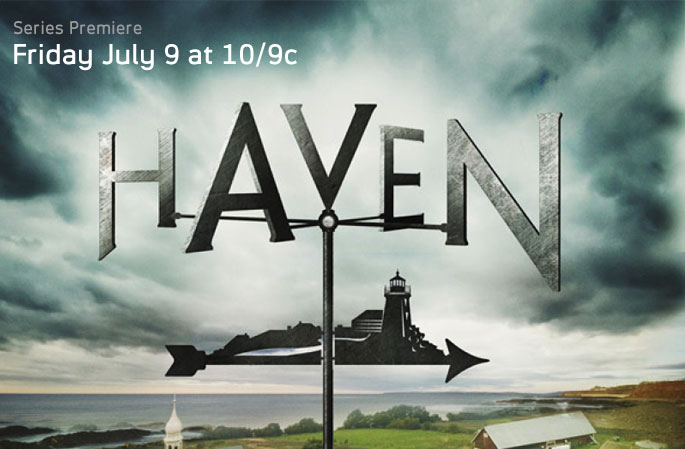
Some pilots don’t have to work very hard. Even if you don’t know that Haven, a new show on SyFy, is based on a book by Stephen King, you’ll likely figure it out pretty fast. A lone cop is sent to a small Maine town filled with colorful characters where something of a vaguely sinister super-nature is going on. Other things we already know: FBI agents and local police officers don’t get along. Female cops work super hard and don’t have time for dating. People who live on boats are odd.

So, putting all of those givens into place, let’s get to know Agent Audrey Parker (Emily Rose). A quick couple of aerial shots show us she lives in a big city. Her boss shows up with an assignment, pausing to comment on a teen vampire novel on her table. “FBI is nonfiction work,” he pontificates. Huh?

Agent Parker gets to Haven, a small harbor town with exceedingly strange weather. You know when a town on TV has a quaint, cozy-sounding name like Haven, bad things are going to happen there. (Point Pleasant, Wisteria Lane.)  She’s driving along when a chasm opens in the road in front of her, forcing her through a guardrail. We never get an explanation for that. It’s funny though, when her car is hanging half-way off a cliff, that she takes the time to turn off the radio so she doesn’t have to die to an annoying 70s song. Her first confrontation with local cop—and soon-to-be love interest, no doubt—is likewise pretty amusing.

The show succeeds with witty dialogue more so than in other areas. There are some truly funny moments. The banter between the cop, Nathan, and Audrey is delivered with the requisite cynicism. The jokes kind of pop up out of nowhere, making them the one element of the unexpected in a show that is supposed to be suspenseful.

The reason Audrey is in Haven is forgettable in light of everything that ends up happening, but she’s supposed to locate an escaped convict. The problem is, he’s already dead. Like a good television FBI agent in heels, she doesn’t let that deter her. She starts nosing around the town, meeting its various denizens.

The stand-out for creep of the year is a handyman named Conrad with “personal space issues.” Whenever this guy gets pissed off there’s bad weather. You would think every school kid in town would be vandalizing his house hoping for a snow day. Spoiler alter. It turns out, though, that it’s not really him that’s affecting the weather. It’s the pretty antique store owner who he hangs around. Audrey wraps this one up nice and neat, so possibly each episode will revolve around a different resident with a bizarre power.

The A plot is that Audrey is an orphan (paging Temperance Brennan) and there is an old photo in the town newspaper of a woman that looks just like her. A quick scene of Audrey’s boss at the FBI having a cryptic phone conversation reveals that she was sent to Haven for a reason we’ve yet to discover.

This pilot is so pilot-y it’s just boring. It could have had a later point of attack and possibly been much more interesting. I for one, probably won’t continue watching to see what becomes of Audrey.

Neighbors from Hell

I am always up for a new animated series, especially one that is NOT by Seth MacFarlane. (Nothing against him, he just has enough airtime.) Neighbors from Hell is being promoted by TBS as “from the studio that brought you Family Guy,” but is written by Kyle McCullouch (South Park). There is little resemblance to Family Guy. Except for the dog—I”ll get to that.

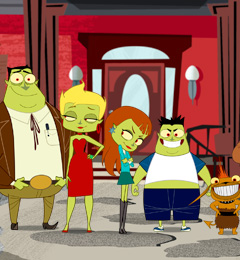
This pilot takes no time at all to introduce the premise: a demon is assigned by his boss, Satan, to transfer to Earth where he will infiltrate and bring down an oil company called Petromundo. We’ve seen the misfit-family-moves-to-new-neighborhood premise before. What makes this one a bit different is that all of the information Balthazar Hellmanneighbors from hell and his family have about Earth comes from watching television. So, we know we’re in for tons ‘o references. What I don’t get however, is why there is a 20-year delay on shows getting to Hell. I mean, it’s not England. They are watching Growing Pains, Alf, and The Cosby Show. That’s not the only thing that is out of date…

Characters are introduced with no unnecessary fanfare or backstory. The main character, Balthazar, has a wife, a son, a daughter, an uncle, and a dog that talks and seems smarter than the rest of the family, ala Brian Griffin. He winds up being the dues-ex-machina that undoes the mess the family finds itself in, and we can surmise that will be his ongoing role.

It is too perfect that this show is hitting the airwaves right now, as the villain (not Satan mind you, the real villain) is an oil company. The company is devising a giant drill that will bore to the center of the Earth, ostensibly disrupting life in Hell. Apart from that coincidence, some of these jokes seem like they have been gathering dust for a while. A demon tortures a damned man by making him listen to Britney Spears’ “Oops I Did it Again.” How old is that song? We’ve also got some jokes about Ugg boots and Criss Angle. The funnier jokes are the ones without an expiration date. Balthazar walks into the house to find bodies all over and inquires calmly, “Tina, did you kill the neighbors?”

The story seems headed for a quick resolution as Balthazar plots to destroy the engineer who is in charge of getting the drill up and running. Toward the end we find out what will give the premise an excuse to last past the first episode; the fact that Balthazar—aw, shucks— likes the guy he needs to destroy. There is also a racist neighbor how apparently practices beastiality with her poodle, and another who’s addicted to Valium. But, um, where are the TV references? The writers teased us with the possibility of Kirk Cameron jokes and there’s not a one.

The animation style is refreshing. (i.e. It doesn’t look like a Seth MacFarlane show) It’s stylized, and deceptively kid-friendly.

This pilot is all over the place. It has the feel of having been revised and rewritten to within an inch of its life. Not sure if that’s the case, but we’ll see where it goes.