
Alias

The pilots I’ve written about so far are ones that I was analyzing in hindsight, having seen nearly all subsequent episodes. You find more meaning in things when you already know where they’re headed. So I decided to watch and write about a pilot for a show I had never seen. I picked Alias, because it was listed by TV Guide in 2008 as one of the best pilots of the past 10 years.

We open with Jennifer Garner being tortured and sporting reddish-orange hair reminiscent of The Fifth Element. Seconds later, we find her in a contrastingly normal environment, a college classroom—a flashback? As she is leaving class with her boyfriend, there is brief mention of her part-time job at a bank, before the boyfriend surprises her with a sappy marriage proposal.

Somewhat predictably, it turns out the “bank” is a front for an international spy operation, an elite branch of the CIA. Garner’s character, Sydney, leads a double life. She’s a newly engaged grad student and a hardass spy. We get that she’s super smart, she’s tough, she looks hot in formal wear. At home, under cover of the sound of the shower, she comes clean—no pun intended—to her fiancé. Which is bad. Really bad. Which lends a problem to the whole premise: if she’s so smart, why did she break this “unbreakable” rule by revealing her true occupation?

The fiancé is killed, Sydney doesn’t want to go back to work, work isn’t down with extended grief leave. As it turns out, she’s not really working for who she thinks she’s been working for. Oh, and her father is involved. We keep getting flashes to these torture scenes, which include Garner getting a tooth mercilessly yanked out.

When Sydney finally dyes her hair red, we get the connection between past and present. (I love how women’s hair color/length is used as a marker of time. This has been used in Veronica Mars, How I Met Your Mother, Defying Gravity, and outstandingly in the film Eternal Sunshine of the Spotless Mind, where Kate Winslet’s hair is practically a character itself.)

So the viewer is caught up to the present, Garner kicks some ass, flies home, dyes her hair back, and goes to work for the CIA—the real CIA—reporting to them on the company she was originally told was the CIA. So now we have a show about a double agent, hardened by the loss of love.

I must say I’m glad this show didn’t go with the overused premise of Hero Hiding True Identity from Loved Ones (Chuck, Smallville, the short-lived Bionic Woman). Although I’m sure that issue will come up. But overall the pilot was a real downer. There was one light moment with the proposal and a weak attempt at humor with Sydney’s best friend saying something like, “You won’t believe the day I’ve had.” But unless you’re really into spy shows (or Jennifer Garner), I’m not sure what about this pilot is so exciting. Maybe I just answered my own question.
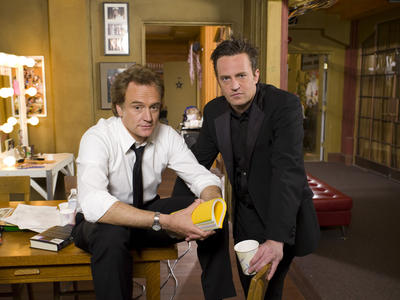
Studio 60 on the Sunset Strip

This is the pilot that interested me in pilots. I watched it twice before proceeding with the series. And, though I did make it through the whole series, it went steadily downhill. The critics tend to agree. Still, I can go back and watch the pilot as a stand-alone story. It’s compelling, it’s exciting, it’s funny, it’s dramatic. Now, any time I hear David Bowie’s “Under Pressure,” I picture the final scene of this episode.

This pilot uses what I call the Prodigal Son Formula. It’s about someone—in this case, two someones—returning to a place they used to call home, changed and matured, for better or worse. In addition, it uses the New Kid on the Block Formula, featuring a person beginning a new job (which could as easily be a new school, new neighborhood, etc.).

Even before we meet the aforementioned Prodigals and New Kid, however, we have The Crisis. We are onstage at the start of the taping of a live, weekly, sketch comedy show akin to Saturday Night Live, called Studio 60 on the Sunset Strip. As an actor whips the studio audience into a frenzy, the Producer, Wes (Judd Hirsch) is arguing backstage the head of Broadcast Standards and Practices over whether to include a controversial sketch in tonight’s show. In the first two minutes, we know that the show (the fictional one) is flagging and the Producer is near the breaking point.

Then we get glimpses into the control booth, the dressing rooms, the hallways… a tone of frenetic energy is set. There is a quick intro to a page who will come into play later in the series. Amid it all, Wes is incongruously calm. Then comes his meltdown. On live television. It’s a scathing diatribe on all-that-is-wrong-with-network-television. It’s uncomfortably funny and horrifying and train-wreck riveting. We see the pressure on Cal (Timothy Busfield), the control booth guy, to pull the plug. The suspense builds to…the opening credits.

So in just nine minutes, we’re pumped and ready to go. Then, we get introduced to the main characters. We meet Jordan McDeere (Amanda Peet), the new President of the NBS network, who ominously predicts, “Nothing bad is going to happen on my first day, right?” We meet Jack Rudolph (Steven Weber), her new boss.

As the live (fictional) show continues, damage control is in full effect backstage. We can’t help but feel that writer Aaron Sorkin is giving us his personal take on the shortcomings of the industry.

Seventeen minutes in, we first hear the names Matt Albie and Danny Tripp. We know there’s history, potential controversy. At minute 19, after the second commercial break, we finally meet them: Matt, played by Matthew Perry and Danny, played by Bradley Whitford, recently off of the success of The West Wing. They are immediately fascinating characters with huge back story; for starters we learn that Matt and his longtime girlfriend, Studio 60 actress Harriett Hayes recently broke up because of the Star-Spangled Banner.

The downfall of this show may simply have been there was too much back story. Every line, every look, conveyed something about these characters and their history. The whole thing takes place in one night, and there is just so darn much happening. It’s totally engaging. But maybe too much for viewers who want to fold the laundry or pack their kids’ lunches while they watch. We get Matt and Danny’s relationship, their relationship to Jack and to Wes. We get a taste of Matt and Harriett’s relationship. We learn about the sketch that was cut from the show that set off this whole fracas—and that will become symbolic of the show’s themes.

 The characters end the pilot with a world of new possibilities before them. This is the way to end a pilot, with room for all kinds of things to happen. The moment is illustrated strikingly and poetically by the theatre house full of people—cast, crew, and staff—sitting expectantly before Matt and Danny, their new producers. And “Under Pressure” boiling up. It’s a great moment.