Charmed (Unaired)

Blogging about the Charmed pilot, “Something Wicca This Way Comes,” has been on my to-do list for some time, but how much more fun is it to cover the unaired pilot? It’s available on YouTube (legally or not I couldn’t say).

In a nutshell, Charmed is the story of the Haliwell sisters, Phoebe, Piper (Holly Marie Combs) and Prue (Shannen Doherty), who learn that they are witches, each with a unique power.

The setup in this version of the pilot is identical. Some of the footage looks to be the same as what aired. Two sisters living in their dead grandmother’s San Francisco house are joined by their third, black sheep sister returned from New York. In the meantime, a detective is trying to solve a series of murders of young women. These events are set against the backdrop of a raging thunderstorm, lending an air of foreboding.

The most unmistakable difference is that Phoebe, the youngest sister, is played not by Alyssa Milano but by Lori Rom, who went on to play a recurring role on Party of Five. This Phoebe is more down-to-earth, lacking the perkiness Milano brought to the role. The trick to Phoebe is that we, the audience, have to like her even though she annoys the heck out of Prue. She needs an impishness that Rom doesn’t pull off. Rom dresses dumpier too; the costumers later made the most of Milano’s hot bod.

Phoebe drives the action throughout the story, so it was important to get the casting right. Her curious nature catalyzes the discoveries that bring the sisters their powers. She is the only one brave enough to venture into the attic when directed there by a spirit board. She recites the incantation that instills the powers, and she continues to read the Book of Shadows and educate her sisters about witchcraft. As the Phoebe character is described, “She has no vision, no sense of the future.” This observation is one of many examples of ironic foreshadowing in the pilot, since Phoebe gains the power to see visions of the future.

In both versions, character introductions and exposition evolve pretty naturally, with one glaring exception. Phoebe asks Piper, “I’m glad you’re still with Jeremy. Where did you meet him anyway?” The answer hints at the “twist” to come, wherein Jeremy is a warlock specifically preying on the sisters. It’s not particularly surprising when he pulls a knife (an athame) on Piper in an abandoned building.

What I’ve never understood about this pilot—this version or the final one—is why they try so hard to be truthful to what Wicca is all about while at the same time making it so far-fetched. Both versions open with an anonymous woman setting up an alter and calling the gods/goddesses to oversee a ritual. The writers explain to us what at athame is and make a point of explaining the Wiccan rede and that witches are not evil—obviously important if we’re to sympathize with the protagonists. This point is subtly different between the two versions, actually. In the unaired pilot, Phoebe says, “A true witch is a good witch,” and in the aired pilot she says, instead, “A witch can be either good or evil.” Either way, the powers of the witch in the opening, and the Haliwell witches, are the stuff of science fiction.

  There are some details missing from the unaired version—tattoos on the murder victims,—and some things that are done better. In the unaired version, Phoebe’s bike accident makes her look foolish, reminiscent of Stacy in Wayne’s World. Prue’s conversation with Detective Andy Trudeau is much shorter, giving less basis for their future relationship. The aired version contains some back story about the Haliwells’ father; Prue doesn’t like him, and only Phoebe is still in touch with him. Basically, the aired version gives more information to build on for the future.

In the end, the women have to overcome their various levels of skepticism about witchcraft and stand together—literally—chanting about “the power of three.” This climactic scene embodies the theme of the whole show, that the three (never mind that one of them gets replaced) have to learn to count on each other.

Happy Halloween!

Slings and Arrows

No one ever thanks the stage manager. If you have ever worked in theatre, you know that when the stage manager gives you a cue backstage, such as “five minutes,” you respond, “thank you five minutes,” or at least “thank you.”It’s not only polite but it’s practical, as it lets the stage manager know that he/she has been heard, and that everyone is on the same page. Never, ever is this done on TV or in movies. It drives me nuts. Slings and Arrows, a now-cancelled Canadian dramedy seems like a show that would get this detail right, but maybe they do things differently in the land of Rod Stewart and Robin Sparkles. The show is pretty authentic in other ways.

The pilot plot is a tale of two theatres. One is desperately poor, with plumbing issues and unpaid electric bills. It’s actually called Theatre Sans Argent. The other one is a big ol’ commercial theatre complete with a corporate sponsor. Both are getting ready to open works by Shakespeare. It’s not immediately clear what the relationship between the two is, but we get to that.

Geoffrey (Paul Gross), the cockeyed optimist who runs the broke company fancies himself an artiste. He’s full of bombast about the ability of theatre to rise above mundane problems like money. “A theatre is an empty space,” he declares, making a Peter Brook reference only theatre geeks would get. He backs up his claims, though, with a realistic onstage tempest created using only sound and lights on a bare stage.

At the helm of the fancy theatre, New Burbage Theatre Festival, is Oliver (Stephen Ouimette), also a pompous airbag but meaner. He abuses his backstage staff as well as his actors. He is directing a production of A Midsummer Night’s Dream while simultaneously navigating administrative politics. The company sponsoring his season has a new CEO, and though she’s as chipper as a protocol droid, we’re not sure if she’s a friend of the arts or The Man.

The show goes on for the latter. At the former, the landlord tries to evict the company, so the artistic director chains himself to the building in protest making the evening news. Oliver catches the coverage—in the middle of his opening—and the connection begins to become clear.

Geoffrey and Oliver are a classic example of Foe Yays. (For a full explanation of HoYays, FoeYays and their relatives check out TV Tropes.) They’re a bit like Dr. X and Magneto. Peter Parker and Harry Osborn. Guys who used be bros and now they hate each to the point of obsession. There is a lot of back story going on and a lot of set-up for future relationships. The women in these men’s lives are introduced, as are a few other company members.

It’s not easy to predict where the season is going to go, because it’s not easy to even label this show. It’s kinda funny, but not in a ROTFL way. And it’s dramatic, but without being too heavy. And it’s about a subject that is anything but mainstream. So it’s not an easy thing to sum up. That should be a good thing, but in this case, the pilot is an amorphous blob. Maybe multiple viewings will reveal new layers. It ran for 3 years so maybe they get it in Canada

Ghost Whisperer

I’ve watched various episodes of Ghost Whisperer over time, in no particular order. I’m always slightly confused because there are different characters on it every time I happen to catch it. Sometimes Camryn Manheim is on it, sometimes Jamie Kennedy, sometimes Jay Mohr and, in the episode I caught today, Aisha Tyler. So I had to get to the bottom of this and see the original cast in action. A lot of shows switch actors and characters over time, in response to ratings or whatever, but we must assume that the pilot is the closest thing to the creator’s real vision.

To introduce Melinda (Jennifer Love Hewitt) the writers present her to us as a little girl. At a funeral for an old man, she has a predictable interaction with the deceased’s ghost, sharing a secret message with his widow. If you came into this viewing with no idea what the show is about, that takes care of it quickly and cleanly.

We then find the adult Melinda at her wedding reception, perhaps suggesting some parallel between this day and the one at the long ago funeral. She has a heart-to-heart with her new brother-in-law that reveals a few details about her husband Jim (David Conrad). He is a paramedic who recently lost a patient.

The newlyweds move into a new house, the house becoming the source of things creepy that will form the plot of the episode. Melinda immediately starts seeing weird stuff, but since that ghost in the cold open was such a sweetie it’s not quite clear why these new ones are scary.

The show’s “rules” are spelled out through a coffee house conversation Melinda has with her best friend Andrea (Aisha Tyler).  She utters an adage that seems to carry great weight: “Places aren’t haunted. People are haunted.”  Yet, the new house certainly seems haunted, and Melinda claims that ghosts don’t usually make house calls.

The pilot plot revolves around the ghost of an M.I.A. Vietnam soldier (Jensen Ackles) who is looking for his wife. He—or someone—yells at her in a dream, something that apparently happens to her regularly. She tracks down the soldier’s son (Balthazar Getty). Although Melinda has been assisting sprits for most of her life, she’s really awkward and embarrassed when it comes time to talk to the living relatives.

By this point, I’m wondering why the writers bothered with the cold open of Melinda as a child. If they were telling us that the talking to ghosts thing is old hat for her, then why does it seems so fresh and scary in her adulthood? Why did they choose her wedding day as the point of attack for this story?

The other unexplained circumstance is that Melinda has recently promised her husband she’ll cut back on the ghost counseling business. Yet her husband seems okay with her vocation, at least until he has his own crisis of faith about being a paramedic. Finally, a Shamylan-style twist keeps this pilot from completely dying on the vine.

Eventully, of course, she reunities father and son through a tearful exchange one-sided exchange. She paraphrases what the ghost says—something I’ve noticed she does in other episodes as well—going to far as to correct his grammar. But I guess you’d be smug, too, if you had supernatural powers.

When all is done and the dead have gone into the light, this pilot doesn’t leave me feeling that I’ve gotten to know these characters. It has been more about how life, death, and afterlife work, and we’ve had that spelled out at least a thousand times since Carol Anne got sucked into the TV. The next episode could just as well be about a different ghost whisperer, solving another ghost’s quest for closure. So, as a pilot I wouldn’t say this episode carries its weight. And with all the subsequent changes one feels like there must have been a lot of “this show would be pretty good if only…” Although it ran for 5 seasons, the network finally threw in the towel last year. (A rumor that ABC is going to pick it up was apparently unfounded.) Jennifer Love Hewitt says an emotional good-bye here.

Modern Family

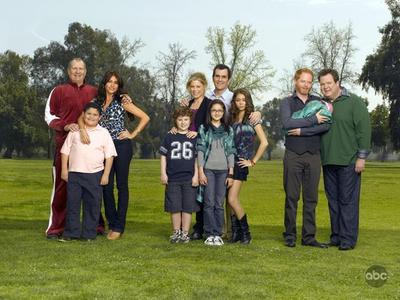
I’ve been feeling like I missed the boat on Modern Family, having pretty much ignored it last season. But since it made such a great showing at the Emmy’s and sounds like it’s here to stay, I figure I check out this pilot. If you haven’t watched it yet, maybe this will help fill you in, too.

The show opens in sit-com 101 mode, with a family starting their day with breakfast in the kitchen. It hits you with a good guffaw right at the top. The dad is yelling for the kids, and the daughter enters with, “Why are you guys yelling at us when we’re way upstairs? Why don’t you just text us?” After that there’s a bit about the daughter’s skirt being too short and the parents having baby oil on the bedside table. These may not be the most original jokes we’ve ever heard about offspring and ‘rents, but they’re delivered pretty fast and furious. This show isn’t going to waste our time. Continue reading