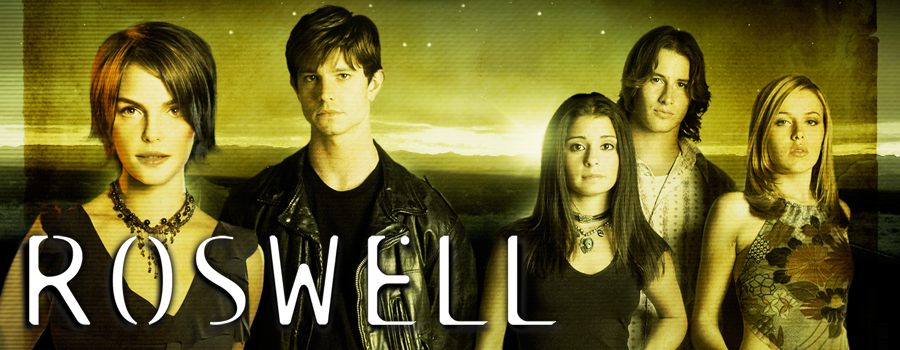
Roswell

Although it spent its 3 seasons with less than stellar ratings, Roswell not only helped put the WB network (now the CW) on the map as a destination for teen girls, but paved the way for another show about an attractive high school student from outer space.

Roswell was based on a series of books called Roswell High, and the title itself serves as back story. The name of the New Mexico town is synonymous with UFO cover-ups. We all know what happened there in 1947. Don’t we? Seriously, do you know what happened? Because other than a vague idea of something about a crater, I didn’t. There may or may not have been an alien crash landing and the U.S. government may or may not have conducted autopsies on the victims. Read more about it here.

Even supposing the viewer knows nothing about Roswell, the show spells it out visually right away. We open with teen narrator Liz (Shiri Appleby) writing in her diary, introducing herself via voiceover. “Five days ago I died,” she says. “After that things got really weird.” Intriguing, if a bit cheesy. Then we find her at work in the Crashdown Café, a 50s-style, UFO-themed diner.

 Liz and Maria (Majandra Delfino) are waitresses in schlocky theme uniforms complete with antennae. They clearly enjoy messing with truth-seeking tourists. It’s a special occasion in Roswell, the day of the Crash Festival. Presumably that’s a day when the residents cash in on their fame. (However, this is set in September and the Roswell “incident” happened on July 8.) Isabel points out that the dopey looking Max Evans (Jason Behr) keeps staring at Liz. Indeed, he is the first to spring to action when she is hit by a stray bullet fired during an argument between customers.

Max runs to Liz, where she has fallen to the floor bleeding from the abdomen. He places a hand across the wound, healing it. He breaks a bottle of ketchup and instructs Liz to say she broke it. He and his friend speed off in a Jeep before the authorities arrive. A pair of nosy tourists start poking holes in Liz’s story with the sheriff. Sheriff Valenti (William Sadler), we see, has his suspicions. He takes note of two empty Tabasco sauce bottles on a table where the boys were sitting.

We next meet Liz at school. She’s kind of a plain Jane, a good student, and for some reason dating a douchebag who is—big surprise—Sheriff Valenti’s son. She confronts Max and he admits with almost no reservation that he is an alien. He swears her to secrecy, but in no time she has dished to Maria. Playing a friend of Liz’s is Colin Hanks, but we don’t get to know much about his character yet.

We get to know two other aliens, the only others, Isabel (fresh-faced Katherine Heigl) and Michael (Brendon Fehr, aka Jared Booth on Bones). They put Tabasco sauce on everything; definitely a detail that is going to get them in trouble. Alarmed by Max’s revelation to Liz, the alien trio debates whether to flee. We get just enough details to understand their background. They were the only survivors of a crashed spaceship. They have been raised by regular human families for the past 16 years. Prior to that, they were in some kind of hibernation.

Mid-way through, the Liz voiceover returns unexpectedly and unnecessarily. It’s as if the vehicle we’ve been cruising along in hits a big puddle of teen romance molasses. It may be moments like this that led the show’s creators to focus more on the science fiction as the show progressed.

The plot then plunges from character description into a plot where Liz and the aliens have to outsmart the Sheriff. Though it seems the most natural thing for the aliens to leave town, that wouldn’t leave much of a television show. So we know they’re hanging around. We’re left to see how Max and Liz will get together—because of course they will—and how the aliens will continue to allude the authorities. The pilot balances the mystery and the romance pretty well, so if you like either you might just tolerate the other.

Cliffhanger or Closure? Top 5 of Each

Pilots, when well executed, make the viewer want to come back for more. However I’ve noticed that pilots fall along a continuum in terms of how they leave you feeling at the end. Some just get the action going, and then abruptly end. They leave you chomping at the bit for episode 2 because you just have to know what happens next. Some shows, say 24, couldn’t work any other way. (That show is such an obvious example it’s not worth listing below.)

Other pilots are more self-contained. Sure, they introduce characters and situations and, ideally, make you want to keep watching. Yet, they wrap up neatly and can be enjoyed again and again like mini-movies.

Still others lie someplace in between. Here are five of the best at either end of the spectrum. It’s by no means an exhaustive list; as I’ve said before I don’t claim to have seen every pilot, or even every great pilot out there! (BTW, spoiler alert.)

What else should be on the list? Let me know in the comments or on Twitter.

Best Pilots that Leave You Hanging

Veronica Mars – So. Much. Stuff. Happening in this pilot. We just get a taste of the Lily murder, which will keep us guessing even after it’s solved.

Heroes – Again, this pilot just scratches the surface of everything that is set to happen. Absolutely no questions are answered.

Jericho – The ending of this pilot scared the bejeezus out of me. You see the map of the U.S. with all these pushpins marking places that were nuked and ask, “Just how bad is this disaster?”

The Walking Dead – Did the sight of Rick in that tank and the sound of the voice over the intercom not make you just want to hit the fast-forward button to the following Sunday?

How I Met Your Mother – This leaves you hanging not for a week, but for… well, it’s been five freaking years. How did you meet their mother for f’s sake?

Best Pilots that Can Stand Alone

The Simpsons – It’s a Christmas special. Need I say more?

Studio 60 on the Sunset Strip – This was so good, it is inexplicable why the series went so far downhill. It was a prodigal son (or sons) story that wrapped up beautifully.

Friends – It’s a happy ending to a story about a woman who walked out on her wedding. It offers possibility—will Ross get Rachel?—but it’s a happy ending.

Glee – This necessarily had to be good all by itself because it aired way before the season actually started. And it wildly succeeded.

Dead Like Me – This pilot delves deeper than it needs to, explaining the whole back story of the character plus the rules of the show’s world all in one go. But even with all the change she’s just faced, George gets a sense of closure by going to see her mom.

Charmed (Unaired)

Blogging about the Charmed pilot, “Something Wicca This Way Comes,” has been on my to-do list for some time, but how much more fun is it to cover the unaired pilot? It’s available on YouTube (legally or not I couldn’t say).

In a nutshell, Charmed is the story of the Haliwell sisters, Phoebe, Piper (Holly Marie Combs) and Prue (Shannen Doherty), who learn that they are witches, each with a unique power.

The setup in this version of the pilot is identical. Some of the footage looks to be the same as what aired. Two sisters living in their dead grandmother’s San Francisco house are joined by their third, black sheep sister returned from New York. In the meantime, a detective is trying to solve a series of murders of young women. These events are set against the backdrop of a raging thunderstorm, lending an air of foreboding.

The most unmistakable difference is that Phoebe, the youngest sister, is played not by Alyssa Milano but by Lori Rom, who went on to play a recurring role on Party of Five. This Phoebe is more down-to-earth, lacking the perkiness Milano brought to the role. The trick to Phoebe is that we, the audience, have to like her even though she annoys the heck out of Prue. She needs an impishness that Rom doesn’t pull off. Rom dresses dumpier too; the costumers later made the most of Milano’s hot bod.

Phoebe drives the action throughout the story, so it was important to get the casting right. Her curious nature catalyzes the discoveries that bring the sisters their powers. She is the only one brave enough to venture into the attic when directed there by a spirit board. She recites the incantation that instills the powers, and she continues to read the Book of Shadows and educate her sisters about witchcraft. As the Phoebe character is described, “She has no vision, no sense of the future.” This observation is one of many examples of ironic foreshadowing in the pilot, since Phoebe gains the power to see visions of the future.

In both versions, character introductions and exposition evolve pretty naturally, with one glaring exception. Phoebe asks Piper, “I’m glad you’re still with Jeremy. Where did you meet him anyway?” The answer hints at the “twist” to come, wherein Jeremy is a warlock specifically preying on the sisters. It’s not particularly surprising when he pulls a knife (an athame) on Piper in an abandoned building.

What I’ve never understood about this pilot—this version or the final one—is why they try so hard to be truthful to what Wicca is all about while at the same time making it so far-fetched. Both versions open with an anonymous woman setting up an alter and calling the gods/goddesses to oversee a ritual. The writers explain to us what at athame is and make a point of explaining the Wiccan rede and that witches are not evil—obviously important if we’re to sympathize with the protagonists. This point is subtly different between the two versions, actually. In the unaired pilot, Phoebe says, “A true witch is a good witch,” and in the aired pilot she says, instead, “A witch can be either good or evil.” Either way, the powers of the witch in the opening, and the Haliwell witches, are the stuff of science fiction.

  There are some details missing from the unaired version—tattoos on the murder victims,—and some things that are done better. In the unaired version, Phoebe’s bike accident makes her look foolish, reminiscent of Stacy in Wayne’s World. Prue’s conversation with Detective Andy Trudeau is much shorter, giving less basis for their future relationship. The aired version contains some back story about the Haliwells’ father; Prue doesn’t like him, and only Phoebe is still in touch with him. Basically, the aired version gives more information to build on for the future.

In the end, the women have to overcome their various levels of skepticism about witchcraft and stand together—literally—chanting about “the power of three.” This climactic scene embodies the theme of the whole show, that the three (never mind that one of them gets replaced) have to learn to count on each other.

Happy Halloween!

Friends

How have I not written about this before? I practically have it memorized. But let’s be honest , the first season (or 2) of Friends was pretty bad. But clearly it resonated way, way back in 1994 despite all those atrocious hairstyles and the need to shove each character into a stereotyped package. (Ross is a nerd, Rachel is spoiled, Phoebe’s a flake, Joey is a womanizer, etc.) It took until season 4 to round it out to “married a lesbian, left a man at the altar, fell in love with a gay ice dancer, threw a girl’s wooden leg in a fire, lives in a box.” 

Eventually, each Friend become a well-rounded human being who we watched grow over a decade, but it was like the writers didn’t give us viewers credit for having the patience to get to know them. Who knows, maybe we wouldn’t have.

This pilot is so pilot-y. We are bombarded with back story, character quirks, and strained jokes. Everything is over the top: the hairstyles, the coffee cups, Joey’s accent. On the off chance that you haven’t seen it, the plot is that Ross (David Schwimmer) has just split from his wife, just as Monica’s (Courteney Cox) old high school friend Rachel (Jennifer Aniston) leaves her husband-to-be at the altar and runs off to Manhattan to get away from her suffocating suburban existence. Ross has had a thing for Rachel since puberty, and now the possibility of a relationship finally exists.

One thing we can observe from the pilot of Friends is that, although it’s purported to be an ensemble show, it’s really about Ross and Rachel. Always was, always will be. In this opening episode the other four are basically just comic relief. The jokes were pretty bad, too. Even Chandler is unfunny, for Chandler (Matthew Perry). The only part that makes me laugh out loud is when Rachel is on the phone to her father. She is all disheveled, still in her wedding dress, pleading with him for understanding. To paraphrase, she describes how everyone has always told her she’s a shoe and today she’s realized she’s a hat. There’s a pause, then: “No I don’t want you to buy me a hat. It’s a metaphor, Daddy!” So although she’s an ingénue, she’s wacky, and a solid comic actress (who gets funnier each season). You may have heard the story about how she originally auditioned to play Monica.

If for some reason you haven’t seen this, just watch one of the 500 channels that carry the show in syndication and you’re bound to catch it.

Top 5 Character Introductions in Pilots

A pilot episode has a lot to accomplish. It has to introduce a time, a place, characters, and relationships, as well as the tone and style of the show. Every once in a while, a pilot really nails a character introduction. In a moment, an audience meets a character and just knows that character. It might be shocking, it might be funny, but it’s memorable. I am sure there are many, many examples of which I am not even aware, but here are my favorites, in no particular order. If you have other suggestions, I would love to hear them!

1. Rachel Green (Jennifer Aniston) on Friends

At this point in the pilot, we’ve had a little while to get to know the other 5 members of the Central Perk gang. You don’t need me to review them. Ross is on the couch in the coffee house, lamenting the dissolution of his marriage. He whines, “I just want to be married,” and in walks this disheveled, rain-soaked bride complete with full-length veil. (Chandler counters, “And I just want a million dollars.”) Rachel hasn’t said a word, but her entry makes its own statement. You see a bride out of context like that and you know you’re in for a story.

2. The Devil (Ray Wise) on Reaper

Sam has already seen some strange sh*t on this, his 21st birthday. But as he’s cruising home from work in his parents’ station wagon, the smarmiest looking guy you’ve ever seen appears out of thin air in the back seat. “Is this a car-jacking,” Sam cries. “For this?” comes the response, “If it was an Escalade maybe.” After a few seconds of this fruitless back-and-forth the stranger reveals, “I’m not a carjacker. I’m the Devil.” Sam wrecks the car, and the Devil vanishes as quickly as he appeared. And that’s the kind of crap Sam is going to put up with for the next 2 seasons. This pilot gets better every time I watch it.

3. Sarah Walker (Yvonne Strahovski) on Chuck

What is cooler than a ninja? A ninja who turns out to be a super hot chick. In the episode, we have already met Sarah when she comes into the Buy More with a broken cell phone, but her true colors are unveiled when she shows up to steal Chuck’s computer. Each and every character on this show is awesome. But nobody makes an entrance quite like Sarah.

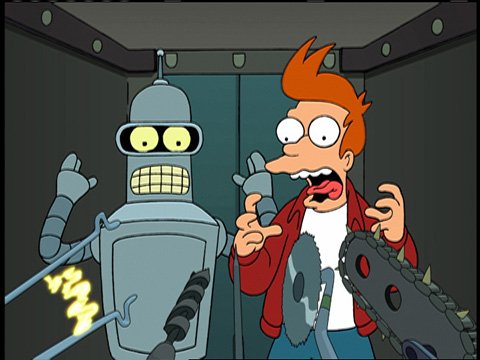
4. Bender Rodriguez (John Di Maggio) on Futurama

I don’t what is the best part of this character introduction; that there is such a thing as a suicide booth, that there is a robot in line to use the suicide booth, or that said robot wants to rip off the suicide booth with a coin on a string. On top of that, the viewer is in the same place as the protagonist, Fry: fresh out of the year 1999, with this whole new world unfolding more and more strangely by the minute. It’s funny, it’s bizarre, and it perfectly captures the tone of the show overall.

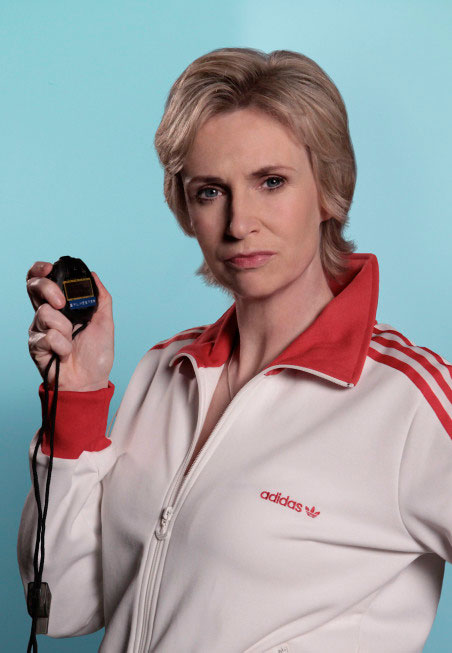
5. Sue Sylvester (Jane Lynch) on Glee

“You think this is hard? Try being waterboarded–that’s hard.” This first line by the sadistic cheerleading coach, the first, in fact, of the pilot, tells us everything we need to know. Although some unexpected complexity to the character was revealed later in the season, that uber-bitch, no-mercy exterior never faltered.

Futurama

Futurama fans are rejoicing. After being cancelled from Fox, then revived in the form of some straight-to-DVD movies, and given another shot with reruns on Comedy Central, the little animated show that could has returned with new episodes. And we didn’t even have to order any Subway footlongs. In celebration of the return (and the fact that the new episodes are hilarious, at least so far), I thought I would take an overdue look at the pilot episode of Futurama. I read once where someone referred to this as “the perfect pilot.” If not perfect, it’s pretty close.

When Futurama aired it was “the new Matt Groening show.” Fortunately for us and Matt Groening it is nothing like the Simpsons. The Simpsons does its thing—well—and Futurama does its just-as-witty- but-totally different thing. In fact, Futurama is more original. The Simpsons basically took an existing TV formula and animated it. Futurama mashed up situation comedy, science fiction, 20-something slackerdom, political satire and Y2K fear.

In the pilot we meet Philip J. Fry (Billy West), a pizza delivery boy with slouching shoulders and gravity-defying orange hair. His life is as miserable as we, the viewers, have ever thought ours were. He finds out his girlfriend is leaving him as she drives by him in a cab with her new man. He’s good at one thing at least, a 1980s-era video game that allows him to fly through space and shoot stuff. For anyone who ever fantasized that their gaming skills would come in handy in the real world someday, Fry is about to live out their fantasy.

Tonight it’s new year’s eve 1999. A newspaper headline reads, “2000. Doomsayers Cautiously Upbeat.” (It’s these simple little gags that fill every moment of the show with humor and make it worth watching over and over.) Fry, as the victim of a crank call, is delivering a pizza to a cryogenics lab when he falls into a cryogenic chamber set to thaw in 1,000 years. A montage of the next millennium shows us Groening’s satirical prophecies for the human race. New York rises, falls, rises, falls, and rises once more. There are many details worth slow-mo’ing.

Fry finds himself in the year 3000, in an unfamiliar New York City. The future has many of the things you would expect—robots, space travel, and flying cars—and many you wouldn’t. It’s got celebrity heads in jars and suicide booths. One of the funniest and weirdest scenes ever takes place when Fry meets the wisecracking robot Bender. “Well, I don’t have anything else planned for today,” Bender declares, “Let’s go get drunk!”

Next we meet Leela (Katey Sagal), whose job is to program other people with a chip that determines their vocation. Apparently their system is pretty accurate, because it labels Fry as a Delivery Boy. Leela is kinda hot considering she’s got one giant eye in the middle of her head, and there is no denying that she’ll be Fry’s love interest for the series. (We’re told she’s an alien, but a later episode will reveal otherwise.) We also meet Professor Farnsworth, who hires Fry, Leela, and Bender as his new flight crew aboard the Planet Express. And, voila, Fry is a delivery boy again. Context is everything; he couldn’t be more excited. Thus, Fry and the audience are off on a series of adventures.

It is brilliant how Groening can say so much about our own time with a story set a thousand years in the future. Bits of what happened since 1999 are filled in here and there like little warnings. And yet, some things never change. Human beings—and other species as well—will probably have the same neuroses in the future that they have now.

Angel

Spin-off pilots are their own breed. In some ways they have it easier than regular pilots, already having a waiting audience. For Joss Whedon creations, this effect is even greater. In other ways, they have it harder, since fans can be demanding. The pilot for a spin-off has to balance enough familiar information to let existing fans feel like they’re in on something, but still lay out the exposition and character introductions needed to get the series started.

In Angel, we’re reintroduced to the title character (David Boreanaz), now living in Los Angeles. He brings us into the setting with a few words describing the City of Angels (pun not spelled out but certainly implied), while he sits somberly in a dive bar. We get that the city is going to be as a much a character as anyone. Angel is drunk off his ass, and we could open a whole discussion on the chemistry of vampire intoxication, but not here. He is slobbering to the unwitting barfly next to him about the girl who got away, without naming Buffy. (For some reason, there is a giant rainbow flag hanging in the bar, but there is no other indication that it’s a gay bar. Or why Angel would be in a gay bar.)

Within moments our hero is dispatching with some evil vampires about to feed on some nubile young clubbers. It’s a big, bad comic-book style brawl that leaves Angel jonesing for blood. He heads home, to his dark basement apartment, to find a half-human Irishman named Doyle (Gleen Quinn) waiting for him. Doyle fills us in on Angel’s origin story and the Buffy-Angel relationship. Doyle is some sort of psychic with migraines. He’s got an assignment for Angel, to go meet a woman at a coffee shop who is some kind of trouble.

The girl is being hunted by a wealthy investor who turns out to be a powerful vampire named Russell. Angel tries to protect her, but she gets herself killed, and Russell decides to lure Cordelia (Charisma Carpenter), who is now an aspiring actress, into his lair. And some other stuff happens.

It’s best not to think too much about the plot. Everything happens a bit too easily: Doyle just pops in and Angel obeys without question, then Angel just happens to be at a party where Cordelia is, then the same vampire that kills the girl in the coffee shop just happens to have his sights set on Cordelia as his next victim. Angel, like Buffy the Vampire Slayer before it, succeeds more on its wit.

For all its action-packed mellowdrama, this pilot is full of laughs. Even Charisma Carpenter’s painful acting is saved by some great one-liners. My favorite is, when she calls Russell out as a vampire, she accuses: “I’m from Sunnydale. We had our own Hellmouth.”  Another one is, after Cordelia babbles on about her fabulous life and then walks away to talk to more important party-goers, Angel remarks, “It’s nice to see she’s grown as a person.” Other bits are more subtle and surprising. Angel jumps gallantly into his convertible to chase after bad guys only to realize it’s not his car.

David Boreanaz’s social awkwardness is just adorable. Lest we forget how beautiful he is, the writers remind us at least twice in this episode. As a character he is oblivious to his own hotness (vampires don’t have reflections, remember) which makes him that much more appealing. Darn it, he just wants to do the right thing.

So for Buffy fans or the uninitiated, this pilot is super entertaining. And it ends with a beginning, the launch of Angel Investigations, so it keeps the viewer coming back for more.

Beverly Hills 90210

Forget that mellow-drama running on the CW called simply 90210. This is where it all began. The pilot for Beverly Hills 90210 opens with a typical pilot premise: It’s the first day of school. Two teens, Brandon (Jason Preistley) and Brenda (Shannen Doherty) Walsh are waking up, getting dressed, and preparing to face a new start in a new town. As we learn in some awkward but mercifully brief exposition, they’re from Minnesota. Dad got a new job, and the family moved to Beverly Hills.

We notice a few things right away. Kids from Minnesota get along with their siblings. Teenagers are slobs universally. And the 80s lasted at least until fall of 1990.

The opening credits are endless by today’s standards, comprising a montage of rich kids doing rich kid stuff. Brenda caps it with, “I think we’re going to need a raise in our allowance.” The one small twist is the chick getting off of a City bus. She’s got serious girl hair and glasses, so we know she’s smart. She’s kind of a bitch, too, when Brandon goes to her to offer his talent writing for the student paper, which she edits. Her name’s Andrea, and she’s set up to be either Brandon’s love interest or nemesis.

Brenda instantly befriends Kelly (Jennie Garth), the quintessential SoCal girl with white blond hair and a recent nose job. Kelly emphasizes to Brenda that this is “definitely not your normal high school.” I have to wonder, how would she know? This line sounds more like it’s directed at the networks asked to pick up the show than to the character Brenda. But, despite the underscoring of everything that makes West Beverly so unique, it’s refreshing to see how decidedly normal these kids were in Season 1. The freshmen are awkward. The girls worry about their weight. The jocks pick on the weaklings.

Brandon and Brenda are really likeable characters. They’re a little unsure of themselves, but far more secure than their Beverly Hills counterparts. Loveably down-to-earth. I love when a hot girl asks Brandon what he’s wearing that smells so good and he replies, “Tide?”

The obligatory party scene gives us all we need to know about the key players. Steve Sanders (Ian Ziering) looks like he came straight from playing the rich asshole in a John Hughes movie. The optimistic freshman David (baby-faced Brian Austin Green) provides some comic relief. And the poor little rich girl, Maryann, flirts shamelessly with Brandon. (And, WTF, are those people in the background of this scene playing tennis?) What is surprising, with the benefit of hindsight, is how little we hear out of Donna (Tori Spelling). She’s little more than Jenny Garth’s shadow.

A word must be said about the clothes. At the time this aired I’m sure they were the height of fashion. But today, whoo! Let’s hear it for blazers with shorts. And the hair! What is the semi-mullet thing Brandon is sporting?

By the end of the pilot we know everyone we need to know, save for one… Dylan is yet to be introduced. We pretty much know what we’re in for, and it’s got a nice blend of drama and humor. One wonders how this show morphed into a soap opera dealing with drug overdoses and whatever else went on in the later years. Not to mention the CW nonsense.

Buffy the Vampire Slayer

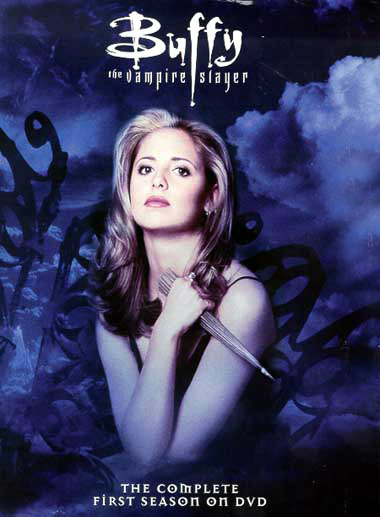
“Welcome to the Hellmouth”

There have been numerous articles in the last few years declaring that geeks are now cool. Shows like Big Bang Theory and Glee are held up as proof of this trend. It’s not the Marcia Bradys or the Mike Seavers we want to root for anymore. We love outcasts and braniacs. ComicCon isn’t just for Trekkers anymore. When did the tide turn? My first answer would be with Veronica Mars. But thinking back, there was Freaks and Geeks—short-lived as it was. But, wait. Even before that, there was Buffy. She may have been the original cool social reject; it helped that she was hot.

So imagine it’s 1997. Buffy the Vampire Slayer is a campy film starring Kristy Swanson that you may remember from earlier in the decade. Joss Whedon is not a name you hear regularly, if at all (did you know he was a writer on Toy Story?), and you’ve certainly never heard of a Whedonverse.

The stage, complete with eerie horror movie music, is set when a horny teenage couple break into the high school, apparently to get it on, but—oops—the perky blond chick is a vampire who changes and brutally kills the guy. (Sucks to be that actor. Congratulations, you landed a part in what promises to be a hit teen drama. But you die in the first two minutes.)

For those not familiar with slayerism, the opening credits and voiceover give the gist; in every generation, there is a chosen one, etc., etc. Here, Buffy is the fresh-faced Sarah Michelle Gellar, known mainly as a soap actress.

Buffy’s mom drops her off at her new school in fictitious Sunnydale, CA, where she has apparently transferred following the events of the film. And wouldn’t you know it? Sunnydale is smack on top of the Hellmouth, a portal to all things occult. On Buffy’s very first day, a body turns up in a locker with telltale bite marks on its neck. But we’ll get back to that…

In addition to introducing Hellmouth-adjacent life, the pilot takes as its storyline a typical teenage tale; Buffy’s attempt to fit in with the cool crowd, only to find that she is destined to walk among the outcasts. She approaches her new school with hope for normalcy, but nevertheless carries a sharpened wooden stake in her bag. (“Pepper spray is just so passé.”)

She first befriends the self-centered beauty queen Cordelia (Charisma Carpenter), who picks on the brainy Willow (Alyson Hannigan). Meanwhile, charmingly awkward Xander (Nicholas Brendon) can’t keep his eyes off of Buffy. Willow likes Xander. Mr. Giles (Anthony Head), new librarian in the apparently deserted school library, seems to already know all about Buffy’s slaying ways. So she goes to him when she learns about the locker body.

Vampires live under the city and are gearing up for some huge revolt, called The Harvest. So Buffy’s going to have a busy sophomore year, what with cheerleading, homework, and ass-kicking.

Oh, and I did I mention there is a dark and mysterious, and ridiculously hot guy trailing Buffy around town? We don’t get a name, or much information at all, except that he knows what’s up with the Harvest.

So the pilot gets us off and running with plenty of action, love triangleism, and more on the mysterious guy (who will, of course, be introduced later in the series as Angel), to look forward to. It’s a bit dark, often funny, and has enough eye candy to get addictive. And this is all despite the fact that, objectively speaking, it’s kind of bad. The acting, the dialogue… but stuff can be bad and still plenty entertaining. Just look at the original Star Wars.

For added fun, there is an unaired version of Welcome to the Hellmouth floating around the ‘net.

Memorable quote: (Said all SoCal bitchy) “God, what is your childhood trauma?”

Knights of Prosperity

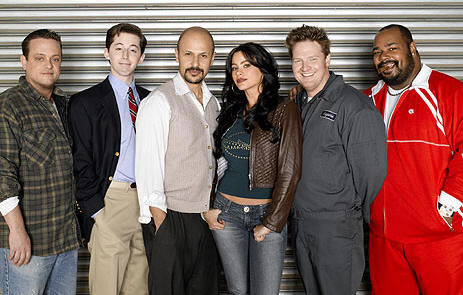
You can’t help but be drawn in by a show that is just plain weird. A guy wakes up. He gets ready for work in his dump of an apartment, accompanied by the music of Journey. He’s a middle-aged high school dropout who works as a janitor. In the show’s first minutes, he is spurred to better his life by witnessing his co-worker’s undignified demise while cleaning a urinal. And, somehow, by the first commercial break, he has assembled a group of ragtag wannabe thieves to rob Mick Jagger.

It’s like, really? This is a premise for a show? They have T-shirts. They have binoculars. They have an intern. It’s a little reminiscent of the geeks in Office Space trying to get into the embezzlement racket.

The show stars Donal Logue, who is not a household name, but recognizable from a role in the terrible Grounded for Life, and redeemed by roles in some good indie films like The Tao of Steve.

Comedic pilots seem to work well when they move fast, throwing information and characters at you so that you can’t blink lest you miss something. Knights does that. We meet a Middle Eastern cab driver who used to be a lawyer, a big black dude with a broken heart, a wise-cracking New Yorker stereotype, and a hot Latina who invites herself into the group.

The goal, in this episode, is not to complete the robbery. It is to complete phase one of Operation Dick Mick, which is to obtain the key to his luxury Manhattan apartment. Ostensibly, each subsequent episode will lead our antiheroes to another phase of the plan until they succeed (or fail?) at the final heist. Then what? Next year, they’ll rob the Kardashians? Only nine episodes ever aired—and I’ve only seen this one—so I don’t know. (Though it was rumored they would later target Kelly Ripa and Ray Romano.) Apparently the show was originally titled Let’s Rob Mick Jagger, but perhaps that was too limiting??

I can’t say the pilot left me dying to see what happens next. It felt more like a predictable screwball heist movie than a series—the kind of thing you might commit to for 90 minutes but not 22 half-hour episodes. But it’s different, which is why I’ve taken the time to write about it. Oh, and there’s a Star Wars reference. Always good.

Memorable quote: “We’re like Robin Hood. We’re stealing from the rich to give to the poor—us.”