Web Pilots

Web shows have become a genre unto themselves. And, like other shows, they need pilots that draw in the audience and set the stage for the series. They have some unique challenges, though. I’ve just started mulling this over, and am wondering if anyone else has any observations. (If so, hit me up!)

Web shows generally have short episodes, ranging from one to ten minutes or so. Perhaps because of our conditioning with YouTube and viral videos, we have limited patience with content designed to be viewed online (despite the fact that we’re now watching network and cable TV online as well). So it has to grab us and grab us fast. Also, it seems we haven’t grown a taste for dramas online. Generally, this stuff has to be funny.

Not only do web show have to accomplish more in a shorter time, there are expectations of edginess. Maybe it’s the medium that dictates it; the internet is younger than TV so it must be edgier. Or, perhaps it’s the audience. People who go digging online for new stuff to watch probably aren’t satisfied with the same old-same old.

Conversely, expectations are lower when it comes to production values. Because we love to see the Chad Vaders of the world make good, we are very forgiving of poor lighting or wonky edits. We still want good acting, though. (Or do we? Do you feel differently?) It’s not all unknowns trying to get noticed; big name actors are treading the pixels.

Stay tuned as I’ll be reviewing pilots of Ikea Heights, FCU: Fact Checkers Unit, and Web Therapy.

New Amsterdam

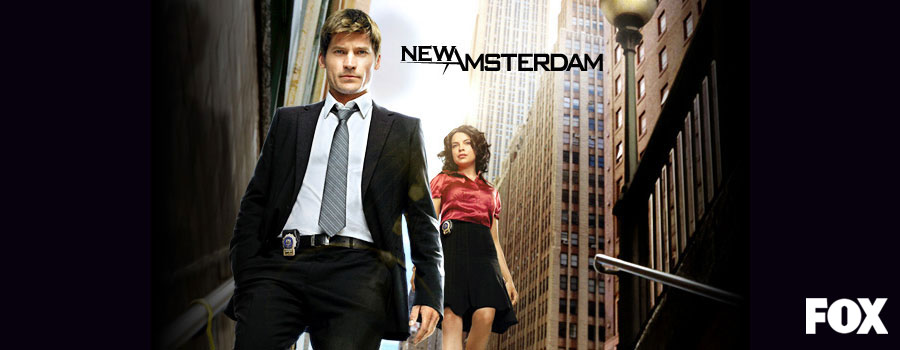
Since I tend to love shows cancelled by Fox, I had to check out New Amsterdam, which I vaguely remember being advertised. It’s about a cop with unique knowledge due the fact that he’s been alive a long time… like, a supernaturally long time. If John Doe and Journeyman didn’t last, what made them think this would?

From the get-go the city is a character. We open with a noir-ish voiceover by the main character, John (Nikolaj Coster-Waldau) describing New York and all that he’s seen happen in it over the years. It’s reminiscent of Angel describing Los Angeles at the beginning of that pilot.

The show sets up a juxtaposition of romance and violence that could become a theme. While John tangos with, and then makes love with, a woman we don’t really meet, flashbacks of a battle scene are interspersed. In the battle, which appears to be set in colonial America*, John is run through with a sword while defending a Native American woman.

Once we have a feel for the character and his story, we learn what he’s doing in the present day. Naturally, he’s a cop. What supernatural being residing in a major metropolitan area wouldn’t spend his days fighting crime? And, naturally, he’s got a mismatched partner of the opposite sex, as TV cops tend to have. She tells us her name twice in the space of a minute: Eva Marquez (Zuleikha Robinson). Perhaps we’re supposed to hate her. We do.

As the odd couple is investigating a crime scene, John takes off after a suspect, chasing him into a subway station. John is doing this whole smooth cop thing, disarming the suspect with his fearlessness, when a certain woman steps off the train. John collapses to the ground for no visible reason, and is rushed to the hospital where the doctors try in vain to revive him. To the resounding ER chants of “clear!” we see a parallel memory of John lying among a group of Native Americans. The oxygen mask in the present is contrasted with the burning sage from the past. The Native American woman who he defended earlier explains that John will never die until he finds “the one” and their souls are wed. In the present, John dies, has his toe tagged, and then wakes up and walks out of the morgue. We surmise this has happened before.

John has a confidante, Omar (Stephen Henderson) who is in on this story. He’s a wise, old, African American bartender… can we have a bigger cliché, please? With everyone else, we assume John’s immortality is a secret, although he is pretty loose with the clues. He casually mentions 609 ex-girlfriends, or five-thousand-some-odd days sober. Apparently he doesn’t care whether anyone knows, either because they wouldn’t believe him anyway, or there is nothing anyone can do to hurt him.

John and Eva (god, she’s a bitch) continue working their case, seeking the killer of a celebutante named Chloe. This mystery-of-the-week is pretty standard, existing to let us, or the network execs, know what to expect in the coming season. John drops bombshells of personal information at the right moments, like when he tells the victim’s mother, “He was six, my son.”

The twist that sets the show apart from other cop dramas is, of course, John’s extensive knowledge of New York. He has a lot of contacts, having been around a while. There is a creepy encounter with an ex-girlfriend, now pushing 90, who holds a clue to the case.

In the meantime, a doctor from the hospital where John died—the woman from the subway—is curious where her corpse got to. She’s doing her own little investigation. Sooner or later the two are bound to meet, and perhaps that will lift the spell. The question is, does the viewer want to slog through cheesy weekly cases to get there?

Some behind the scenes information and interviews can be found here.

*According to the show’s description this scene is set in 1642, but you wouldn’t necessarily know that.

Firefly

I have been putting off writing this entry for a long time, which is in no way a reflection on my opinion of the show. It’s more like I’m afraid I can’t do Firefly justice, especially considering the rapturous devotion of its fans. If you’re a loyal browncoat you probably know the pilot backwards and forwards. If you’re not, it may be that you blinked and missed it before Fox canceled it. (I won’t rehash the whole fan outcry/Serenity story.)

It’s not like Joss Whedon invented a new genre here; we’ve seen space anti-heroes before. And I, for one, was not a Whedon fan prior to this, so I wasn’t like “Hooray, a new show from the creator of Buffy.” The show just hit all the right notes with cool setting, fascinating characters, great dialogue, and a healthy dose of dark humor.

The show opens with an in-the-trenches war scene, which could be out of any number of movies. The clue that something is different is that the aircraft flying overhead look like nothing we’ve seen before. A man (Mal, played by Nathan Fillion) and a woman (Zoe, played by Gina Torres) are leading a shell-shocked contingent against an attack. Their language is slightly heightened; in fact, the whole scene is a bit confusing the first time around. All we really need to know is that the troops are forced to lay down arms when their back-up abandons them. The look on Mal’s face and the music playing tell us all we need.

Music is huge in this pilot. The score is a twangy, gritty collection of music reminiscent of old westerns. Its juxtaposition with high-tech space travel gives Firefly its own unique tone.

We jump ahead six years from the battle scene to a spacewalk by a crew of three. The striking quality of this scene is that it is very quiet—opposite the previous scene—with sound seemingly sucked up by the vastness of space. Meanwhile the pilot of the ship, who seems to be keeping an eye on the mission, is actually playing with dinosaur toys on his console. (I may have to add this to my list of best character introductions.) “Curse your sudden but inevitable betrayal,” cries the Stegosaurus to the Tyrannosaurus.

From there, we start to meet the rest of the crew. There is the ever-cheerful mechanic, Kaylee (Jewel Staite). There is a “companion,” or prostitute, Inara (Morena Baccarin). And there’s Jayne (super-dreamy Adam Baldwin), all-around tough guy. The pilot is Wash (Alan Tudyk), Zoe’s husband.

The crew has to quickly shut down the ship’s power as they pass an enemy, and we find out a few details. The ship our crew flies is an out-of-date model called a Firefly. Its name is Serenity, and it becomes a character unto itself over the course of the series. The ship and its crew are, for lack of a better term, off the grid. They’re clearly hiding from something.

Captain Mal and company land on a dusty planet and pick up some new passengers, a preacher, a doctor, and a third man. A lot of characters and a lot of information are introduced very fast. The show demands your attention and is worth watching over and over, because so much happens. The dialogue is layered with character revelations and plenty of wit. The basics are, they’re short on cash, carrying stolen cargo, and on their way to seek help from a woman who once shot Mal. This is not going to go smoothly.

If you haven’t seen this, watch and enjoy the twists and turns for yourself. No one is who they seem. They all have secrets. Some violence beaks out now and again. And the doctor is transporting some very unusual cargo. Our protagonist, Mal, seems cool on the surface, even when angry, but clearly that war experience—and maybe a lot of other pain—is seething beneath the surface. Oh, and there are enemies out there in space called Reavers, to whom the crew’s reaction is bone-chilling. Just watch it.

Top 5 Character Introductions in Pilots

A pilot episode has a lot to accomplish. It has to introduce a time, a place, characters, and relationships, as well as the tone and style of the show. Every once in a while, a pilot really nails a character introduction. In a moment, an audience meets a character and just knows that character. It might be shocking, it might be funny, but it’s memorable. I am sure there are many, many examples of which I am not even aware, but here are my favorites, in no particular order. If you have other suggestions, I would love to hear them!

1. Rachel Green (Jennifer Aniston) on Friends

At this point in the pilot, we’ve had a little while to get to know the other 5 members of the Central Perk gang. You don’t need me to review them. Ross is on the couch in the coffee house, lamenting the dissolution of his marriage. He whines, “I just want to be married,” and in walks this disheveled, rain-soaked bride complete with full-length veil. (Chandler counters, “And I just want a million dollars.”) Rachel hasn’t said a word, but her entry makes its own statement. You see a bride out of context like that and you know you’re in for a story.

2. The Devil (Ray Wise) on Reaper

Sam has already seen some strange sh*t on this, his 21st birthday. But as he’s cruising home from work in his parents’ station wagon, the smarmiest looking guy you’ve ever seen appears out of thin air in the back seat. “Is this a car-jacking,” Sam cries. “For this?” comes the response, “If it was an Escalade maybe.” After a few seconds of this fruitless back-and-forth the stranger reveals, “I’m not a carjacker. I’m the Devil.” Sam wrecks the car, and the Devil vanishes as quickly as he appeared. And that’s the kind of crap Sam is going to put up with for the next 2 seasons. This pilot gets better every time I watch it.

3. Sarah Walker (Yvonne Strahovski) on Chuck

What is cooler than a ninja? A ninja who turns out to be a super hot chick. In the episode, we have already met Sarah when she comes into the Buy More with a broken cell phone, but her true colors are unveiled when she shows up to steal Chuck’s computer. Each and every character on this show is awesome. But nobody makes an entrance quite like Sarah.

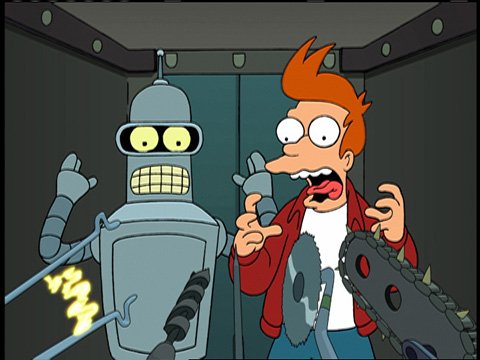
4. Bender Rodriguez (John Di Maggio) on Futurama

I don’t what is the best part of this character introduction; that there is such a thing as a suicide booth, that there is a robot in line to use the suicide booth, or that said robot wants to rip off the suicide booth with a coin on a string. On top of that, the viewer is in the same place as the protagonist, Fry: fresh out of the year 1999, with this whole new world unfolding more and more strangely by the minute. It’s funny, it’s bizarre, and it perfectly captures the tone of the show overall.

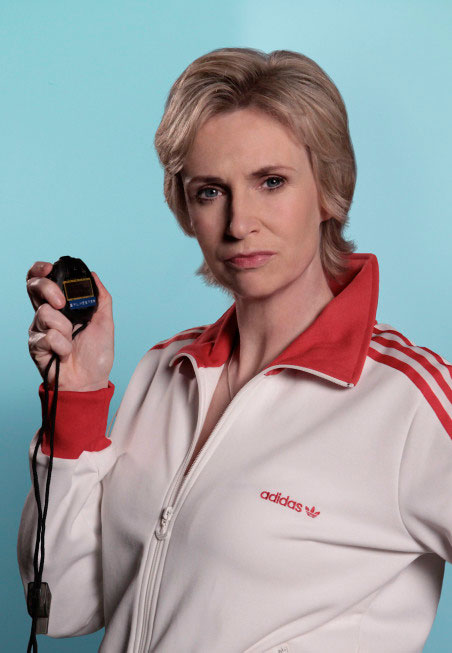
5. Sue Sylvester (Jane Lynch) on Glee

“You think this is hard? Try being waterboarded–that’s hard.” This first line by the sadistic cheerleading coach, the first, in fact, of the pilot, tells us everything we need to know. Although some unexpected complexity to the character was revealed later in the season, that uber-bitch, no-mercy exterior never faltered.

Futurama

Futurama fans are rejoicing. After being cancelled from Fox, then revived in the form of some straight-to-DVD movies, and given another shot with reruns on Comedy Central, the little animated show that could has returned with new episodes. And we didn’t even have to order any Subway footlongs. In celebration of the return (and the fact that the new episodes are hilarious, at least so far), I thought I would take an overdue look at the pilot episode of Futurama. I read once where someone referred to this as “the perfect pilot.” If not perfect, it’s pretty close.

When Futurama aired it was “the new Matt Groening show.” Fortunately for us and Matt Groening it is nothing like the Simpsons. The Simpsons does its thing—well—and Futurama does its just-as-witty- but-totally different thing. In fact, Futurama is more original. The Simpsons basically took an existing TV formula and animated it. Futurama mashed up situation comedy, science fiction, 20-something slackerdom, political satire and Y2K fear.

In the pilot we meet Philip J. Fry (Billy West), a pizza delivery boy with slouching shoulders and gravity-defying orange hair. His life is as miserable as we, the viewers, have ever thought ours were. He finds out his girlfriend is leaving him as she drives by him in a cab with her new man. He’s good at one thing at least, a 1980s-era video game that allows him to fly through space and shoot stuff. For anyone who ever fantasized that their gaming skills would come in handy in the real world someday, Fry is about to live out their fantasy.

Tonight it’s new year’s eve 1999. A newspaper headline reads, “2000. Doomsayers Cautiously Upbeat.” (It’s these simple little gags that fill every moment of the show with humor and make it worth watching over and over.) Fry, as the victim of a crank call, is delivering a pizza to a cryogenics lab when he falls into a cryogenic chamber set to thaw in 1,000 years. A montage of the next millennium shows us Groening’s satirical prophecies for the human race. New York rises, falls, rises, falls, and rises once more. There are many details worth slow-mo’ing.

Fry finds himself in the year 3000, in an unfamiliar New York City. The future has many of the things you would expect—robots, space travel, and flying cars—and many you wouldn’t. It’s got celebrity heads in jars and suicide booths. One of the funniest and weirdest scenes ever takes place when Fry meets the wisecracking robot Bender. “Well, I don’t have anything else planned for today,” Bender declares, “Let’s go get drunk!”

Next we meet Leela (Katey Sagal), whose job is to program other people with a chip that determines their vocation. Apparently their system is pretty accurate, because it labels Fry as a Delivery Boy. Leela is kinda hot considering she’s got one giant eye in the middle of her head, and there is no denying that she’ll be Fry’s love interest for the series. (We’re told she’s an alien, but a later episode will reveal otherwise.) We also meet Professor Farnsworth, who hires Fry, Leela, and Bender as his new flight crew aboard the Planet Express. And, voila, Fry is a delivery boy again. Context is everything; he couldn’t be more excited. Thus, Fry and the audience are off on a series of adventures.

It is brilliant how Groening can say so much about our own time with a story set a thousand years in the future. Bits of what happened since 1999 are filled in here and there like little warnings. And yet, some things never change. Human beings—and other species as well—will probably have the same neuroses in the future that they have now.

The Clone Wars

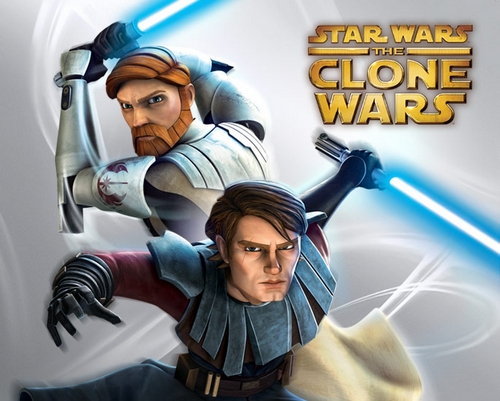
In discussing the animated series The Clone Wars, I’ve chosen to treat the movie as the pilot. It functions as one, more or less, but then this series doesn’t need a pilot in the traditional sense anyway. Anyone who hasn’t been living in a Dagobah swamp for the last 35 years has at least a passing familiarity with the Star Wars universe. There are only two signficiant new characters we need to meet here. (For purposes of this analysis I’m ignoring the 2003 TV series, Clone Wars.)

To talk about a Star Wars movie experience you have to start even before the characters appear on screen. At the opening we get the thrill of the “A long time ago…” caption followed by the triumphant appearance of the yellow title logo we know and love (modified with the new title, obviously.) We’re pumped. But instead of a crawl, we get a voiceover reminiscent of a 1940s newsreel. It’s just as boring.

As in the other films, this one doesn’t weigh us down for too long with talk of trade blockades and treaties, although it does start off that way. We jump into the action of battle as Obi-Wan (James Arnold Taylor) and Anakin (Matt Lanter) lead a corps of Clone Troopers against some spindly-legged robots (which look a lot like the robot from The Incredibles).

Once our Jedi heroes dispatch with the enemies they discuss the impending arrival of Obi-Wan’s new padawan. Right on cue, the new character Ahsoka (Ashley Eckstein) shows up–only Yoda has assigned her to train with Anakin, not Obi-Wan, much to Anakin’s chagrin. Thus we get our Reluctant Partnership, staple of cop shows and romcoms.

(I’d like something clarified. Exactly what is the age requirement to train as a Jedi? Mixed messages on this abound throughout the films.)

The first thing we notice about Ahsoka, besides that she looks like the victim of  spray tanning accident, is that she’s really freaking annoying. Sure, she’s supposed to annoy Anankin, but why us? Just thank the Force they don’t mention her midichlorian count.

The other character to be introduced is from a separtist Sinead O’Connor-looking creature called Ventress. There is not much to say about her at this stage except she’s bad.

After Act I we move on to a plotline where the Jedi have to rescue Jabba the Hutt’s infant son. (Which begs the question, how do Hutts reproduce?) It turns out the rescue mission is a frameup by Count Dooku to make it look like the Jedi are trying to kill the mini-Jabba. Padme Amidala comes along to assist. She looks and sounds pretty cool, probably the least cartoony, if that makes sense, of all the characters. There is just the briefest reminder that Padme and Anakin’s relationship is a secret, which sets up lots of possibility down the road for series plotlines. It is when her character is introduced that we get some variety to the action, cutting between her scenes and Anakin’s. You can’t even call it a subplot – the story is pretty much one thread.

So what works and what doesn’t about this pilot? The good: Obi-Wan, a consistently interesting character from all six previous films is back. Yoda looks fantasic animated. And Anthony Daniels as C3PO. The bad: Samuel L. Jackson as Mace Windu. Doesn’t he have other stuff to work on? Can’t he go away and let us forget that “This party’s over” ever happened?

Possibly the biggest problem with this is that it can’t seem to decide whether it is for kids or adults. It’s like what happened to Return of the Jedi with all the Muppets, and to Phantom Menace with all the Gungin nonsense. The best thing, though is this: After years of hearing about the Clone Wars, we actually get to see the Clone Wars! The show has certainly found success, with season 3 set to begin in fall 2010, and enough merchandise to choke a Hutt.

Drop Dead Diva

When I saw the ad for this show on Hulu, it looked so schlocky and awful I couldn’t resist. And now various cable channels are plugging the hell out of the Season 2 premiere, guest starring—and this should be a red flag—Paul Abdul.

 The show opens with a blond bombshell nervously preparing for her big new job – as a prize model on The Price is Right. I have to admit that’s pretty funny. Her perky self-doubt is reminiscent of Elle Woods. In a parallel story with no immediately obvious connection, an ugly-by-television-standards woman is getting chewed out by her bitchy boss. Her co-worked, played by Margaret Cho, hits us over the head with some exposition.

In the show’s first five minutes both characters are unexpectedly killed and we’re vaulted into a bright white afterlife processing office, where a Scott Baio look-alike informs the blond-whose name I still haven’t been able to catch by this point-that she is completely neutral on the good/evil scale. The absence of good or evil, in this universe, is shallowness. The hot blond is shallow. He had to look that up in a database. She pushes a button on his keyboard and is beamed up into a stream of light, then wakes up in a hospital bed in the body of the unattractive character. Her name is Jane. I got that one. Plain Jane, couldn’t be more obvious.

There are too many stereotypes at work here to get through the pilot. I made it to minute 14. If you’re going to make a show about the afterlife, you have to find something creative to do with it. Call Bryan Fuller for tips. Furthermore, haven’t we made it past the assumption that brains and beauty are mutually exclusive? Did we learn nothing from Legally Blonde? Television lawyers are another area that has been hunted to extinction. High pressure, high heels, blah, blah. The ONE area where this show chose to stray from the predictable is they made Margaret Cho not funny.  How has this show lived to see a second season?

White Teeth

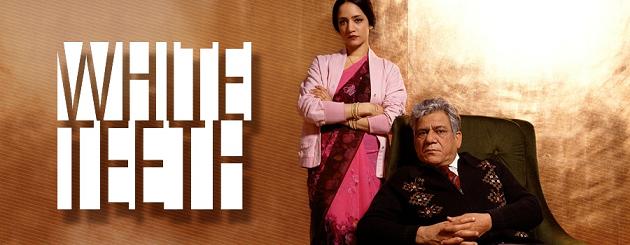
“You have picked up the wrong life in the coatroom of existence.” Who hasn’t felt that way at one time or another? This sentiment, uttered by Samad Iqbal (Om Puri) to his old war buddy Archie Jones (Philip Davis) encapsulates a theme that permeates the pilot episode of White Teeth.

The pilot of this UK drama, based on the eponymous book by Zadie Smith, is rife with moments. Like an older woman making her way along a row of apartments painting “666” on the windows. Or a man flipping a coin to decide whether to kill himself. It doesn’t matter that it’s 1974, because these oddities transcend time.

There are many characters to introduce who, in the beginning, have no clear connection. As readers of the book will know, there are many yet to come, and decades to cover. But this is one of those pilots that eschews exposition in favor of setting a tone. As relentless as the London rain, life’s dark moments wash over these characters wherever they go.

As the show opens, we’re driving through a dreary, dark neighborhood that the narrator (Archie) informs us is Willesden, “the kind of place a man goes to die.” As Archie sets up his car to asphixiate him, we flash back 3 months to meet teenager Clara (Naomie Harris). She is singing with abandon to her bedroom mirror. Her pure joy makes her instantly likeable. Described as homely in the book, she is actually quite cute save for her frumpy duds (and totally unrecognizable as Tia from Pirates of the Caribbean.)

The bleakness of the show echoes that of the book, but offers the added bonus of music, strategically used to juxtapose the action and make it that much more ridiculous. Clara’s singing moment is instantly silenced by her strictly religious mother’s entrance. Archie’s death-to-disco is interspersed with bouncy Indian music inside the meat truck that will momentarily save his life. It’s no spoiler that Archie lives — he’s the main character.

Archie’s world finally collides with Clara’s at an End-of-the-World party on New Year’s Eve. Clara, a Jehovah’s Witness has long been preparing for Doom’s Day, first by distributing warning pamplets, then by living it up having sex in public bathrooms. She has informed her ragtag band of friends of the apocalypse, and they count down to midnight dutifully. (Why does everyone assume the world will end according to their own time zone?) When our two misfits wake up in each other’s arms, they are plunged headlong into a new dawn. They have picked up new lives from the proverbial cloakroom. Thus begins their May-Decemeber romance, referenced by the episode’s title, “The Peculiar Second Marriage of Archie Jones.”

John Doe

John Doe debuted in 2002, airing on Friday nights at 9pm on Fox, a timeslot that is apparently where perfectly good sci-fi shows go to die.

The show opens with a square-jawed, naked man (Dominic Purcell, more recently of Prison Break, and so much cuter with hair) stumbling confusedly around an island. A few quick cuts and horror movie-style sound clips later, he is plucked out of the ocean by a fishing vessel off the coast of Seattle. Despite speaking Khmer and being able to tell the date and time, down to the second, by the position of the sun, he doesn’t know who he is or how he wound up in the water. As the audience, we’re as lost as the character.

Walking aimlessly down the street, Mr. Square Jaw notices a scar or a brand of some sort on his neck (which, although this show came first, reminds me of those marks the characters on Heroes used to find on themselves in Season 1.) It’s sort of a C-shaped thing with a couple of slashed through it. For reasons not yet explained, he sees only in black and white.

The nameless man quickly discovers, as do we, that he is a genius, or a human encyclopedia, or both. He puts his uncanny smarts to work in short order, first dazzling a crowd at a library by answering any question they can imagine. And, I may be over-thinking this, but there is an overhead shot of the library desk and the crowd around it that vaguely resembles the scar.

He gets himself a social security number and names himself John Doe. Before long, John is on his way to financial largesse, putting his brain to work on horse races and foreign currency. But wait, there’s more! Not only is he a brainiac, he’s musically talented, and soon stumbles into a gig playing piano in a bar. So we’re thinking he’s going to land on his feet.

At last through the set-up, we’re vaulted into action when John sees a missing little girl on TV, and her photo is the only thing he sees in color. Figuring that must mean something, he offers his services to the local police. The cop in charge of the missing person’s case lets him help pretty much right off the bat, while maintaining the requisite skepticism.

The mystery unfolds, with John seeing key people and items in color. The question that propels us through is, will John find the girl, or will the girl help him find himself?

With the forensics skills of Temperence Brennan, the learning ability of Chuck Bartowski, and the looks of – wow, I don’t know who – John has it all, as a character. The supporting characters come off as superficial, like the head-scratching cop and the really annoying-yet artistic-young woman who works at the bar with John. Everyone else introduced in this episode is a throw-away.

This isn’t the official pilot of John Doe. There was an unaired version with a different cast. But this one finds the balance needed for an action/sci-fi pilot between giving us enough to be intrigued but not enough to know what the hell is going on. Other shows have done this successfully, only to nosedive (Dollhouse, Journeyman, Defying Gravity) and this show’s fate was no better. Perhaps it was ahead of its time, predating themore successful shows referenced above. Or perhaps it got sucked into the great black hole of cop show stereotypes. I haven’t watched beyond this episode, but if it ended up being just another mystery-of-the-week show, the originality of the premise may not have held up.

The Oblongs

I think this animated show was on the air for a couple of weeks before it was cancelled. The story goes that it was actually cancelled mid-episode in Australia, because the network got so many outraged calls. It has recently resurfaced on Cartoon Network (and it’s available on DVD), so I thought I’d revisit it.

The first image we see as the pilot begins is a clean-cut man stepping out of a huge, fancy house. He reads the headline of his newspaper, Rich Get Richer, and smiles. Then he flushes his toilet and we, the viewer follow along a pipe down the side of the hill to where the sewage empties into a cesspit. This show is not about the rich people.

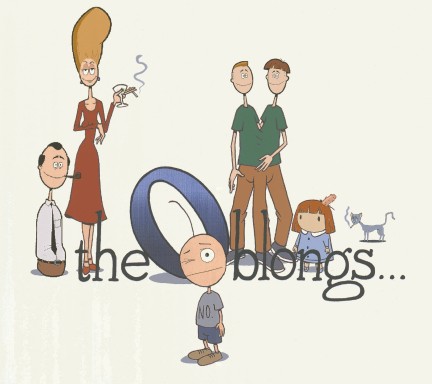
One by one, we meet the members of the family living at the bottom of the pipe. Bob Oblong (Will Ferrel) rises and shines. He is very cheerful for a guy with no arms or legs. He notes how cute his wife, Pickles (Jean Smart), is. She has no hair and wakes up still drunk enough that she’s not sure where she is. There are teenage conjoined twins in the shower. Bob reminds them to be thankful for their extra buttock. There’s a daughter who has something that resembles a cross between a penis and a pickle growing out of her head. We know the younger son, Milo, is the real focus since he’s introduced last. He’s busy sawing the foot board of his bed. We’re not told the exact nature of his ailment, but one eye is bigger than the other and he attends a special school. Where he needs a muzzle. Is this ridiculous enough yet? No? The cat smokes. Before you can even process any sense of plotline you are almost overwhelmed with over-the-top, bizarre images. You might be offended, if there were time.

As we head out to the bus stop it only gets worse. Everyone in this valley is some kind of mutant. The kids who go to “normal” school have too many abnormalities to take in at one glance. There are about four of them in assorted shapes and sizes, who hang out with Milo.

At the factory where Bob works he is surrounded by more valley freaks, and the rich guy from the opening, Mr. Climber, is his boss. Bob’s job is using his mouth to screw tops onto bottles of poison. (“The poison tastes different today,” he notes matter-of-factly.) The boss tells Bob that he has filed too many health insurance claims, and if he files any more he will lose his coverage. So, when the twins get in an accident, the family can no longer afford to send Milo to public school. There’s a pretty tasteless joke where the doctor is informed that the boys are conjoined twins. “Oh,” he says, “then it’s not as bad as I thought.” The jokes are like that; so out of left field you can’t help but laugh, tasteless as they may be.

Now that Milo has to transfer, the episode takes on a new-kid-at-school storyline. Like the Karate Kid before him, he falls for one of the popular girls, and gets beaten up by the popular guys. But the story is familiar for all of five seconds. It turns out the popular girl is an alien. She removes Milo’s brain for a quick look-see and then sends him on his way, smitten and outfitted with a tracking device.

We learn that Pickles is from the Hills, but relocated for love. She has a rival in Pristine, a mother of one or more of the popular girls. The popular girls come in a package deal; they all dress and talk the same and have the same name, Debbie.

The fun of this show is how sickeningly cheerful the Oblongs are in the face of adversity. They express worry and frustration at their day-to-day problems, but they don’t dwell on their big problems – the really big ones that are in your face the whole time you’re watching the show. Even the people from the Hills, although they think the Valley dwellers are icky, seem to have adapted to this way of life. That kind of juxtaposition makes the jokes spring up all over the place, like whack-a-moles. If you can get your head around how freaking weird this show is, it’s absolutely hilarious.

Spoiler alert. Milo doesn’t get the girl. His goth little friend burns down his club house, and thinking Milo is dead, the alien girl vaporizes herself.

Memorable quote: “I think I’ll hang around for a while and poke my first love’s remains with a stick.”