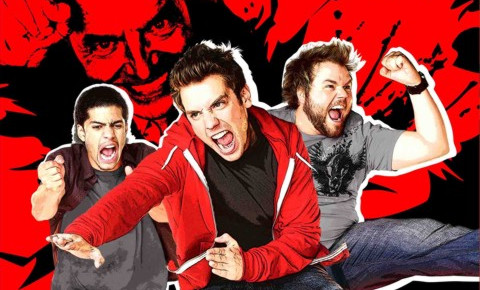
Party Down

So excited: I have been searching for a way to watch this show since I heard it existed! I don’t have Starz, but I finally tracked it down online. It shares creators, producers, and actors with Veronica Mars, one of my all-time favorite shows, and has been cited as one the best shows of 2009.

The show opens with a chipper, tuxedoed man (Ken Marino – Tony from Reaper) reciting the really long motto of Party Down Catering. The guy, we learn, is Ron, and he’s in charge of the catering crew getting ready for a party. He is manic about succeeding and earning a great feedback card from the client.

Ron has his work cut out for him; two of his staff are already eating the client’s cheese while rehearsing for an audition. Another is late. Still another was recently fired for masturbating on the job. We know early on that nothing is going to be held back, here.

Henry (Adam Scott) is the new guy. In a pilot, you need a new guy. He and Ron are old friends. We sense right away that Henry has recently experienced some kind of major life setback, but we’ll get the details gradually.

The crew of incompetents making Ron’s life hell include the ever-hilarious Jane Lynch (Glee), Lizzy Caplan (the underrated Related), Ryan Hansen (playing pretty much the same character as he did on Veronica Mars), and Martin Starr (Knocked Up, Superbad). The characters are all showbiz wannabes. Ryan Hansen’s character, Kyle, is perhaps the most fervent in his ambitions, and the hardest to watch, in that he’s so committed to being obnoxious, you’re embarrassed for him (think Michael Scott).

Once the party gets started, we find Kyle hitting on the client’s daughter and Jane Lynch’s Constance having water gun fights with some young guests. This may not be their dream job, but they’re doing their best to have fun at it.

Enrico Colantoni plays the husband of the party-thrower, and he is totally over suburban family life. He drinks to cope with his uptight wife and the smug neighbors and winds up skinny dipping in the pool, to the guests’ horror. He jokes about trading places with Henry, which I’ll take as a hint at things to come in the series.

Eventually we discover Henry’s secret, that his single claim to fame is having appeared in a beer commercial, where he popularized the catch phrase, “Are we having fun yet?” (Sort of his answer, I suppose, to “Whaaazzzz up?”) Now he’s given up acting, and wants desperately to remain anonymous.

In fact, desperation is the name of the game for these cater waiters. Desperation to succeed, to escape, to slog through one more party. And that’s a good premise for lots of funny situations. While this pilot wasn’t fall-on-the-floor funny, it sets us up. We know everyone’s desires. It’s hinted that romance may lie ahead for Henry and Lizzy Caplan’s unhappily married Casey. Cuz you have to have sexual tension. And Ron seems very close to snapping. And a Joey Lauren Adams guest appearance awaits. Plus, knowing that people like Paul Rudd, Dan Etheridge and Rob Thomas are behind the scenes, I am eager to keep watching.

UPDATE 1/10/2012: Megan Mullally has confirmed that a Party Down movie is in the works!
Better Off Ted

Better Off Ted opens with a commercial. It’s got lots of dramatic photography of dams, satellites, and cows, and a calm, confident-sounding voiceover explaining Veridian Dynamics.  It sounds like Veridian does some serious stuff, except there are some incongruous details. “Everything we make, makes your life better,” the calm woman says. And then we see a bomb destroy a building. It’s sort of a heavy-handed way to bring in the audience, but they insert these “commercials” into a lot of their later episodes. It sets the stage for a wacky, slightly disturbing comedy skewering corporate America. And that’s what you get with Better Off Ted.

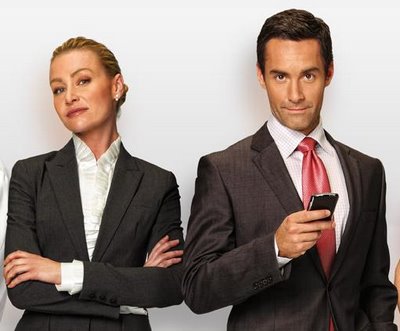
We get right to the point. “I have the best job in the world,” Ted (Jay Harrington) tells the camera. He explains what he does, how long he’s been doing it, and who helps him get it done. Ted is the head of Research and Development, Veronica (Portia DiRossi) is his boss, Lem and Phil are scientists, and Linda manages product testing. We also find out early on how the company messes with its employees; they’ve placed the toilet paper in the stalls just out of reach, to encourage people to use less of it.

So we get all those back story details out of the way, and we’re on to Ted’s conflict for this episode. He has to talk Phil into being frozen for an experimental procedure.

Ted has a precocious daughter, Rose, who serves as his conscience. The kid, in effect, winds up saving Phil’s job.

Linda is somewhat new at the company, but it almost seems as if she’s never had a job before, saying things like, “All companies do stuff like this, right?” Nonetheless, she is the normal one in the office, the one easiest for the audience to connect with.

Ted and Linda kinda like each other, but Ted has had a fling with Veronica, and he has a one-time limit on intra-office boot-knocking. His scruples rear their heads at the strangest moments.

The really twisted part about this show, which comes on strong in the pilot and doesn’t let up in subsequent episodes, is the employees’ loyalty to Veridian. They know they’re being treated like pawns, yet they revel in the lab rat race. Phil goes willingly to the cryogenic chamber; Veronica is practically orgasmic at the thought of abusing people in the company’s name. The pilot leaves one wanting to sympathize with Ted and Linda, maybe even hoping for them to get together, but then they’re not exactly role models either.

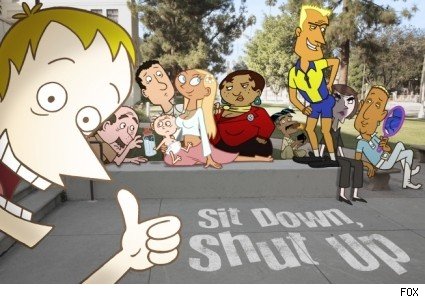
Sit Down Shut Up

This is a loveable little show that flies under the radar. When it disappeared from the Fox Animation Domination line-up after only a few episodes, I thought it been canceled for good, but then it turned up at midnight on Saturdays. Guess it was too offensive for prime time viewing. I don’t see how it’s any worse than Family Guy and American Dad; in fact it skips the cheap fart jokes and goes for the more nuanced vulgarities.

Before you even watch an episode, you can expect great things based on the cast; Kristin Chenoweth, Jason Bateman, Kenan Thompson, and Will Forte, for starters. If the cast isn’t enough to grab you, the animation should be. The show uses hand drawn animation against live action backdrops. It messes with your head a little at first, and almost allows you to forget you’re watching an animated show.

So the pilot opens with a road sign telling the audience this is Knob Haven, FL, population 9,334. It is, the sign says, “As pretty as a picture except for the people.” And below that, “You get used to it.” Okay, I had to pause the video to read all that, but that’s the kind of little joke that is buried throughout for those willing to look.

Within seconds we have a nutsack joke—although English teacher Ennis Hoftard is referring to an actual sack of nuts. Ennis wears a bicycle helmet all day. Each of the eccentric teachers at Knob Haven High School is introduced by his or her yearbook entry, with name, subject, and catchphrase. Each is a loser of the highest order, in his or her own colorful way. There is simply too much wackiness flying out of this show to keep up in one viewing. Watch it at least twice.

There is a new principal (Kenan Thompson) at KNHS, a no-nonsense African American woman who—like most of the other characters—isn’t in it for the love of the kids. Her catchphrase is “No.” She announces to the teachers that heads are about to roll. The budget is being cut since the school performed badly on No Child Left Behind standards. The lone ray of sunshine in a bunch of perfectly miserable people is Miracle Grohe (Kristin Chenoweth), a neo-hippie/creationist single mother on whom the sun always seems to shine. Natch, one of the other characters, the P.E. teacher, Larry “I don’t like to say my last name” Littlejunk (Jason Bateman), has a mad crush on her.

There is a drug scandal, in which some unidentified pills are confiscated from a student’s locker. Miracle, the science teacher, asks God to tell her what kind of pills they are. Sue figures, if they should happen to be steroids, she can use them to enhance the skill of the football team and therefore, alumni donations. Only they’re not steroids, the vice principal, Stuart “I need a catch phrase” Proszakian, takes them, and, well… things go awry.

It is refreshing to see high school life viewed through the eyes of the adults. This has been attempted here and there, as with the canceled Miss Guided, and on Glee, but I have never seen it done with such joyful irreverence. (Actually, if Sue Sylvester finally gets fired from William McKinley High she should take the first bus to Knob Haven.)

In addition to being ROTFL ridiculous, the show delivers a bit of social commentary, with its references to public school funding and a joke about the current U.S. political climate. Where it really pushes the envelope is with its near constant references—with varying degrees of subtlety—to student/teacher sex.

Larry: “I always ending up blowing it, like the stupid P.E. teacher that I am.”

Stuart: “I could never even get my P.E. teacher to do that.”

Is it wrong that that’s funny? Maybe, but Sit Down Shut Up doesn’t give you enough time to dwell on it, since it’s on to the next bit in the time it takes to slam a kid’s head in his locker door.

Favorite teacher catchphrase:  Willard Deutschebog (Henry Winkler) – “If I believed in reincarnation I’d kill myself tonight.”

Community Ep. 1.12

Okay, so this is not a pilot, but I have to gush about this most recent episode of Community, “Comparative Religion.” If you are new to the show, this would be a great episode to start with because, in fact, it has all the elements of a pilot. Each member of the ensemble cast is featured more or less equally, and we get to learn what each one is like. And it’s set on a day that will be a turning point for all of them—passing Spanish 101.

It’s the last day of classes at a Greendale Community College before the winter break; we know all of this from a brief announcement by the bumbling Dean. This is much the same as the opening scene of the pilot. Through his portrayal of “Mr. Winter,” a religion-neutral holiday character, we get the message about the school’s obsessive PCism. The scene really captures the insanity of this show.

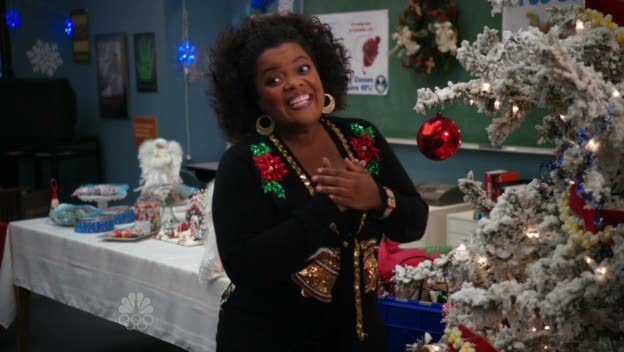
The episode revolves around a holiday party, being planned by Shirley (Yvette Nicole Brown), a recently divorced, middle-aged student who professes her strong adherence to the true (i.e. Christian) meaning of the holiday season. By each character explaining his or her beliefs or lack thereof, we get a well-rounded and hilarious picture of this ragtag group of Spanish students. There’s the Jehovah’s Witness, the Atheist, the Agnostic, the Muslim, the Jew—ahem, the Jewish woman — and the claims-to-be-Buddhist-but-is-apparently-just-in-a-cult guy. I’m disappointed that there’s no Pagan, but it’s a fun mix anyway. It’s the perfect set-up for grossly offensive humor. And it works because, for all their differences, these people are all friends, who operate more like a dysfunctional family.

The show also has a running gag of parodying 80s movies. When Jeff (Joel McHale) is challenged to a fight a tough guy in the cafeteria, we’re reminded of any number of films where the main character is challenged to a schoolyard brawl, and his friends are by his side to help him prepare.

The group is divided over Jeff’s choice to fight; Shirley thinks it violates the Christmas spirit (even though it’s only December 10), and Britta thinks it represents repressed homosexuality. These are typical responses by both of these characters that have been reinforced throughout the fall season. Of course it all has a hooray-Christmas-is-saved ending, but with a hilarious twist that further emphasizes the characters’ kinship and the show’s irreverence. Lessons are learned, but the characters remain as crazy as ever.

I was a little skeptical about this show’s promise when it debuted in September. But it has turned out to be consistently entertaining and out-of-the-box, culminating in a fantastic fall finale. You have to buy into the premise that these seven people would hang out together in the first place, but if you can do that, it’s totally worth it. I just have one question… what ever happend to John Oliver’s character?

For added laughs, check out the Greendale website.

Memorable quote: “As much as I hate you and the cast of Breakin’, I have to ask myself, ‘what would Shirley do’?”

Scrubs [Medical School]

So this isn’t exactly a pilot, but the first episode of the “new” Scrubs, which AdAge has dubbed “the show that won’t die” can almost be treated as a brand new show.  Scrubs, the half-hour dramedy about life as a medical intern, then resident, then doctor, has had two “series finales,” and here it is again, albeit in a slightly different incarnation. This time, the docs—yes, the same ones—are teachers. It’s still technically called Scrubs, but the title in the opening sequence is Scrubs [Medical School]. Early on, J.D. (Zach Braff) declares, “I hope I can find a way to make this all feel new.” We do too.

It’s been a whole year since J.D. (Zach Braff) has worked with Turk (Donald Faison), Elliott (Sarah Chalke), Perry (John C. McGinley), and the gang. Not sure what he’s been doing for the past year, other than getting Elliott, his now wife, pregnant. Carla is missing, and her absence isn’t addressed. There is also no sign of Jordan, but she was never on regularly anyway. Some of the characters introduced in Season 8, after the show was revived that last time, are back as well.

Early on when get an answer to “whatever happened to the janitor?” The show assumes prior knowledge of its earlier incarnation, with lots of recurring jokes, but then, the characters have always been so distinctly drawn, it doesn’t take much work even if you’re coming in cold—like, if you’ve been living under a rock.

J.D. approaches his first day teaching with the same wide-eyed, can-do attitude that he brought to his first day as an intern. Natch, he wants to succeed so badly that he makes an ass of himself. He makes his students mix tapes and signals them to take notes by displaying jazz hands.

And in case the old cast is a little long in the tooth for your viewing pleasure, there’s a new J.D. She is Lucy, a new intern who, just like J.D., has managed to land squarely on Dr. Cox’s bad side. Just to make sure everyone is good and miserable, Dr. Kelso is still there, crotchety as ever. (Didn’t he retire?) Also there’s a older (30ish) student, and an asshole rich kid whose father help pay for the building, so he can get away with murder.

Some things are re-established: the campy man love between Turk and J.D. Dr. Cox’s callous teaching methods. The unpredictability of hospital life.

J.D. is still desperately trying to get Dr. Cox’s approval, which is a little tedious after eight years, and especially after their big breakthrough in last season’s finale. But at least now, we see that he can pass on the benefit of his experience to someone new, Lucy.

We end with the obligatory sad-reality-of-the-medical-profession moment when a patient with whom Lucy connected dies. So despite some changes in scenery, we have much the same show. Supposing you were experiencing this cast of characters for the first time, they would likely seem appealing in their flaws, and capable of providing plenty of laughs.

It seems the episode titles will now all start with “our” instead of “my,” as in “My First Day,” the title of the pilot. Maybe this is to indicate more focus on the ensemble nature of the show than on J.D. as protagonist. It doesn’t seem this way based on this first episode, though. Time will tell if this show still has life in it, or if the plug should be pulled once and for all.

Clone High

I’ve realized that, although I love animation, I have yet to write about any animated series on this blog (except for a couple of mentions in this entry on my favorite pilots).

I started thinking about why this is. There are a couple of characteristics that make animated series a little different from other series in the pilot department. Animated series tend to have more emphasis on the plot-per-episode than on a longer story arc. In other words, nothing much changes episode to episode. Bart Simpson has been in fourth grade for 20 years, for chrissake. So the pilot is not necessarily distinguishable from later episodes.

Also, animated series are often based on existing properties, like comic book or film characters, who don’t need a lot of introduction. There are some obvious exceptions to this, like Seth MacFarlane’s brain candy or earlier, Futurama (great pilot).

I couldn’t decide what animated series to start with, but then I happily discovered a little show from the creator of Scrubs, Bill Lawrence, called Clone High. There were 13 episodes, which aired during the 2002-03 season on MTV, and it still airs in Canada, according to www.clone-high.com.

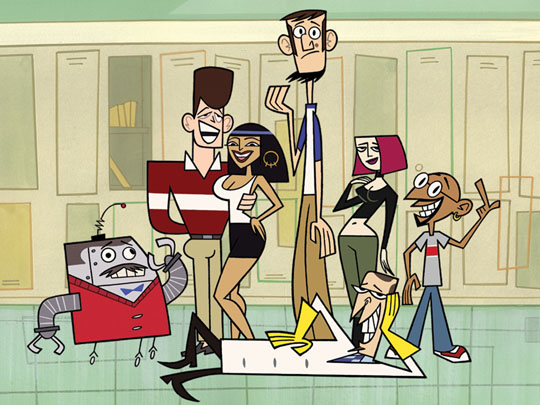
It’s the first day back at a high school where all of the students are young, contemporary versions of historical figures. There’s Abraham Lincoln (Will Forte), Joan of Arc (Christa Miller, Mahatma Ghandi, John F. Kennedy (Chris Miller), Cleopatra (Nicole Sullivan), and—you gotta love this—two Elvises, one young/thin and the other old/fat. Already you know by the wackiness of the premise this show is going to be different, as well as irreverent. In the first moments we get a crude sexual joke from JFK, and a drug use bit from old/fat Elvis, and learn that Ghandi is a lech. The animation looks a bit like Foster’s Home for Imaginary Friends with the sharp angles and bold outlines.

Each character falls into a high school social category. JFK is a handsome jock, Abe Lincoln is a gangly nerd, Joan of Arc is a down to earth do-gooder, Cleo is the popular chick, etc. There’s a love triangle: Joan likes Abe, who likes Cleopatra. (Who wouldn’t, right?)

The principal, Dr. Scudworth is pulling the strings. He is visited by someone from the military and we learn, in case it wasn’t obvious from the title, that the students are clones. They were created by the government, though we’re not yet told why. The pricipals office comes equipped with test tubes and other mad scientist paraphernalia. And he’s nuts.

There are lots of whimsical little details, like the diner where they hang out is called the Grassy Knoll. Van Gogh calls the school suicide hotline.

The episode plot has to do with Abe supplying a keg of non-alcoholic beer for the Big Party, but it appears the real story will be the aforementioned love triangle. We’re also told that Marilyn Manson will make an appearance next week. If the pilot is any indication, this show is funny, edgy, and has plenty of room for political commentary. I’m hooked, and can’t wait to watch the remaining episodes.

Memorable line: “Hey man, Ghandi’s anti-violence, not anti-comedy.”

My Name is Earl

The a simple premise: a hillbilly criminal (Jason Lee) decides to turn his karma around by righting the wrongs he’s committed in his 30-odd years. There is a lot of back story to tell us how he got here, though. The first thing that strikes me about the pilot is that the creators communicate a ton of information in very concise packages. Having voiceover by the protagonist helps, of course, but in under ten minutes we have a picture of Earl’s whole life up to the present moment. For example, a quick close-up of Joy’s belly, and Earl looking over at it from his position before the porcelain god, tells us all we need to know about their marriage.

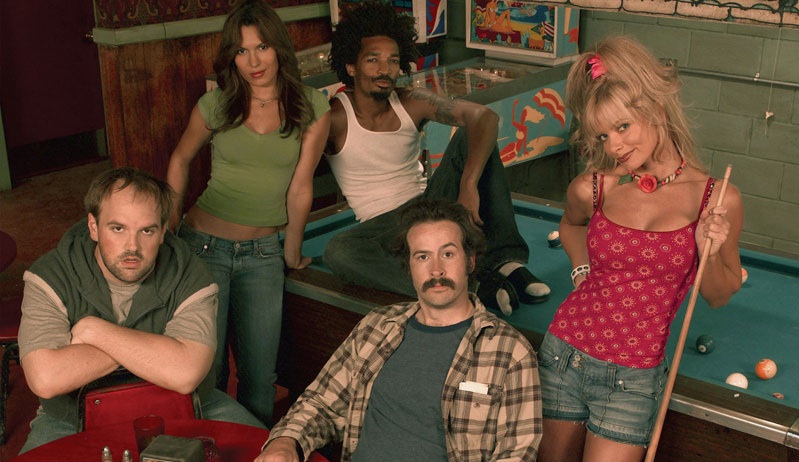
We’re introduced to lot of colorful characters; there’s Earl’s ex-wife, Joy (Jaime Pressly), his brother, Randy (Ethan Suplee), Randy’s love internet, Catalina (Nadine Velazquez), Joy’s old/new man, Darnell (Eddie Steeples), an old schoolmate, Kenny, and a couple of kids with questionable parentage. They’re so white trash, the jokes spawn like microorganisms. They’ve never even heard the word karma until Carson Daly explains it, and they figure he made it up. Yet, by the time it’s all over, we’ve come to like a guy who, as he describes, you would wait to exit a convenience store before you and your family go in.

Earl’s transgressions range from robbery to “harmed and possibly killed people with second-hand smoke.” We get a little commentary on gay issues, since the first person Earl chooses to help is a closeted gay man who has never had the confidence, thanks to Earl’s childhood taunting, to come out. It all brings us to a feel-good ending that is at once funny and slightly bizarre. Rob Bass and DJ Easy Rock are an unlikely unifier. The ending is so quirkily sweet, it’s almost a tear-jerker.

So we get a great one-off story as well as a great set-up with potential for many seasons to come. Each actor shines in his or her own way, with great costuming and tons of hilarious and character-revealing one-liners. They’re stereotypes, sure, but we want to revel in their mistakes and hope for their futures; except maybe Joy’s. She’s such a bitch.

Reaper

reaper_headerThe guy’s soul is owned by the devil. What more could you need to know?

Reaper fits squarely into the dramedy category, shows that follow an hour-long drama formula, but heavy on laughs (Bones, Ugly Betty). It was highly anticipated by the ComicCon set in 2007, thanks to having Kevin Smith on board as director of the pilot.

As in all shows with supernatural settings, we need some rules for how this world works. But first, we start with our protagonist, Sam (Bret Harrison) getting up and getting ready for work in the morning…to the song “Devil’s Haircut.” Nice. His sweet, upper middle class parents wish him a happy birthday, but they seem a little distressed. His jerky brother (who pulled a shark jump vanishing act later in the series but looks like he could really be Bret Harrison’s brother) gives us the 4-1-1: “The guy’s 21, lives with his parents, and wears an apron for a living. There’s no happy in that birthday.” Sam’s mom defends him with, “College made him sleepy.”

I won’t try to document every funny line in this thing, because there are just too many. Sam’s best friend, Sock (Tyler Labine), is your basic slacker clown character. Sam is in the friend zone with the beautiful Andi. Goofy co-worker Ben rounds out the merry band of losers. They all work at a home improvement big box store called The Workbench.

Even before we get to the hocus pocus, we’ve got a solid basis for a funny buddy show. Despite the restraints of network TV, the show’s tone smacks of Kevin Smith; in the midst of adventure, this bunch of co-workers shares glib observations on life, always maintaining their slacker posture. And I’d swear Tyler Labine studied at the Silent Bob School of Acting.  There are so many fun little moments; the Devil drinks orange juice out of the carton. Sock wraps his hand in duct tape for no apparent reason and gleefully declares, “tape hand”! And my favorite touch – the mysterious vessel that Sam must use to catch an escaped soul is a Dirt Devil.

The plot of the show is that Sam’s parents agreed that their firstborn would be indentured to the Devil as of his 21st birthday, working to recapture damned souls who have escaped from Hell. In this episode, the soul is a departed arsonist repeating his crimes. The Workbench makes for the perfect headquarters for demon busting, as hardware comes in awful handy when battling Hell’s esapees.

One unpredictable moment is Sock’s complete and immediate acceptance of Sam’s devil gig. Instead of disbelief or horror, Socks expresses only enthusiasm. The Devil doesn’t seem to have any restrictions on who Sam can share his work with, which does away with the lone hero idea in many superhero shows.

The Devil (Ray Wise) is the icing on the cake. There are no red horns or tail here, but the guy just looks like a bastard. And you see him having an absolute blast being evil.  He’s like a cat who enjoys batting his prey (Sam) around just to mess with it. He is truly scary, dancing between humor and meanness; he heartily enjoys watching a guy get shredded by a zamboni.

You could say Reaper jumped the shark in its second episode, based simply on the fact that it changed directors. It changed direction numerous times, introducing new characters and plot twists all the time, always giving off the scent of a show on the verge of cancellation. Still, the pilot stands out as a purely entertaining 44 minutes of television.

Gilmore Girls

Despite being off the air for two years now, Gilmore Girls still has a strong following, with reruns airing on ABC Family, and plenty of discussion in the blogosphere. This highly successful show must have started off on the right foot, right?

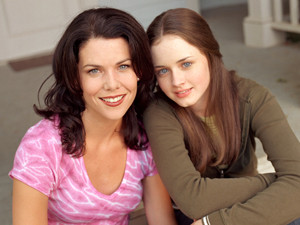
The pilot is thin on actual plot. It’s the kind of pilot that focuses on setting up a world in which a show will take place. I’d say the writers’ intention here was simply to train the audience in how to listen to these characters speak. The rapid fire dialogue filled with nonstop, sometimes obscure, pop culture references, is what makes someone either love or hate this show. When Rory, the cute, 16-year-old protagonist meets a guy, Dean (Jared Padalecki, now on Supernatural), she interrupts her own incessant babbling to say, “I never talk this much.” Already, only a few minutes into this pilot, we know that can’t possibly be true.

The opening scene in which Rory (Alexis Bledel) and her also cute mother, Lorelei (Lauren Graham) sit at the diner discussing a scattershot array of topics heavily weighted toward lip gloss, leaves me feeling a little empty. They come off as vapid girly-girls. Soon enough, though, we find out that Rory reads a lot of classic literature—a character trait that seems forced at this stage. The diner is run by a less-than-friendly guy in a ball cap named Luke who, it is hinted, has the hots for Lorelei. Lorelei is immediately portrayed as the “best friend” type of mom, acting as a pal to her daughter and letting her indulge a caffeine addiction. We see her limits, though, when she runs a flirtatious adult male away from Rory.

So, we are introduced to the quaint New England town of Star’s Hollow, Connecticut, which looks like the next studio lot tour could wander through the background at any moment. There’s the diner—we know it’s important since the episode both begins and ends there—and there’s a very busy inn, where Lorelei works, and naturally, a public school. We find out quickly that everybody knows everybody. Having a new kid in school, in this case Dean, is always a handy device for introducing characters and locations.

The most interesting character is Rory’s Korean best friend, Lane, whose parents are already planning her betrothal to a fiscally promising young man, and who changes clothes on her way to school so her mother doesn’t see her in a Woodstock T-shirt. Her ultra-conservative mother and Lorelei’s friend Sookie are both funny characters, but fall into the common pilot trap of making everyone a stereotype.

The same is true of Lorelei’s parents, rich socialites who live half an hour away, and who have been largely estranged from their offspring. Snarkiness appears to be matrilineal. It is all Lorelei can do to swallow her pride and ask them for the money to send Rory to a private school. I have to wonder, why private school? Star’s Hollow doesn’t exactly seem like the kind of place where metal detectors or drug dogs are de riguer in the high school, and Lorelei is portrayed as a strong, down-to-earth type for whom public school should be good enough. If growing up Gilmore didn’t lead to the life she wanted for herself, why does she want it for her daughter? But, we have to accept the lure of private school to care whether Lorelei can come to an agreement with her parents, and whether Rory can tear herself from her new crush. And, I know teenage girls are fickle—I was one—but she’s really so in love with a guy she talked to for 20 minutes that she is ready to change her whole life’s plan and jeopardize her best pals relationship with her mother?

The whole thing ends with a sickeningly cute exchange.

Luke: You do not want to grow up to be like your mom.

Rory: Sorry. Too late.

Based on this pilot, I hate this show. I watched the last couple of seasons, and found it pretty entertaining. The more mature version of Rory was interesting, her success in college enviable. The teenybopper version, however, and her teenybopper-past-her-expiration-date mom were just annoying. Sorry, fans, I know you are plentiful, but this pilot promises just another teen drama about nothing.

Pushing Daisies

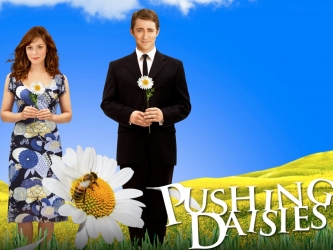
Pushing Daisies KeyartWe know in an instant that Pushing Daisies is going to be an unusual show. The first image we see is of an endless field of bright yellow flowers capped by an impossibly blue sky. A narrator with a deep, storyteller voice tells us that the little boy and his dog running through the flowers are Ned and Digby, along with their ages, down to the minute.

Digby is dramatically run down by a truck, but when Ned touches him, more with curiosity than sadness, the dog jumps up fully alive. Ned, we are told, has the ability to bring dead things back to life. Now pay attention. His mom is struck dead by on the kitchen floor by an aneurysm. Ned brings her back to life. Exactly one minute later, the man across the street drops dead. The dead guy’s daughter is Chuck, the apple of Ned’s eye. When Ned hugs his mom good night, she dies. Again. It’s a complicated gift, and if you missed this first three minutes, I doubt you would make much sense out of the show later on. One touch brings someone back to life, a second kills them. If the person is kept alive for more than one minute, someone nearby dies is his stead.

Fast forward to present day. Ned (the adorable Lee Pace) owns a pie shop. Emerson Cod (Chi McBride), a customer and a private investigator, has recruited Ned to help him investigate murders. It’s a big—and refreshing—leap from the normal cop-with-an-unusual-partner show. Kristen Chenoweth plays the pixie-like waitress Olive, who has a thing for Ned.

Soon, we see Ned and Emerson in action, as Ned sets his watch alarm for one minute and wakes a dead guy to find out how he got that way. Bam, the mystery is solved, and the audience has a sense of how the show will go.

Things become more complicated, however, when the next murder victim turns out to be Chuck (Anna Friel, kind of a British Zooey Deschanel–that’s a good thing), Ned’s childhood crush. He wakes her; she’s spunky, she’s charming, and reveals that the two of them were each other’s first kiss. Awww… Ned can’t bring himself to re-kill her, so after a minute, she is stuck between life and death for good. What really sucks is Ned has found the love of his life and he can’t touch her. Great dramatic tension, if difficult to believe.

The rest of the pilot (titled “Pie-lette”) involves solving Chuck’s murder, and protecting her aunts, Vivian and Lillian, from the killer. The aunt’s back story is that they are former synchronized swimming stars until one lost an eye, and now they are agoraphobics with a penchant for cheese.

To love this show requires buying fully into the premise. You have to treat it like the beautiful storybook that it is and not over-think reality. The characters talk at Gilmore Girls speed, and plays on words fly back and forth like ping-pong balls. Every detail matters. There is a sort of 1950s aesthetic in both the language and the look. Color in this show is a character in itself. Everywhere there are brighter-than-life hues, from the bulbous cherry red lamps in the pie shop to Olive’s floral print wallpaper and matching pajamas.

As with creator Bryan Fuller’s other shows, Dead Like Me and Wonderfalls, not enough people apparently got it. It was, however, nominated for several Emmys, winning for Directing, Editing, Music Composition (2008), Art Direction, Make-up, Costumes, and Best Supporting Actress—Kristen Chenoweth (2009). Honestly, it was one of those impossible to sustain premises, much like in the aforementioned shows, that couldn’t work forever. But the Pie-lette is delicious.