Firefly

I have been putting off writing this entry for a long time, which is in no way a reflection on my opinion of the show. It’s more like I’m afraid I can’t do Firefly justice, especially considering the rapturous devotion of its fans. If you’re a loyal browncoat you probably know the pilot backwards and forwards. If you’re not, it may be that you blinked and missed it before Fox canceled it. (I won’t rehash the whole fan outcry/Serenity story.)

It’s not like Joss Whedon invented a new genre here; we’ve seen space anti-heroes before. And I, for one, was not a Whedon fan prior to this, so I wasn’t like “Hooray, a new show from the creator of Buffy.” The show just hit all the right notes with cool setting, fascinating characters, great dialogue, and a healthy dose of dark humor.

The show opens with an in-the-trenches war scene, which could be out of any number of movies. The clue that something is different is that the aircraft flying overhead look like nothing we’ve seen before. A man (Mal, played by Nathan Fillion) and a woman (Zoe, played by Gina Torres) are leading a shell-shocked contingent against an attack. Their language is slightly heightened; in fact, the whole scene is a bit confusing the first time around. All we really need to know is that the troops are forced to lay down arms when their back-up abandons them. The look on Mal’s face and the music playing tell us all we need.

Music is huge in this pilot. The score is a twangy, gritty collection of music reminiscent of old westerns. Its juxtaposition with high-tech space travel gives Firefly its own unique tone.

We jump ahead six years from the battle scene to a spacewalk by a crew of three. The striking quality of this scene is that it is very quiet—opposite the previous scene—with sound seemingly sucked up by the vastness of space. Meanwhile the pilot of the ship, who seems to be keeping an eye on the mission, is actually playing with dinosaur toys on his console. (I may have to add this to my list of best character introductions.) “Curse your sudden but inevitable betrayal,” cries the Stegosaurus to the Tyrannosaurus.

From there, we start to meet the rest of the crew. There is the ever-cheerful mechanic, Kaylee (Jewel Staite). There is a “companion,” or prostitute, Inara (Morena Baccarin). And there’s Jayne (super-dreamy Adam Baldwin), all-around tough guy. The pilot is Wash (Alan Tudyk), Zoe’s husband.

The crew has to quickly shut down the ship’s power as they pass an enemy, and we find out a few details. The ship our crew flies is an out-of-date model called a Firefly. Its name is Serenity, and it becomes a character unto itself over the course of the series. The ship and its crew are, for lack of a better term, off the grid. They’re clearly hiding from something.

Captain Mal and company land on a dusty planet and pick up some new passengers, a preacher, a doctor, and a third man. A lot of characters and a lot of information are introduced very fast. The show demands your attention and is worth watching over and over, because so much happens. The dialogue is layered with character revelations and plenty of wit. The basics are, they’re short on cash, carrying stolen cargo, and on their way to seek help from a woman who once shot Mal. This is not going to go smoothly.

If you haven’t seen this, watch and enjoy the twists and turns for yourself. No one is who they seem. They all have secrets. Some violence beaks out now and again. And the doctor is transporting some very unusual cargo. Our protagonist, Mal, seems cool on the surface, even when angry, but clearly that war experience—and maybe a lot of other pain—is seething beneath the surface. Oh, and there are enemies out there in space called Reavers, to whom the crew’s reaction is bone-chilling. Just watch it.
Futurama

Futurama fans are rejoicing. After being cancelled from Fox, then revived in the form of some straight-to-DVD movies, and given another shot with reruns on Comedy Central, the little animated show that could has returned with new episodes. And we didn’t even have to order any Subway footlongs. In celebration of the return (and the fact that the new episodes are hilarious, at least so far), I thought I would take an overdue look at the pilot episode of Futurama. I read once where someone referred to this as “the perfect pilot.” If not perfect, it’s pretty close.

When Futurama aired it was “the new Matt Groening show.” Fortunately for us and Matt Groening it is nothing like the Simpsons. The Simpsons does its thing—well—and Futurama does its just-as-witty- but-totally different thing. In fact, Futurama is more original. The Simpsons basically took an existing TV formula and animated it. Futurama mashed up situation comedy, science fiction, 20-something slackerdom, political satire and Y2K fear.

In the pilot we meet Philip J. Fry (Billy West), a pizza delivery boy with slouching shoulders and gravity-defying orange hair. His life is as miserable as we, the viewers, have ever thought ours were. He finds out his girlfriend is leaving him as she drives by him in a cab with her new man. He’s good at one thing at least, a 1980s-era video game that allows him to fly through space and shoot stuff. For anyone who ever fantasized that their gaming skills would come in handy in the real world someday, Fry is about to live out their fantasy.

Tonight it’s new year’s eve 1999. A newspaper headline reads, “2000. Doomsayers Cautiously Upbeat.” (It’s these simple little gags that fill every moment of the show with humor and make it worth watching over and over.) Fry, as the victim of a crank call, is delivering a pizza to a cryogenics lab when he falls into a cryogenic chamber set to thaw in 1,000 years. A montage of the next millennium shows us Groening’s satirical prophecies for the human race. New York rises, falls, rises, falls, and rises once more. There are many details worth slow-mo’ing.

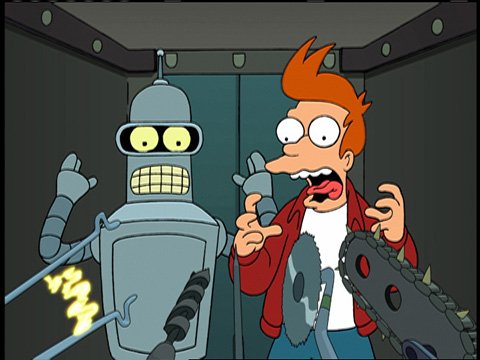
Fry finds himself in the year 3000, in an unfamiliar New York City. The future has many of the things you would expect—robots, space travel, and flying cars—and many you wouldn’t. It’s got celebrity heads in jars and suicide booths. One of the funniest and weirdest scenes ever takes place when Fry meets the wisecracking robot Bender. “Well, I don’t have anything else planned for today,” Bender declares, “Let’s go get drunk!”

Next we meet Leela (Katey Sagal), whose job is to program other people with a chip that determines their vocation. Apparently their system is pretty accurate, because it labels Fry as a Delivery Boy. Leela is kinda hot considering she’s got one giant eye in the middle of her head, and there is no denying that she’ll be Fry’s love interest for the series. (We’re told she’s an alien, but a later episode will reveal otherwise.) We also meet Professor Farnsworth, who hires Fry, Leela, and Bender as his new flight crew aboard the Planet Express. And, voila, Fry is a delivery boy again. Context is everything; he couldn’t be more excited. Thus, Fry and the audience are off on a series of adventures.

It is brilliant how Groening can say so much about our own time with a story set a thousand years in the future. Bits of what happened since 1999 are filled in here and there like little warnings. And yet, some things never change. Human beings—and other species as well—will probably have the same neuroses in the future that they have now.

John Doe

John Doe debuted in 2002, airing on Friday nights at 9pm on Fox, a timeslot that is apparently where perfectly good sci-fi shows go to die.

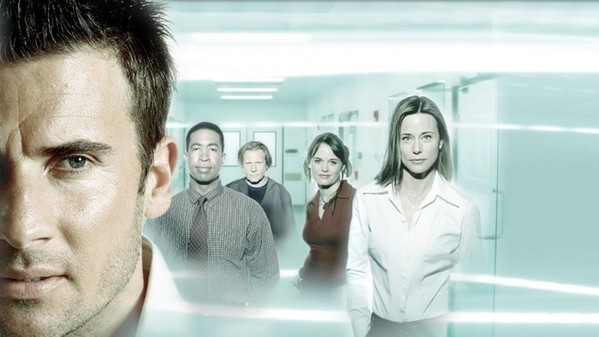
The show opens with a square-jawed, naked man (Dominic Purcell, more recently of Prison Break, and so much cuter with hair) stumbling confusedly around an island. A few quick cuts and horror movie-style sound clips later, he is plucked out of the ocean by a fishing vessel off the coast of Seattle. Despite speaking Khmer and being able to tell the date and time, down to the second, by the position of the sun, he doesn’t know who he is or how he wound up in the water. As the audience, we’re as lost as the character.

Walking aimlessly down the street, Mr. Square Jaw notices a scar or a brand of some sort on his neck (which, although this show came first, reminds me of those marks the characters on Heroes used to find on themselves in Season 1.) It’s sort of a C-shaped thing with a couple of slashed through it. For reasons not yet explained, he sees only in black and white.

The nameless man quickly discovers, as do we, that he is a genius, or a human encyclopedia, or both. He puts his uncanny smarts to work in short order, first dazzling a crowd at a library by answering any question they can imagine. And, I may be over-thinking this, but there is an overhead shot of the library desk and the crowd around it that vaguely resembles the scar.

He gets himself a social security number and names himself John Doe. Before long, John is on his way to financial largesse, putting his brain to work on horse races and foreign currency. But wait, there’s more! Not only is he a brainiac, he’s musically talented, and soon stumbles into a gig playing piano in a bar. So we’re thinking he’s going to land on his feet.

At last through the set-up, we’re vaulted into action when John sees a missing little girl on TV, and her photo is the only thing he sees in color. Figuring that must mean something, he offers his services to the local police. The cop in charge of the missing person’s case lets him help pretty much right off the bat, while maintaining the requisite skepticism.

The mystery unfolds, with John seeing key people and items in color. The question that propels us through is, will John find the girl, or will the girl help him find himself?

With the forensics skills of Temperence Brennan, the learning ability of Chuck Bartowski, and the looks of – wow, I don’t know who – John has it all, as a character. The supporting characters come off as superficial, like the head-scratching cop and the really annoying-yet artistic-young woman who works at the bar with John. Everyone else introduced in this episode is a throw-away.

This isn’t the official pilot of John Doe. There was an unaired version with a different cast. But this one finds the balance needed for an action/sci-fi pilot between giving us enough to be intrigued but not enough to know what the hell is going on. Other shows have done this successfully, only to nosedive (Dollhouse, Journeyman, Defying Gravity) and this show’s fate was no better. Perhaps it was ahead of its time, predating themore successful shows referenced above. Or perhaps it got sucked into the great black hole of cop show stereotypes. I haven’t watched beyond this episode, but if it ended up being just another mystery-of-the-week show, the originality of the premise may not have held up.

Journeyman

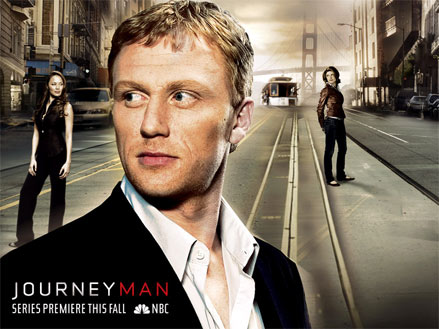
It’s 2007. A San Francisco reporter and loving family man is having a strange day. When Dan (Kevin McKidd) arrives at a restaurant to meet his wife for their anniversary dinner, a football game from 8 years earlier is playing on television. Then he wakes up in a cab, disoriented, but continues with his evening. The next morning, he wakes up in Golden Gate Park. He goes to his house to find a strange man living there. It’s 1987. His wife wakes up to find him missing, and his brother, a cop, hasn’t heard from him.

Time travel into the recent past is always fun, since we get to enjoy laughing about old music (10,000 Maniacs, anyone?), movies (Less Than Zero) and, of course, technology (giant, bricklike mobile phones). In Journeyman, however, the laughs are few, as eerie lighting and music build a sense of foreboding. Dan saves the life of a man about to let himself be hit by a streetcar. He continues to suspect that it’s all a dream. You can feel his fear when he returns to his wife to learn that he has been away for two days, and his wife’s as she wonders where he’s been.

Soon, our traveler is off again. He is in a car accident and disappears from the scene. (Something similar happened this season on Fringe.) He always seems to stay in San Francisco, although he pops up in various locations. There is no immediately visible pattern. People seem to be the unifying factors: Neil, the guy whose life he saved and Olivia (Moon Bloodgood), an ex-girlfriend.

Little details are introduced gradually, leaving the viewer to enjoy the mystery as it unfolds. In a show where the main character doesn’t know what’s going on, it’s more fun if the audience is just as lost. We’re also learning the character’s past. His wife used to date his brother. His girlfriend died in a plane crash. You share his frustration in the fact that he never knows when he will pop back in time, or where (when) he will land. And think what it would be like if you had to exist pre-internet now that you’re dependent on it for so many things.

The pilot brings more questions than answers; like, what if Dan talks to himself in the past? Or prevents the conception of his son? And if he sleeps with his old girlfriend, is that cheating?

This is the kind of stuff that will keep a viewer watching. You would think. Apparently, not too many people did keep watching, though, as the show only lasted 13 episodes.

The pilot comes to a satisfying conclusion. We learn, if not why Dan has been selected for this mission, at least what this group of journeys was meant to accomplish. He causes the death of the guy who he first saved, preventing that guy from killing his son, who grows up to save eight lives in a bus crash. So it looks like he is going to be evening out the balance between life and death, and possibly, finding out what really happened to Olivia. There’s a kind of feel-good ending where Dan promises his wife, “I’ll always come home.” The line sets the stage for a series of similar adventures.