The Clone Wars

In discussing the animated series The Clone Wars, I’ve chosen to treat the movie as the pilot. It functions as one, more or less, but then this series doesn’t need a pilot in the traditional sense anyway. Anyone who hasn’t been living in a Dagobah swamp for the last 35 years has at least a passing familiarity with the Star Wars universe. There are only two signficiant new characters we need to meet here. (For purposes of this analysis I’m ignoring the 2003 TV series, Clone Wars.)

To talk about a Star Wars movie experience you have to start even before the characters appear on screen. At the opening we get the thrill of the “A long time ago…” caption followed by the triumphant appearance of the yellow title logo we know and love (modified with the new title, obviously.) We’re pumped. But instead of a crawl, we get a voiceover reminiscent of a 1940s newsreel. It’s just as boring.

As in the other films, this one doesn’t weigh us down for too long with talk of trade blockades and treaties, although it does start off that way. We jump into the action of battle as Obi-Wan (James Arnold Taylor) and Anakin (Matt Lanter) lead a corps of Clone Troopers against some spindly-legged robots (which look a lot like the robot from The Incredibles).

Once our Jedi heroes dispatch with the enemies they discuss the impending arrival of Obi-Wan’s new padawan. Right on cue, the new character Ahsoka (Ashley Eckstein) shows up–only Yoda has assigned her to train with Anakin, not Obi-Wan, much to Anakin’s chagrin. Thus we get our Reluctant Partnership, staple of cop shows and romcoms.

(I’d like something clarified. Exactly what is the age requirement to train as a Jedi? Mixed messages on this abound throughout the films.)

The first thing we notice about Ahsoka, besides that she looks like the victim of  spray tanning accident, is that she’s really freaking annoying. Sure, she’s supposed to annoy Anankin, but why us? Just thank the Force they don’t mention her midichlorian count.

The other character to be introduced is from a separtist Sinead O’Connor-looking creature called Ventress. There is not much to say about her at this stage except she’s bad.

After Act I we move on to a plotline where the Jedi have to rescue Jabba the Hutt’s infant son. (Which begs the question, how do Hutts reproduce?) It turns out the rescue mission is a frameup by Count Dooku to make it look like the Jedi are trying to kill the mini-Jabba. Padme Amidala comes along to assist. She looks and sounds pretty cool, probably the least cartoony, if that makes sense, of all the characters. There is just the briefest reminder that Padme and Anakin’s relationship is a secret, which sets up lots of possibility down the road for series plotlines. It is when her character is introduced that we get some variety to the action, cutting between her scenes and Anakin’s. You can’t even call it a subplot – the story is pretty much one thread.

So what works and what doesn’t about this pilot? The good: Obi-Wan, a consistently interesting character from all six previous films is back. Yoda looks fantasic animated. And Anthony Daniels as C3PO. The bad: Samuel L. Jackson as Mace Windu. Doesn’t he have other stuff to work on? Can’t he go away and let us forget that “This party’s over” ever happened?

Possibly the biggest problem with this is that it can’t seem to decide whether it is for kids or adults. It’s like what happened to Return of the Jedi with all the Muppets, and to Phantom Menace with all the Gungin nonsense. The best thing, though is this: After years of hearing about the Clone Wars, we actually get to see the Clone Wars! The show has certainly found success, with season 3 set to begin in fall 2010, and enough merchandise to choke a Hutt.
Neighbors from Hell

I am always up for a new animated series, especially one that is NOT by Seth MacFarlane. (Nothing against him, he just has enough airtime.) Neighbors from Hell is being promoted by TBS as “from the studio that brought you Family Guy,” but is written by Kyle McCullouch (South Park). There is little resemblance to Family Guy. Except for the dog—I”ll get to that.

This pilot takes no time at all to introduce the premise: a demon is assigned by his boss, Satan, to transfer to Earth where he will infiltrate and bring down an oil company called Petromundo. We’ve seen the misfit-family-moves-to-new-neighborhood premise before. What makes this one a bit different is that all of the information Balthazar Hellmanneighbors from hell and his family have about Earth comes from watching television. So, we know we’re in for tons ‘o references. What I don’t get however, is why there is a 20-year delay on shows getting to Hell. I mean, it’s not England. They are watching Growing Pains, Alf, and The Cosby Show. That’s not the only thing that is out of date…

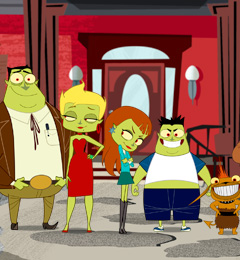
Characters are introduced with no unnecessary fanfare or backstory. The main character, Balthazar, has a wife, a son, a daughter, an uncle, and a dog that talks and seems smarter than the rest of the family, ala Brian Griffin. He winds up being the dues-ex-machina that undoes the mess the family finds itself in, and we can surmise that will be his ongoing role.

It is too perfect that this show is hitting the airwaves right now, as the villain (not Satan mind you, the real villain) is an oil company. The company is devising a giant drill that will bore to the center of the Earth, ostensibly disrupting life in Hell. Apart from that coincidence, some of these jokes seem like they have been gathering dust for a while. A demon tortures a damned man by making him listen to Britney Spears’ “Oops I Did it Again.” How old is that song? We’ve also got some jokes about Ugg boots and Criss Angle. The funnier jokes are the ones without an expiration date. Balthazar walks into the house to find bodies all over and inquires calmly, “Tina, did you kill the neighbors?”

The story seems headed for a quick resolution as Balthazar plots to destroy the engineer who is in charge of getting the drill up and running. Toward the end we find out what will give the premise an excuse to last past the first episode; the fact that Balthazar—aw, shucks— likes the guy he needs to destroy. There is also a racist neighbor how apparently practices beastiality with her poodle, and another who’s addicted to Valium. But, um, where are the TV references? The writers teased us with the possibility of Kirk Cameron jokes and there’s not a one.

The animation style is refreshing. (i.e. It doesn’t look like a Seth MacFarlane show) It’s stylized, and deceptively kid-friendly.

This pilot is all over the place. It has the feel of having been revised and rewritten to within an inch of its life. Not sure if that’s the case, but we’ll see where it goes.

Drop Dead Diva

When I saw the ad for this show on Hulu, it looked so schlocky and awful I couldn’t resist. And now various cable channels are plugging the hell out of the Season 2 premiere, guest starring—and this should be a red flag—Paul Abdul.

 The show opens with a blond bombshell nervously preparing for her big new job – as a prize model on The Price is Right. I have to admit that’s pretty funny. Her perky self-doubt is reminiscent of Elle Woods. In a parallel story with no immediately obvious connection, an ugly-by-television-standards woman is getting chewed out by her bitchy boss. Her co-worked, played by Margaret Cho, hits us over the head with some exposition.

In the show’s first five minutes both characters are unexpectedly killed and we’re vaulted into a bright white afterlife processing office, where a Scott Baio look-alike informs the blond-whose name I still haven’t been able to catch by this point-that she is completely neutral on the good/evil scale. The absence of good or evil, in this universe, is shallowness. The hot blond is shallow. He had to look that up in a database. She pushes a button on his keyboard and is beamed up into a stream of light, then wakes up in a hospital bed in the body of the unattractive character. Her name is Jane. I got that one. Plain Jane, couldn’t be more obvious.

There are too many stereotypes at work here to get through the pilot. I made it to minute 14. If you’re going to make a show about the afterlife, you have to find something creative to do with it. Call Bryan Fuller for tips. Furthermore, haven’t we made it past the assumption that brains and beauty are mutually exclusive? Did we learn nothing from Legally Blonde? Television lawyers are another area that has been hunted to extinction. High pressure, high heels, blah, blah. The ONE area where this show chose to stray from the predictable is they made Margaret Cho not funny.  How has this show lived to see a second season?

White Teeth

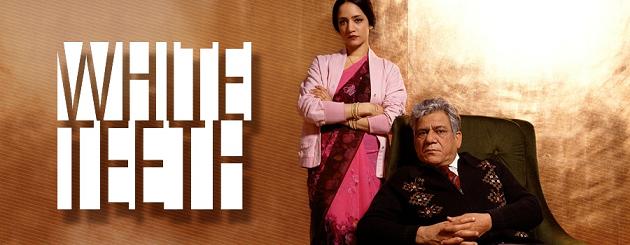
“You have picked up the wrong life in the coatroom of existence.” Who hasn’t felt that way at one time or another? This sentiment, uttered by Samad Iqbal (Om Puri) to his old war buddy Archie Jones (Philip Davis) encapsulates a theme that permeates the pilot episode of White Teeth.

The pilot of this UK drama, based on the eponymous book by Zadie Smith, is rife with moments. Like an older woman making her way along a row of apartments painting “666” on the windows. Or a man flipping a coin to decide whether to kill himself. It doesn’t matter that it’s 1974, because these oddities transcend time.

There are many characters to introduce who, in the beginning, have no clear connection. As readers of the book will know, there are many yet to come, and decades to cover. But this is one of those pilots that eschews exposition in favor of setting a tone. As relentless as the London rain, life’s dark moments wash over these characters wherever they go.

As the show opens, we’re driving through a dreary, dark neighborhood that the narrator (Archie) informs us is Willesden, “the kind of place a man goes to die.” As Archie sets up his car to asphixiate him, we flash back 3 months to meet teenager Clara (Naomie Harris). She is singing with abandon to her bedroom mirror. Her pure joy makes her instantly likeable. Described as homely in the book, she is actually quite cute save for her frumpy duds (and totally unrecognizable as Tia from Pirates of the Caribbean.)

The bleakness of the show echoes that of the book, but offers the added bonus of music, strategically used to juxtapose the action and make it that much more ridiculous. Clara’s singing moment is instantly silenced by her strictly religious mother’s entrance. Archie’s death-to-disco is interspersed with bouncy Indian music inside the meat truck that will momentarily save his life. It’s no spoiler that Archie lives — he’s the main character.

Archie’s world finally collides with Clara’s at an End-of-the-World party on New Year’s Eve. Clara, a Jehovah’s Witness has long been preparing for Doom’s Day, first by distributing warning pamplets, then by living it up having sex in public bathrooms. She has informed her ragtag band of friends of the apocalypse, and they count down to midnight dutifully. (Why does everyone assume the world will end according to their own time zone?) When our two misfits wake up in each other’s arms, they are plunged headlong into a new dawn. They have picked up new lives from the proverbial cloakroom. Thus begins their May-Decemeber romance, referenced by the episode’s title, “The Peculiar Second Marriage of Archie Jones.”

Deaths of 80s TV Stars

With the recent passing of Gary Coleman and now, Rue McClanahan, I have been hoping to locate the pilot episodes of Diff’rent Strokes or The Golden Girls. (I haven’t come across them online, so I may have to go old school and drive over to Blockbuster.) And, who can forget that Andrew “Boner” Koenig from Growing Pains took his own life not long ago? It gets you thinking about how a character can make such an impression. It is as if we all knew Arnold Jackson, Blanche Devereaux and Boner personally. When you’re a kid, especially (as I was when these shows aired) the folks you hang out with for half an hour a week can seem as real as your neighbors. We laughed with them through their daily mishaps, and cried with them in the “very special” episodes.

So without rewatching the pilot of Diff’rent Strokes, I can still share this part from memory. When the kids arrive at Philip’s house, Arnold brings along his pet fish, which is black, and which he introduces as his goldfish. Philip says, “I’ve never seen a black goldfish before.” Arnold replies, “That’s okay, he’s never seen a rich white man before.”

Okay it’s not brilliant, but it sticks with me 30 years later. Thanks, Gary, Rue, and Andrew for the memories.

Beverly Hills 90210

Forget that mellow-drama running on the CW called simply 90210. This is where it all began. The pilot for Beverly Hills 90210 opens with a typical pilot premise: It’s the first day of school. Two teens, Brandon (Jason Preistley) and Brenda (Shannen Doherty) Walsh are waking up, getting dressed, and preparing to face a new start in a new town. As we learn in some awkward but mercifully brief exposition, they’re from Minnesota. Dad got a new job, and the family moved to Beverly Hills.

We notice a few things right away. Kids from Minnesota get along with their siblings. Teenagers are slobs universally. And the 80s lasted at least until fall of 1990.

The opening credits are endless by today’s standards, comprising a montage of rich kids doing rich kid stuff. Brenda caps it with, “I think we’re going to need a raise in our allowance.” The one small twist is the chick getting off of a City bus. She’s got serious girl hair and glasses, so we know she’s smart. She’s kind of a bitch, too, when Brandon goes to her to offer his talent writing for the student paper, which she edits. Her name’s Andrea, and she’s set up to be either Brandon’s love interest or nemesis.

Brenda instantly befriends Kelly (Jennie Garth), the quintessential SoCal girl with white blond hair and a recent nose job. Kelly emphasizes to Brenda that this is “definitely not your normal high school.” I have to wonder, how would she know? This line sounds more like it’s directed at the networks asked to pick up the show than to the character Brenda. But, despite the underscoring of everything that makes West Beverly so unique, it’s refreshing to see how decidedly normal these kids were in Season 1. The freshmen are awkward. The girls worry about their weight. The jocks pick on the weaklings.

Brandon and Brenda are really likeable characters. They’re a little unsure of themselves, but far more secure than their Beverly Hills counterparts. Loveably down-to-earth. I love when a hot girl asks Brandon what he’s wearing that smells so good and he replies, “Tide?”

The obligatory party scene gives us all we need to know about the key players. Steve Sanders (Ian Ziering) looks like he came straight from playing the rich asshole in a John Hughes movie. The optimistic freshman David (baby-faced Brian Austin Green) provides some comic relief. And the poor little rich girl, Maryann, flirts shamelessly with Brandon. (And, WTF, are those people in the background of this scene playing tennis?) What is surprising, with the benefit of hindsight, is how little we hear out of Donna (Tori Spelling). She’s little more than Jenny Garth’s shadow.

A word must be said about the clothes. At the time this aired I’m sure they were the height of fashion. But today, whoo! Let’s hear it for blazers with shorts. And the hair! What is the semi-mullet thing Brandon is sporting?

By the end of the pilot we know everyone we need to know, save for one… Dylan is yet to be introduced. We pretty much know what we’re in for, and it’s got a nice blend of drama and humor. One wonders how this show morphed into a soap opera dealing with drug overdoses and whatever else went on in the later years. Not to mention the CW nonsense.

John Doe

John Doe debuted in 2002, airing on Friday nights at 9pm on Fox, a timeslot that is apparently where perfectly good sci-fi shows go to die.

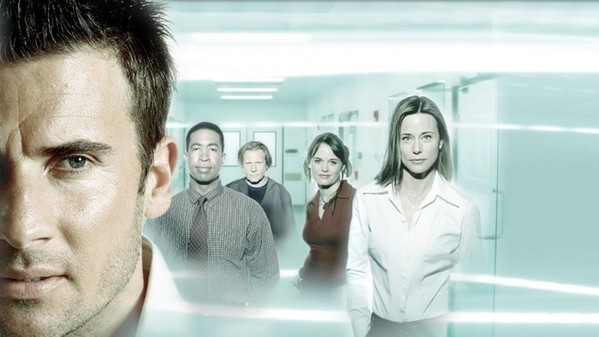
The show opens with a square-jawed, naked man (Dominic Purcell, more recently of Prison Break, and so much cuter with hair) stumbling confusedly around an island. A few quick cuts and horror movie-style sound clips later, he is plucked out of the ocean by a fishing vessel off the coast of Seattle. Despite speaking Khmer and being able to tell the date and time, down to the second, by the position of the sun, he doesn’t know who he is or how he wound up in the water. As the audience, we’re as lost as the character.

Walking aimlessly down the street, Mr. Square Jaw notices a scar or a brand of some sort on his neck (which, although this show came first, reminds me of those marks the characters on Heroes used to find on themselves in Season 1.) It’s sort of a C-shaped thing with a couple of slashed through it. For reasons not yet explained, he sees only in black and white.

The nameless man quickly discovers, as do we, that he is a genius, or a human encyclopedia, or both. He puts his uncanny smarts to work in short order, first dazzling a crowd at a library by answering any question they can imagine. And, I may be over-thinking this, but there is an overhead shot of the library desk and the crowd around it that vaguely resembles the scar.

He gets himself a social security number and names himself John Doe. Before long, John is on his way to financial largesse, putting his brain to work on horse races and foreign currency. But wait, there’s more! Not only is he a brainiac, he’s musically talented, and soon stumbles into a gig playing piano in a bar. So we’re thinking he’s going to land on his feet.

At last through the set-up, we’re vaulted into action when John sees a missing little girl on TV, and her photo is the only thing he sees in color. Figuring that must mean something, he offers his services to the local police. The cop in charge of the missing person’s case lets him help pretty much right off the bat, while maintaining the requisite skepticism.

The mystery unfolds, with John seeing key people and items in color. The question that propels us through is, will John find the girl, or will the girl help him find himself?

With the forensics skills of Temperence Brennan, the learning ability of Chuck Bartowski, and the looks of – wow, I don’t know who – John has it all, as a character. The supporting characters come off as superficial, like the head-scratching cop and the really annoying-yet artistic-young woman who works at the bar with John. Everyone else introduced in this episode is a throw-away.

This isn’t the official pilot of John Doe. There was an unaired version with a different cast. But this one finds the balance needed for an action/sci-fi pilot between giving us enough to be intrigued but not enough to know what the hell is going on. Other shows have done this successfully, only to nosedive (Dollhouse, Journeyman, Defying Gravity) and this show’s fate was no better. Perhaps it was ahead of its time, predating themore successful shows referenced above. Or perhaps it got sucked into the great black hole of cop show stereotypes. I haven’t watched beyond this episode, but if it ended up being just another mystery-of-the-week show, the originality of the premise may not have held up.

The Oblongs

I think this animated show was on the air for a couple of weeks before it was cancelled. The story goes that it was actually cancelled mid-episode in Australia, because the network got so many outraged calls. It has recently resurfaced on Cartoon Network (and it’s available on DVD), so I thought I’d revisit it.

The first image we see as the pilot begins is a clean-cut man stepping out of a huge, fancy house. He reads the headline of his newspaper, Rich Get Richer, and smiles. Then he flushes his toilet and we, the viewer follow along a pipe down the side of the hill to where the sewage empties into a cesspit. This show is not about the rich people.

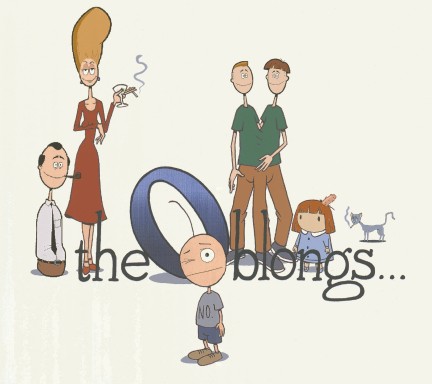
One by one, we meet the members of the family living at the bottom of the pipe. Bob Oblong (Will Ferrel) rises and shines. He is very cheerful for a guy with no arms or legs. He notes how cute his wife, Pickles (Jean Smart), is. She has no hair and wakes up still drunk enough that she’s not sure where she is. There are teenage conjoined twins in the shower. Bob reminds them to be thankful for their extra buttock. There’s a daughter who has something that resembles a cross between a penis and a pickle growing out of her head. We know the younger son, Milo, is the real focus since he’s introduced last. He’s busy sawing the foot board of his bed. We’re not told the exact nature of his ailment, but one eye is bigger than the other and he attends a special school. Where he needs a muzzle. Is this ridiculous enough yet? No? The cat smokes. Before you can even process any sense of plotline you are almost overwhelmed with over-the-top, bizarre images. You might be offended, if there were time.

As we head out to the bus stop it only gets worse. Everyone in this valley is some kind of mutant. The kids who go to “normal” school have too many abnormalities to take in at one glance. There are about four of them in assorted shapes and sizes, who hang out with Milo.

At the factory where Bob works he is surrounded by more valley freaks, and the rich guy from the opening, Mr. Climber, is his boss. Bob’s job is using his mouth to screw tops onto bottles of poison. (“The poison tastes different today,” he notes matter-of-factly.) The boss tells Bob that he has filed too many health insurance claims, and if he files any more he will lose his coverage. So, when the twins get in an accident, the family can no longer afford to send Milo to public school. There’s a pretty tasteless joke where the doctor is informed that the boys are conjoined twins. “Oh,” he says, “then it’s not as bad as I thought.” The jokes are like that; so out of left field you can’t help but laugh, tasteless as they may be.

Now that Milo has to transfer, the episode takes on a new-kid-at-school storyline. Like the Karate Kid before him, he falls for one of the popular girls, and gets beaten up by the popular guys. But the story is familiar for all of five seconds. It turns out the popular girl is an alien. She removes Milo’s brain for a quick look-see and then sends him on his way, smitten and outfitted with a tracking device.

We learn that Pickles is from the Hills, but relocated for love. She has a rival in Pristine, a mother of one or more of the popular girls. The popular girls come in a package deal; they all dress and talk the same and have the same name, Debbie.

The fun of this show is how sickeningly cheerful the Oblongs are in the face of adversity. They express worry and frustration at their day-to-day problems, but they don’t dwell on their big problems – the really big ones that are in your face the whole time you’re watching the show. Even the people from the Hills, although they think the Valley dwellers are icky, seem to have adapted to this way of life. That kind of juxtaposition makes the jokes spring up all over the place, like whack-a-moles. If you can get your head around how freaking weird this show is, it’s absolutely hilarious.

Spoiler alert. Milo doesn’t get the girl. His goth little friend burns down his club house, and thinking Milo is dead, the alien girl vaporizes herself.

Memorable quote: “I think I’ll hang around for a while and poke my first love’s remains with a stick.”

Being Erica

Okay, so this show looked a little cheesy when I saw it advertised while catching reruns of Gilmore Girls on the Soap network. It turns out the show, from the CBC, is a little cheesy, but it has several characteristics that intrigue me. It’s a little bit Wonderfalls (highly educated but dissatisfied chick suddenly has supernatural things happening, pointing her in the direction of her true calling); a little bit Journeyman (lots of sudden trips to the 90s); and a little bit Reaper (protagonist has frequent, unexpected visits from a jerk with supernatural powers who doesn’t feel the need to explain much). Also, Tyron Leitso, who played the recently jilted hottie in Wonderfalls, plays the recently jilted hottie in this. So off we go…

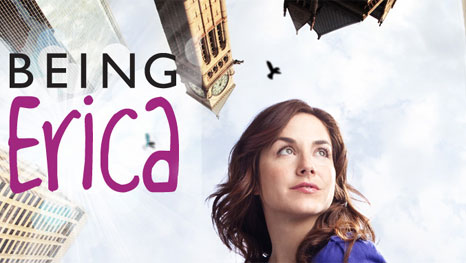
Erica Strange (Erin Karpluk) is 32. She works for an insurance company. She mentions that she still sleeps with her cat, although I can’t recall seeing a cat at any point during Season 1. And, she tells us, she has made an unending series of mistakes that have left her unfulfilled. She gets fired. The guy she has a date with cancels at the last minute. She gets caught in the rain, then has an allergic reaction to some hazelnut coffee. Your basic suck-ass day.

Erica is visited in the hospital by a mysterious therapist who appears out of nowhere and has an uncanny understanding of her sad life alone with her cat (again with the cat). “In the middle of difficulty lies opportunity,” he quotes. Thus begins a long series of quotes that make up the bulk of this guy’s conversation. He leaves his card, but one has to wonder why she would even keep it. Personally I can’t stand those elusive mentor-figure characters who speak in riddles and expect protagonists to follow their instructions without question. In a similar situation I’m sure I’d walk away, but then my story wouldn’t be a television series…

We next meet Erica’s family and friends. For complaining about how much her life sucks, she certainly has a good support system. At least half a dozen people rush over to brunch following her showdown with hazelnuts. It seems though, that she senses strong disappointment from these folks for not having a career or relationship. She runs off to find the therapist, Dr. Tom (Michael Riley). He’s waiting in a typical shrink’s office, dimly lit and lined with books. It could easily be the same set from the shrink’s office in Wonderfalls.

Dr. Tom is a little abrasive, a lot vague, and has no visible credentials. But he promises happiness. And he doesn’t charge. While it’s easy to criticize this story introduction as simplistic, one must admit the need to find happiness can eclipse skepticism, even in a reportedly smart woman like Erica. The show is fantasy – accept it and go along for the ride.

Tom instructs Erica to make a list of all her regrets, and it’s long. It ends with “Leo died.” That’s important later in the series, but we don’t get any details here.

The heart of the show is this. Tom can send Erica back in time to redo events that she regrets. We see by her trip back to a high school dance that these experiences won’t be easier to control the second time around. It’s not really going to be about changing the outcome of certain events. It’s about Erica learning things about herself. In this episode, she has to overcome worrying about what people think of her; a tall order for a high school junior. The flashback stuff is fun, with fashion, music, and slang from the early 90s. “Teenagers are idiots,” Erica declares. What a trip to reflect on yourself as a high schooler with 16 added years of wisdom.

This is just supposed to be a discussion of a pilot, but this is one show where you really have to hang with it. There are deliberate details everywhere that come together later in the season. For a show about time travel, Being Erica is completely devoid of science fiction. No flux capacitors, no Bridge Device. Dr. Tom quickly brushes off Erica’s question about the Butterfly Effect. This a soap opera that just happens to have time travel in it. Though I wasn’t blown away by the pilot, it was different and entertaining enough to keep watching. Let’s be honest. The real hook was, I know a few things about being a 30-something woman who graduated high school in the 90s, earned a literary BA and MA, and can’t find a profitable use for said degrees. And has a cat. (Where the hell is that cat?) So there. Erica is my new best friend.