Reboot!

It seems like you can’t go a day without hearing about another upcoming reboot of an old movie or TV show. Currently, viewers of the small screen are speculating about new takes on Charlie’s Angels, Wonder Woman, Beavis and Butthead, Dallas, Miami Vice, Teen Wolf… there’s even been the threat of a Bryan Fuller-helmed Munsters remake.*

A pilot for a reboot has a unique task. There is the assumption that most viewers are already familiar with the property, and there is going to be a niche audience that is much more than familiar. The diehard fans are poised to critique every detail.  So what makes a pilot for a reboot successful?

There are two ends of the spectrum when it comes to approach. At one end, the pilot could say to the viewer, “Forget everything you knew about previous incarnations of this property.” The story basically starts over, in the present day. V is an example. Viewers need not have a clue about the 1980s mini-series and following TV series. In fact, they might be better not having seen the original and having the whole lizard reveal spoiled for them.

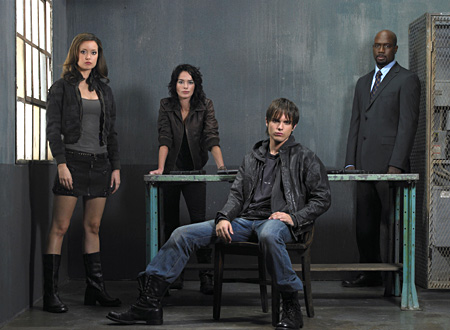
At the other end, a pilot can dive in to a storyline already in progress. Terminator: The Sarah Connor Chronicles does this really well. We last saw Sarah and son John in 1991, when John was about 12 years old, so the show now has to bring us up to 2008, when it debuted. The pilot opens in 1999 and, staying faithful to the timeline set forth by the movies, John is introduced as a teenager. We learn in the opening scene Sarah is haunted by the same nightmares of worldwide destruction that we remember. In order to get us to the right year, the writers have the new Terminator, played by Summer Glau, bring the characters forward in time to 2008. If you’re actually new to this, it’s likely you just won’t care about these characters. It’s also likely you’ve been living under a rock.

On the lighter side, 90210 stuck with the timeline set forth by its predecessor, Beverly Hills 90210. The newer show had some fun updating viewers on the lives of characters we once knew, even bringing some of them back so we wouldn’t always be stuck remembering them with hideous hairstyles.

According to Ramon Rodriguez, who has been cast as Bosley, the new Charlie’s Angels is set to go in a new direction. However, the movies already took a big step away from the camp of the original series. So what, exactly, are they moving away from? And do we care? Does a show’s pedigree matter, or only that it’s good?

There’s still a long way to go with all of the aforementioned reboots, and no telling how much restructuring they will go through on their way to the airwaves—if they even make it that far. Then will each one be a 90210? Or a Melrose Place? Once they debut, fans will no doubt have their expectations well in place.

*Here’s an update on the Bryan Fuller Munsters remake, 8/11/11
Project G.e.e.K.e.R.

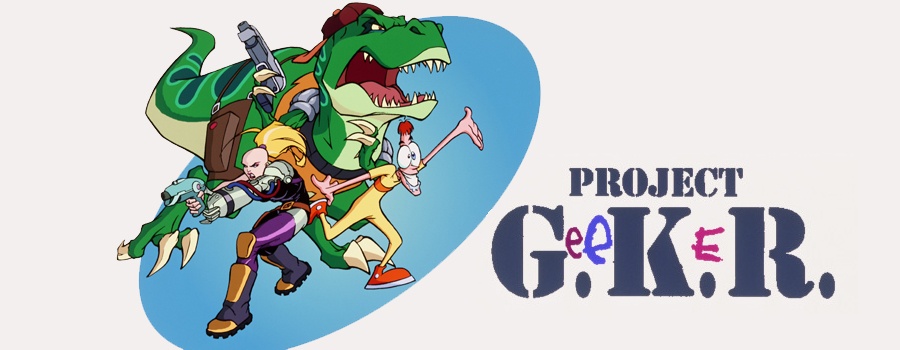
You’d be forgiven for having never heard of Project G.e.e.K.e.r., an animated sci-fi series that aired for just three months in 1996. And, you wouldn’t be crazy for thinking that the protagonist kinda looks like a worm; or that he sounds an awful lot like Philip J. Fry. Actually, the only two reasons worth watching this little show are that Doug TenNapel of Earthworm Jim fame created it and Billy West voices Geeker.

The animation is after school quality. After school in the mid-90s quality. We didn’t demand much from our animated series until later in the decade when we started to see more of it in prime time, with shows like Futurama and King of the Hill. Futurama fans watching Project Geeker today may get a brief second of déjà vu; both pilots open with a voiceover by the main character (played by the same dude, you remember) pontificating, “The future…” before explaining things to the audience. (Of course, in Futurama, it’s a goof, as it turns out that Fry is explaining a video game. Have I mentioned that Futurama rocks?)

As with a lot of kids’ shows—I’m assuming kids were the target audience—the premise is explained fully in the opening so the pilot could just as well be any random episode. The plot of this one doesn’t matter. Something about a destruct sequence. The overall plot of the series is that an evil genius, Moloch (Jim Cummings, most recently of Gnomeo and Juliet), is trying to track down the AI he created. The AI is Geeker, or Project GKR, and he wasn’t quite fully baked when he was stolen. Now he is in the hands of a voluptuous cyborg whom he calls Becky but who calls herself Lady MacBeth (Cree Summer, of a million different projects including Dragon Age: Origins). Brad Garrett, who I didn’t even realize has done a ton of animation, plays a big talking Tyrannosaurus who hangs out with them. The trio runs around trying to escape the reach of Moloch, while Geeker shape-changes, getting them in and out of various scrapes.

What else can I say? It’s a kids’ show. There’s a lot of noise and color and predictable jokes. The bad guy talks like a Bond villain. Geeker is kind of loveable, though. He’s one of those unlikely heroes who succeeds by screwing up. Kind of like Jar-Jar Binks. Wait, I said loveable. I don’t know, it’s a weird show. In prime time it could have been edgier and echoed the brilliance of the original Earthworm Jim game.

Square Pegs

Sarah Jessica ParkerGiven the current surge in nostalgia for the 80s, it’s a good time for Hulu to reintroduce the world to Square Pegs. From 1982, the show centers around two geeky high school girls trying to fit in. It stars Sarah Jessica Parker, even before Footloose and Girls Just Wanna Have Fun. Her co-star is Amy Linker who, according to IMDB hasn’t done anything since 1985. What I remember about this show is that the two lead actresses were on the cover of Dynamite magazine. Anyone? Dynamite magazine?

The show begins with the two of them talking, in voiceover, about their intentions to infiltrate the right cliques. “This year we’re gonna be popular,” the one with a slight Northern accent declares, “Even if it kills us.”

The pilot opens, as you might expect, on the first day of school. As the opening scene unfolds, at a pep rally, we learn that the one offering popularity instructions was braces-wearing Lauren (Linker). Glasses-wearing Patty (Parker) is her willing follower on the road to coolness. (See that? Glasses and braces are universal shorthand for geeky. Apparently Linker was also wearing padding to make her look fat, but she is only Hollywood fat, if anything.)

Lauren’s superior knowledge of who’s who gives the audience a chance to learn some names and ranks. The dreamiest guy in school is Larry Simpson. The most popular girl is Jennifer (Tracy Nelson – one of those Nelsons), who has a Princess Diana thing going on. Being popular also means talking with a Valley Girl accent, peppered with ‘like’s and ‘ya know’s. “Gross me out the door” she declares in once scene, prompted by nothing.

The pep rally scene also introduces Jami Gertz as Muffy Tepperman, the Patty Simcox of the group, and the token black student, L.D. The latter performs a song-and-dance number with the hideousness only the 80s could conjure.

For some reason the kids are dressed like it’s February, but forgetting that, the fashion paints us squarely in the 80s. Not in the send-up way that shows depict the 80s today, but realistically. )Seriously, we didn’t wear Madonna gloves and stirrup pants every day.) There are some really specific references to pop culture of the time too, like to a particular Budweiser commercial.

It takes a few scenes to get a feel for the tone of this show. Although it’s a half-hour comedy, it doesn’t feel like a sit-com. It’s single camera, with a lightly used laugh track. There’s a weightiness to it that would be seen in later shows like Freaks and Geeks and My So-Called Life, and still later, Glee. It’s nice to see high school girls drawn as intelligent and articulate, even if they do still turn to butter in the presence of dreamy senior boys. Although Patty is heartbroken to learn that Larry isn’t into her, she responds with, “Larry, you needn’t reproach yourself.” Actually, much of the episode’s humor derives from her intense seriousness.

Oddly, we never see any of the characters’ home lives. In a show of this kind, we expect to see fights with parents, rule breaking and groundings. The pilot takes us from the pep rally, to lunch, to gym class, and finally to a school dance. As a side note and further sign of the times, the Waitresses appear as the band playing the school dance. It’s as if the writers are letting us know that school is these characters’ whole world, which is how it often feels at age 14. “My life is over,” Patty observes at the end. And we know her life will end in some little way every week, because that what happens in high school.

Beavis and Butthead

MTV is going to reboot the 1990s animated series Beavis and Butthead, so it’s a good time to revisit the original. Beavis and Butthead got its start at Spike and Mike’s Festival of animation, which is no surprise; it’s weird and disgusting, and really edgy for a time when the edgiest animated series on TV was The Simpsons. The episode that aired at the festival, the pilot, was “Frog Baseball.” The episode labeled 1.01 on the DVDs now available is something different, apparently from about a year later.

The show, as it aired, interspersed short snippets of story with longer stretches of Beavis (creator Mike Judge) and Butthead just sitting on the couch commenting on music videos. The DVDs seem to contain only the in-between stories, which are pretty weak on their own, and not even that funny. (I’m guessing this is an issue with the rights to the music videos.) The couch sections were what made the show different and, dare I say, relatable, to anyone who grew up with afternoons that grew long and boring as summer vacation wore on, in the era when MTV played videos. Who doesn’t enjoy making fun of Milli Vanilli?

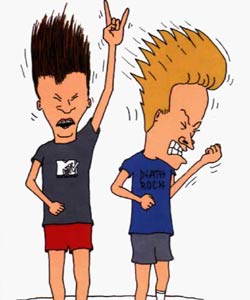
The “plot,” to use the term loosely, isn’t important in this pilot. It’s about, well, frog baseball, which is pretty self-explanatory. It gives us a chance to meet these two slacker kids who love blood and hard rock. They wear T-shirts emblazoned with the names AC-DC and Metallica. When the game goes well—well meaning bloody—the characters air guitar anthems like “Iron Man.” Butthead is the ersatz leader of the pair, and Beavis is even dumber than him, if that’s possible. The outdoor landscape is dried out and bleak, and knowing now that Mike Judge tends to set things in Texas… it’s probably Texas.

When they’re back home in front of the tube, nothing else in life seems to matter. There is nary a parent in sight and, in the pilot, we don’t meet any other characters at all. (Later there are various neighbors and classmates, including the inspiration for the spinoff Daria.) The slacker ethos pervades every aspect including the crappy animation. But, for all their apathy, B & B have strong opinions about music. They don’t articulate these opinions with any grace; stuff either sucks or rocks. If it really rocks it warrants lifting one’s hands in devil horns and headbanging. The animation quality actually seems to tick up a notch as the characters’ hair flies back and forth in heavy metal abandon. When, before 1992, did we see an animated character headbang? The videos alternate between terrible and what is now terrible but was then cool. If you ever liked Axl Rose, even a little, you can probably find something to like here.