Unknown's avatar

About meekthegeek

Writer, animal lover, environmentalist, pop culture fanatic, and Star Wars fan.

Pilot-y Tidbits from Comic-Con

H+

This new web series, produced by Bryan Singer, was teased to minimal fanfare–actually, lumped together in a panel with Mortal Combat: Legacy–but it looks highly promising. The premise is that a good chunk of the world’s population has been tied into some futuristic version of the internet, where information is downloaded straight to your brain. Due to a glitch, a third of those people have dropped dead. Those remaining are left to figure out what the frak happened. Here’s a trailer.

What sounds cool about this series is, you will be able to view the episodes (48 total) in the order of your choosing, organizing them by character, chronologically, or geographically. This approach capitalizes on the uniqueness of the medium, rather than just creating a show as one would for television and throwing it up on the web.

Effin With Tonight

This animated series created by former Tonight Show writer Jim Shaughnessy is set to launch on the web at Crackle.com. They screened a clip and it looks pretty damn funny. It stars Patrick Warburton (The Tick, Family Guy, Venture Bros., etc., etc., etc. This guy is in everything.) as well as Joe Cipriano (the voice of Animation Domination). It’s basically an animated late night talk show that parodies everything that Shaughnessy despised about his old gig. And, in the panel, he made no bones about how much he hated it. They’re hoping to take it to a network, but I can see it being about as successful as the equally irreverent and highly underrated Sit Down, Shut Up.

Writing for TV

This was just a random tidbit I picked up in a panel on writing genre TV. It used to be you needed to write spec scripts of existing shows to break into writing. Now, according to the panelists, there is more demand for scribes who have written their own pilots. Still no solid advice on how the hell you get that script into the hands of anyone who gives a damn, but one writer had an interesting story about how she wooed Joss Whedon.

Archer

This was not a pilot, but the first of three-part story arc that will run this September. It was too awesome not to mention. This mini-story takes our hero, “Duchess,” out of his usual surroundings at ISIS and places him on the high seas, and introduces a new character, played by–you guessed it–Patrick Warburton. There are pirates. ‘Nuff said.

Partial or complete pilots of a number of other shows were screened during the Con, including Terra Nova, Alcatraz, Person of Interest, The Secret Circle and Locke & Key. Reviews and opinions abound so I won’t rehash. But the fall season is looking up.
The Secret Circle and Locke & Key

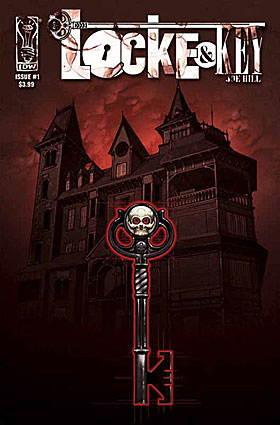
So far at Comic-Con I have seen two pilots, which bear several similarities. The Secret Circle and Locke and Key each begin with a parent gruesomely murdered by a mysterious villain, and children going to live with relatives in old family homes harboring secrets. Both involve elements of the supernatural.  That’s about where the similarities end.

The Secret Circle has lots of pretty girls and high school rivalries and a budding grandmother-granddaughter bonding story. Locke and Key is terrifying, set in a remote manor, and raises more questions than it answers. Which one do you think got picked up for the fall schedule? Yep… If you didn’t see Locke and Key at one of its two Comic-Con screenings today, you probably never will. And it’s a damn shame, because it’s awesome. Fox (who passed on it) probably wasn’t the right network. It looks like something one would see on AMC or even HBO. One of the concerns from fans of the comics was that the emphasis of the show would be too much on the mother character and less on the children. That fear turned out to be unfounded, and the audience in the screening room seemed delighted by the pilot.

I’ll write descriptions of both of these later. Too busy geeking out!

Breaking Bad

Bryan Cranston in Breaking Bad pilotBreaking Bad is gearing up for Season 4 this Sunday, which is sort of a spoiler in and of itself if you’ve never seen the show, but perhaps, like me, you are behind the curve. If so, here’s a look at where it started.

This pilot opens in media res–an intense scene where the hero is in deep s**t–before flashing back to tell us how he got here. It’s a technique used in everything from The Odyssey to Ratatouille. I must say, though, Breaking Bad threw me for a loop. Our hero, Walter’s (Bryan Cranston) life is such a mess when we open, I thought we were going to take a whole season to get there. It only takes one episode.

As the show opens, a pair of pants fly through the air just as an RV careens into view. It is driven by a pants-less man in a gas mask while another man is passed out or dead in the passenger seat and two others roll around the floor. The driver loses control and runs off the road, then grabs a video camera to record what we expect may be his final words.

No-pants is Walter Hartwell White of Albequerque, NM. He tells his family he loves them and, he says, despite what they are about to learn about him, “I only had you in my heart.” He leaves his wallet and the camera on the ground and steps into the dusty road aiming the gun at whatever is headed his way.

We then flash back three weeks, into “a day in the life” mode. It’s Walter’s 50th birthday and he shares a simple, low-cholesterol breakfast with his wife Skyler (Anna Gunn) and son Walter Jr. (RJ Mitte) Other than the fact that Skyler is a bit of a nag and teenage Walter Jr. is a bit of a smartass, they seem like a pretty loving middle-class family.

The next succession of scenes gives us a taste for how mundane Walter’s life is, but it’s not tragic. The writers could have made Walter into a Lester Burnham (American Beauty), and there are parallels, but Walter’s even more middle-of-the-road, if that’s possible. And, we have to like him to make this show work. Walter teaches a high school chemistry class, giving a presentation that you can see he thinks is snazzy and hip, which his students receive as if Ben Stein is teaching.

Next, Walter moves on to his night job at a car wash, where his boss bullies him into staying late–after Skyler has specifically asked that Walter not let this happen. He arrives home late to find a surprise birthday party in progress. Here we meet his brother-in-law, a loud-mouth cop who just made a big meth bust.  Walter’s curiosity about the bust, specifically the amount of money involved, is the first spark we see in him that he just might hold aspirations for something else.

As if to top off–or put into perspective–his sad existence, Walter soon learns that he has inoperable lung cancer. But for a guy who’s just gotten really shitty news, his luck seems to be changing. A series of serendipitous events including bumping into one of his former students while on a ride-along with his brother-in-law, leads him on a fast spiral into making crystal meth. He blackmails the former student, Jesse Pinkman (Aaron Paul), into help him, snags some lab equipment from the school and buys an RV, and there’s no looking back.

While Jesse is an arrogant, punkass kid who prides himself on the artistry of his “cooking,” Walter is his antithesis. Walter’s methods are meticulous and thorough. He’s the kind of guy who, if he’s going to commit crime, he’s going to do it the best he can. And that’s why we like him. He may be “breaking bad,” but he’s got fierce integrity and devotion to his family. A scene where he stands up to some bullies picking on his son in a store is inspired. It gives us a sense that being faced with death is giving Walter a new-found confidence. Walter turns out to be a genius at making meth, which leads him and Jesse to run afoul of some drug dealers, eventually leading to the chase scene we see at the beginning. But Walter doesn’t die. Or get arrested. Or suffer any consequences at all. It’s as if a condemned man is suddenly leading a charmed life; it’s a fascinating premise to kick off a highly original show.

Check out this post on how AMC has become a force to be reckoned with where TV drama is concerned.

The Brady Bunch

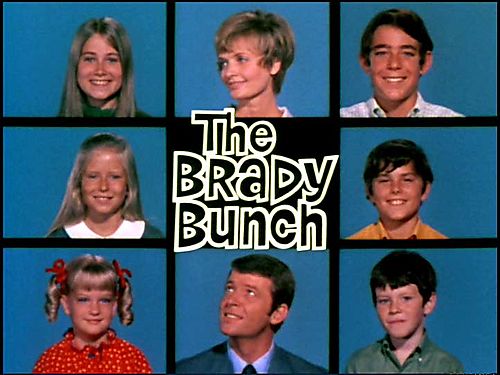
The Brady Bunch–the show as well the members of said ‘Bunch’–have been analyzed to the point where you might want to be beaten to death with a Tiki god statue if you hear one more Brady legend.  Here is some history. And it’s been referenced to death in pop culture. (I still love that bit in Reality Bites about how things don’t go back to normal after a half hour, becuase Mr. Brady died of AIDS.) However, yesterday’s news that Sherwood Schwartz died warrants a mention of this, his most enduring creation.

The pilot episode of The Brady Bunch, “The Honeymoon,” aired on September 26, 1969. Mike and Carol get married in Carol’s parents’ backyard. Then they leave on their honeymoon, only to find that they miss the kids so much that they go back for them–and thus begins five seasons of family love-hate. If you are from this planet you have probably seen it. If not, or if you’re feeling nostalgic, you can watch it here

Two things have always bugged me about this pilot. Although the former Mrs. Brady is mentioned when Bobby struggles with whether to put away his mom’s photo, why does no one mention the former Mr. Martin (Carol’s previous husband)? But more importantly, what’s up with the cat? Tiger, the dog, at least hung around for a few episodes, but the cat, Fluffy, was never seen again after the pilot.

Mary Tyler Moore

Mary Tyler Moore, a.k.a The Mary Tyler Moore Show is considered to be such a seminal work of television that I’m a little embarrassed to admit that I had never seen it before. In my defense, I wasn’t born yet when it came on the air. But, it turns out, the show is so relevant and, for lack of a better word, timeless, that it is thoroughly worth watching in 2011. Apart from the landline phones and typewriters dotting the set, it could be a show currently on the air. Even the clothes don’t look dated.

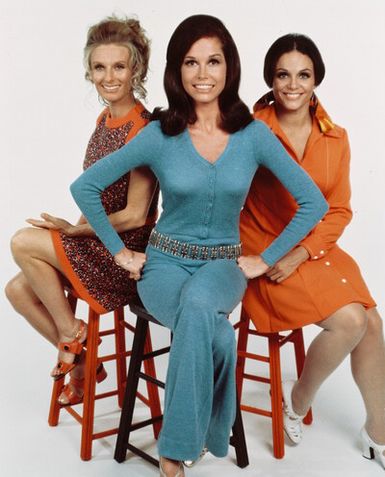
The show opens with the theme song–no cold open–and that sequence lays the basis; our protagonist is moving to a new city to make a new start, on her own. We meet the thin and stylish Mary Richards as she arrives to look at an apartment. Showing her the real estate is friend Phyllis (Cloris Leachman–OMG, that’s Maw-Maw!), with grade school-aged daughter Bess in tow. We learn that Phyllis lives downstairs while a woman named Rhoda, who Bess calls Aunt Rhoda, lives upstairs. Rhoda herself (Valerie Harper) is revealed a moment later, positioned from the start as a foil to Mary.

Phyllis is charged with the task of telling the audience Mary’s story, by telling it to Rhoda. For two years, Mary supported a doctor named Bill through his medical residency, only to find him unwilling to get married. A lot is implied with this story, both about women’s expectations of marriage in general, and about Mary as an individual. Even today some women might expect a marriage proposal as a given after two years of dating, in one’s late 20s. (It hasn’t yet been mentioned at this point in the episode, but Mary is 30.)

Mary’s decision to walk away rather than wait around could be given a great deal of discussion–about how it’s brave, liberated, self-respecting, or whatever. But they don’t waste time on that. And it although it may have been an unusual move in 1970, it’s been considered a worthy premise for introducing a strong female character ever since. (Rachel on Friends, Grace on Will and Grace, and Penny on The Big Bang Theory are positive examples. In the pilot of the more recent Happy Endings, the runaway bride character is treated more like a foolish bitch, while we side with the groom.) We could also look at Mary’s actions as petulant; if she can’t have a diamond ring she doesn’t want anything. However, any doubts about Bill’s worth as a partner are put to rest when we meet him later in the episode. He brings Mary stolen flowers and is generally oblivious to her feelings. The breakthrough was that this single female protagonist was a first. Now that it’s more common, it’s no less interesting.

Mary’s home life forms one half of the show’s world, while her new workplace forms the other. She arrives at a the studio of WJM-TV News to interview as a secretary, a job that has already been filled. The boss, curmudgeonly Lou Grant (Ed Asner) whisks her into his office to conduct an interview anyway. His inappropriate line of questions–How old are you? What’s your religion? Would you like a drink?–at first seem to be a sign of the times, ala Mad Men, but then Mary points out that his questions are illegal.

The character of Lou could have come off kind of skeevy, even intimidating, but instead he seems like kind of a teddy bear with a gruff exterior. He shows up at Mary’s house drunk and even though Mary suspects he’s hitting on her, it doesn’t really look that way to the audience–today’s audience, at least.

Mary gets the job of Associate Producer which, Lou tells her, pays $10 less a week than the secretarial job she came for.  “If you can get by on $15 less a week, I’ll make you Producer,” he says.” “No, no,” she says, “I think all I can afford is Associate Producer.” The humor flows naturally from the conversation this way. On my first viewing I didn’t even notice the laugh tracks — a sign that the jokes are genuinely funny. This one example of dialogue also illustrates Mary’s cheery outlook and, as Lou puts it, “spunk.”

There is no clear set-up for a love interest here, a staple of the modern sit-com. If this were done today Mary would no doubt have a gorgeous buy exasperating neighbor who she instantly hates. Instead, the Mary-Rhoda relationship fills this need, a much more interesting choice that  allows much room for exploring the lives of single women in the city. They continue to fight over the apartment throughout the episode, but the groundwork is there for a true friendship. “You’re really a hard person to dislike,” Mary tells Rhoda, who comes back with, “I’m having a hard time hating you, too.”

Clearly audiences found the whole cast lovable. Lou, Rhoda and Phyllis all got their own spin-offs. You can see why right from the start.

Titus, or Picking your Pilot

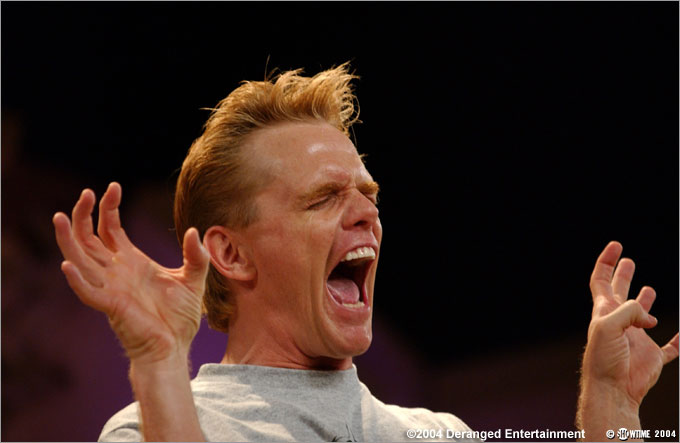
When comedian Christopher Titus got a development deal for a sitcom based on his stand-up routine, “Normal Rockwell is Bleeding” it could have been a slam dunk. Instead, his show “Titus,” despite getting decent reviews was cancelled after 3 seasons and some shark-jump-type changes that are usually a telltale sign of a show on the bubble.

(UPDATE: Please see Christopher Titus’s comment below. Network politics were to blame for the cancellation. And lest it seem that I didn’t like the show… I LOVED it. Just thought that first episode wasn’t representative.)

To say his routine is based on his true story of growing up in a dysfunctional family would be an over-simplification. Every comedian grew up in a dysfunctional family. But shows based on stand-up tend to be about family life, with relatively unattractive guys being nagged by better-looking wives and obnoxious kids, with love winning out over all manner of adversity.

In Titus, which debuted in March 2000, Christopher is a single guy still shell-shocked from what he’s been through with his insane family. (“Not as in, ‘your mom is insane,’ but as in, ‘We the jury find the defendant…'”)

It is remarkable when someone like Christopher Titus can not only survive what he went through but embrace it. If you don’t know the whole story watch “Normal Rockwell,” but suffice it to say his dad was the worst imaginable role model and his mom killed her husband and then herself. The series focused primarily on Titus’s relationship with his father, Ken, played with no redeemable qualities by Stacy Keach. His younger brother Dave (Zack Ward) is something of a sidekick, while his friend Tommy (David Shatraw) and girlfriend Erin (Cynthia Watros) round out the cast.

Word is that Titus wanted the episode “Dad’s Dead” to be the pilot. In watching the episode that actually aired as the pilot “Sex With Pudding,” you can see where the show may have gotten off on the wrong foot. It’s freaking awful. In the end, however, the show was cancelled for being too edgy. So maybe the blandness of “Pudding” was an attempt at a safer choice. It makes one wonder how it’s decided in what order a show’s episodes will air. Except in a show where the pilot involves heavy exposition and character introduction, there is some choice available. The first episode of Firefly to air was “The Train Job,” a great episode but not the “pilot.” Could a different choice have changed that show’s fate?

But back to “Sex With Pudding.” Isn’t that an awful title? The episode is not, like most of the others, set in the Titus household, the scene of so much of the referenced crime. It’s not about Christopher’s dad, or about his family at all, aside from the fact that his brother is always hanging around. It’s a stereotypical sitcom story about a jealous guy who thinks his girlfriend is cheating. It opens, as does every episode, with Titus talking directly to the camera in a dimly lit, sparsely furnished room. He talks to the camera about trust. His inability to trust, thanks to his parents, affects his relationship with Erin. But although trust is the theme of the episode, if you will, it’s a story we’ve seen a million times.

Most of the episode is set in Erin’s workplace, a bland office environment that might as well be Veridian Dynamics or Dunder Mifflin. Christopher makes an ass of himself going down there to try and gather evidence. Erin soundly reprimands him in a series of exchanges that tells us nothing about their relationship. And the big twist is, the person who has a crush on Erin, the person calling themselves “Pudding” is a woman. Shock me, shock me, shock me.

By contrast the episode “Dad’s Dead” captures the personality of the show. Christopher opens it with, “The Los Angeles Times states that 63% of American families are now considered dysfunctional. “That means we’re the majority.” He goes on to explain, “Normal people terrify me. They haven’t had enough problems in their lives to know how to handle problems when they come up.” And that’s really what makes him a good “character”–he’s been through some shit and come out stronger.

Titus arrives at the home his dad and brother share to find Dave freaking out. Dave thinks their dad may be dead since he hasn’t emerged from his bedroom for a beer in four days. See, that’s funny. Things get a little scattered midway through, when we meet a nurse that Ken is nailing, but that’s kind of a good thing. It’s not formulaic, and nothing is resolved by the end. Titus is just going to keep on living this life because it’s what he knows. And it will keep on making us laugh–and cringe a little, too. Would anything have been different if “Dad’s Dead” were the pilot?

100th Post: It All Started with a Big Bang

It wasn’t really The Big Bang Theory that inspired me to start this blog; it was Studio 60 on the Sunset Strip. But for my 100th post I wanted to write about a show that I really, really love but for some reason hadn’t written about yet.

Actually there is a reason. I’ve been holding out hope that I would someday get to see the unaired pilot and blog about that, but Chuck Lorre isn’t letting that particular Schroedinger’s cat out of the bag/box. In our minds it will remain simultaneously great and terrible.

…except for the cold open, available on YouTube here: http://youtu.be/jftzOTnB30I (No embed code, for some reason.)

Like the opening scene of the aired pilot, it’s set in a high I.Q. sperm bank, and the dialogue is similar. The main difference is that here, Sheldon Cooper (Jim Parsons) and Leonard Hofstadter (Johnny Galecki) have already made their “deposits,” while in the aired pilot they have a change of heart and leave. Personally, thinking that they couldn’t go through with it makes me like them a little better.

Even in the aired version, this scene feels tacked on, and a few things don’t quite fit with what we now know of the characters. Leonard makes a masturbation joke to Sheldon: “You’re a semi-pro.” (Sheldon? Really?) And donating sperm just isn’t the sort of thing Sheldon and Leonard would do. They never seem to lack for money and Sheldon seems incapable of anything remotely sexual. And Leonard just acts like a jerk telling the receptionist the answers to her crossword puzzle–sure, he’s smart but he’s not a jerk. (Weird trivia: both Parson’s and Galecki’s fathers died in accidents.) 

Once you get past that scene, however, the show comes to life. As the guys trudge up the three flights of stairs past the forever broken elevator in their apartment building, they get a glimpse of the beautiful, tan blonde (Kaley Cuoco, previously the jump-the-shark character addition on Charmed) unpacking in the unit across the hall. A lesser show would have had them do something like trip and fall or stutter when they talk to her. Instead, Leonard extends a heartfelt but off-kilter greeting.

In the original the guys meet a girl on the street—rather than a new neighbor— and let her stay with them. I can’t see them sustaining that plotline for very long. Perhaps the plan was to have the girl eventually take the apartment across the hall.

And who doesn’t love the theme song? It was almost “She Blinded Me with Science,” but the Bare Naked Ladies’ recitiation of the formation of the universe is infinitely more satisfying.

Many of the show’s recurring elements are introduced in the pilot: Sheldon’s spot on the couch, the broken elevator, Leonard’s previous relationship with Joyce Kim (who we later learn was a North Korean spy), and Raj’s inability to talk to women. Also, Sheldon wears a Flash T-shirt, the first in a collection.

One of the great things about TBBT is Penny isn’t just an empty-headed blonde bimbo, though unfortunately this is how she comes across in the pilot. Her reference to astrology acts as short-hand for “she’s a ditz” while her bangs give her a little girl look that she outgrows as the character develops. She even seems to talk in a higher voice than normal. Sheldon, on the other hand, is a little too astute about sexual proclivities. He knows Leonard’s intentions almost before Leonard does.

Raj (Kunal Nayyar) and Wolowitz (Simon Helberg) are introduced about midway. Their characters are fairly one-dimensional and would remain so for at least a season. That goodness they’ve come so far! In hindsight it’s kind of hard to believe that Chuck Lorre, the creator of such douchebags as the Harper brothers also created such loveable characters.

Though Sheldon and Leonard are introduced with equal weight, it’s suggested that Leonard is the one most desiring to sleep with Penny and is thus assumed to be the protagonist. As the show has progressed, it could be argued which one of the guys is actually the star. Sheldon continues to grow as a person, in the meantime garnering Emmy nominations for Jim Parsons, while Leonard has a followed a typical boy-pines-for-girl-gets-girl-then-loses-girl trajectory. Sheldon makes the show. Even on their Comic-Con panels, Parsons tends to grab the spotlight.

Throughout the episode the geek jokes abound, ranging from Klingon Boggle and Luke Sykwalker shampoo to complex equations worked out on a whiteboard just for fun, complete with jokes that no one without a Ph.D. would get. This stuff is just the icing on the cake, though. Although a good portion of us fans are no doubt geeks, the truth is most of us are somewhere in between the guys and Penny on the genius spectrum. We might have Lukeskywalker shampoo (or want some – do they have that at Rite Aid?) but we probably didn’t build anything that’s currently orbiting a moon of Jupiter. If you did, mad props.

…math, science, history, unraveling the mystery that all started with a big bang. (Bang!)

Lovespring International

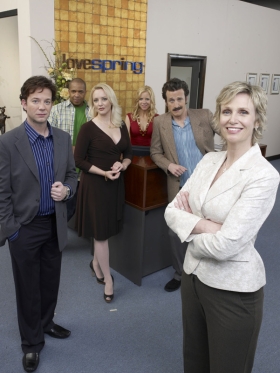
jane lynch lovespring internationalWe’ve probably had enough of the mockumentary format for TV shows. We had probably already had enough of it in 2006 when Lovespring International ran for one basic cable-length season. But damned if it doesn’t make a handy format for introducing all of your characters in a pilot.

The trick is to capture the essence of each character in a just a handful of lines. If you go back to the pilot of The Office and look at Pam’s face when she says, “Jim said mixed berry?” you witness a real where-it-all-began moment. But I digress…

Lovespring International was produced by Eric McCormack of Will and Grace (who guest stars in ep. 2). It was partially improvised and features a cast familiar to fans of improv/sketch comedy. We are introduced to Lovespring International, elite Beverly Hills dating service (located in Tarzana, CA) by each member of the staff telling us what they do.

Victoria Rachford (Jane Lynch) is founder and CEO. Burke (Sam Pancake) claims to “run the place.” Lydia (Wendi McLendon-Covey, of Reno 911 and more recently the inappropriate mother from Bridesmaids) is a Relationship Consultant who asserts that she can find a match for anyone and assures the viewer that she is “married in her heart” to her partner of 20 years. Steve (Jack Plotnik, also of Reno 911), the company psychologist doesn’t mince words about his job saying he is “in charge of weeding out the crazies.” Alex (Mystro Clark) directs client videos, making people appear hotter than they are. Tiffany (Jennifer Elise Cox) is the whiny blond receptionist smacking her gum. Burke reminds us repeatedly that he is in charge of all of these people–we see more of him than anyone else.

All of these introductions might be an effective way to introduce characters quickly, but it feels a bit like spoon-feeding the viewer. Introducing the characters this way tells us a couple of things: It’s going to be an ensemble effort. The workplace is going to be a constant battle of egos. And the irony is going to stem from a bunch of so-called relationship experts who suck at relationships.

The meat of the episode happens as the agency’s top gold-level client files a complaint that too many men are falling in love with her. Victoria, learning that the agency is in danger of losing a major client, threatens to fire someone if they don’t save the account. Lydia comes up with a plan, which Burke co-opts as his own and then turns into a disaster with the assistance of Alex and plenty of booze.

The character we get the least time with, regretably, is Jane Lynch’s Victoria. She is just returning from a vacation in this ep. and it’s looking like her repeated absences are set up to become a bit.

The whole show has a sketch comedy feel that prevents the viewer (me, at least) from feeling really invested in the characters. Maybe it’s the improv element, the mockumentary format, or maybe it’s just the actors’ clowny make-up. It feels like, perhaps they might have grown on you over enough time. The Office felt really weird and cartoonish in the beginning (and the pilot wasn’t well-received), but after a couple of season you could say stuff like, “That is so Dwight.” Maybe the Lovespring crew could have grown on audiences if they had been allowed to hang around long enough.

Veronica Mars Season 4

So this has nothing at all to do with pilots, aside from the fact that the show in question has one of the best pilots ever, but it is so completely awesome that I had to post it. It’s unaired footage from Season 4 of Veronica Mars. No, there never was a Season 4, but this gives us a little taste of what might have been after that incredibly frustratingly open-ended series finale. I guess it’s been hanging around the web a while, but I just discovered it.

Our little girl made it to the FBI–and what a great frakking premise for her first assignment!


I guess the world will never know whether Keith was elected sheriff.

Archer

You can literally blink and miss things in this pilot*. Watch it twice. Or three times. First just let the absurdity of the situation wash over you, then go back and soak up all the sight gags and the often casually tossed-off hilarious dialogue. Then absorb the animation; it’s amazing, with remarkable depth of field and subtlety of facial expressions. In the scene where Archer is eating breakfast, pause it and just look at the detail of the food on the table; it’s gorgeous.

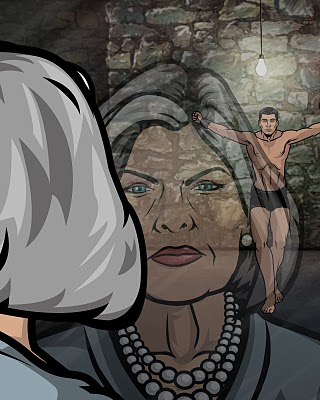
The first moments of the pilot give you the idea you’re watching something really dark. Our hero, Sterling Archer/code name Duchess (H. Jon Benjamin), is about to be tortured for information by an old guy with a vaguely Russian accent and a golf cart battery. But the female face that appears on the far side of the observation window looks far more intimidating.

Thus we have our set-up. Archer is a super spy who works for his mom (Jessica Walter). As evidenced by their first scene together, they’re a solidly matched in toughness, narcissism, and vitriol.

Acher’s uniqueness is its successful mash up of spy action with workplace comedy. It’s like if the chick from Alias went to work at Dunder Mifflin. At ISIS, we get pithy axioms like, “When your co-workers put food in the refrigerator, that’s a bond of trust.” They worry about expense accounts and break room etiquette.

Natch, there’s intra-office schtuping. Archer used to date machine gun-toting uber-bombshell Lana (Aisha Tyler). They broke up over–you guessed it–his mommy issues. This woman scorned is now with Cyril (Chris Parnell), who has no earthly business dating the likes of her. He is so painfully dull that his scene with Archer is literally the only boring moment of the episode.

Archer is sleeping with the secretary, Cheryl or Carol. He can’t get her name right. Remember that–the joke lasts beyond this episode.

Archer pretends he thinks there’s a mole in the office, as a ploy to gain access to the ISIS mainframe. When he is forced to break in, he reveals how painfully inadequate the company’s security is. It turns out there is a mole in the office and he is only caught by complete accident.

This thing is just packed with oddball lines ranging from the unexplained “that thing with the mayonnaise” to the twice-used “Johnny Bench called.” (Look it up. I had to.)

The pilot gives a taste of what every episode will be about; It’s not that the agents are complete bumbling idiots. That would be too easy. They’re totally cool and skilled, it’s just that their extreme self-interest blinds them to half the stuff going on around them. And they hate each other, but it’s as a team that they somehow win the day.

And, whether Archer loves his mother or hates her, he does so too strongly to be healthy. At any rate, they’re eerily alike from their piercing blue eyes, revealed in the pilot’s first moments, to their peculiar vehemence about ants, revealed in the last.

*This is actually episode 1.1, “Mole Hunt.” There is an unaired pilot available on DVD through Amazon.