Unknown's avatar

About meekthegeek

Writer, animal lover, environmentalist, pop culture fanatic, and Star Wars fan.

Pilot Types

Pilots tend to fit into one or more of a handful of categories. I don’t know if writers consciously choose among these when they set out to write pilots, or if it just happens organically. So this is a list of my own creation, which I will add to over the next several days. Let me know if you can think of others to add.

1. First Day on the Job/First Day of School

This is a super easy way for a writer to introduce a bunch of characters, since the protagonist is meeting them for the first time, too. Usually there will be a mentor character that tells the protagonist things that we, the audience, need to know about the setting and characters. The mentor will say a lot of stuff like “Look out for Bob, he’ll steal your lunch.” If done well it won’t sound contrived.

Examples: Scrubs, Beverly Hills 90210, Neighbors from Hell, Community, Privileged, Ugly Betty, Sit Down Shut Up, WKRP in Cincinnati

2. New Kid in Town

This can work in tandem with #1, a close relative. The character(s) might just be arriving in town and meeting the neighbors, sans jobs or school. It is especially handy for spin-offs; we already know the character but need to learn about a new location.

Examples: Buffy the Vampire Slayer, Angel, The Cleveland Show, Haven, Make it or Break It, The Riches, Joey

3. Happy Birthday, Dear Protagonist

This could actually be any significant date: the protagonist’s birthday, the anniversary of a life-changing event, or the day someone moves into a new life stage, like getting married or divorced.

Examples: Reaper, Chuck, The Brady Bunch

 4. Prodigal Son/Daughter or You Can’t Go Home Again

In this one, a protagonist who has been away returns. Usually that person has changed in some significant way, or else the place that person is from has changed.

Examples: Bones*, Jericho, Studio 60 on the Sunset Strip, Free Ride

*Bones doesn’t really fit any category I can identify. That’s why I love it. Read this post to see what I mean.

5. R.I.P. Main Character

This is most fun when the person who has died will go on being a character on the show. Otherwise it becomes a how-to-cope-with-loss story.

Examples: Dead Like Me, Pushing Daisies, Brothers and Sisters

 5. Howdy, Neighbor

The protagonist(s) get a new neighbor, for better or worse. This could also be a new roommate or officemate.

Examples: Big Bang Theory, Three’s Company

6. The First Day of the Rest of Your Life

This one is my favorite. It gives a reason for the show to exist; that the protagonist is starting a new journey, but in a totally natural way. The pilot isn’t forced into a birthday or first day of work, it grows out of the nature of a character. (Often, episode 2 is the First Day on the Job). This can happen in two ways; either the protagonist makes a conscious decision to change his/her ways, or the universe decides for him/her. Maybe the person almost dies and decides to lead a better life. Or maybe wax figurines start talking to her. This often works along with the Significant Day, but is even better when it doesn’t. A popular spin on this recently has been people having kids appear in their lives that they didn’t know they had.

Examples: My Name is Earl, Futurama, Sex and the City, Wonderfalls, Heroes, How I Met Your Mother, Friends, Chuck, Being Erica, The Riches, Glee, Life Unexpected, John Doe, Dollhouse
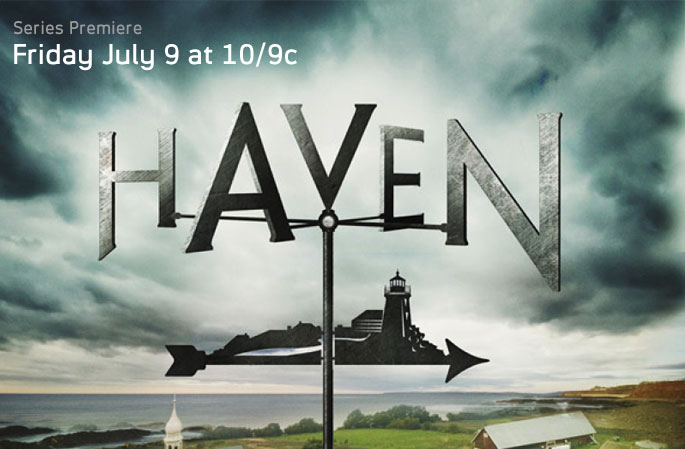
Haven

Some pilots don’t have to work very hard. Even if you don’t know that Haven, a new show on SyFy, is based on a book by Stephen King, you’ll likely figure it out pretty fast. A lone cop is sent to a small Maine town filled with colorful characters where something of a vaguely sinister super-nature is going on. Other things we already know: FBI agents and local police officers don’t get along. Female cops work super hard and don’t have time for dating. People who live on boats are odd.

So, putting all of those givens into place, let’s get to know Agent Audrey Parker (Emily Rose). A quick couple of aerial shots show us she lives in a big city. Her boss shows up with an assignment, pausing to comment on a teen vampire novel on her table. “FBI is nonfiction work,” he pontificates. Huh?

Agent Parker gets to Haven, a small harbor town with exceedingly strange weather. You know when a town on TV has a quaint, cozy-sounding name like Haven, bad things are going to happen there. (Point Pleasant, Wisteria Lane.)  She’s driving along when a chasm opens in the road in front of her, forcing her through a guardrail. We never get an explanation for that. It’s funny though, when her car is hanging half-way off a cliff, that she takes the time to turn off the radio so she doesn’t have to die to an annoying 70s song. Her first confrontation with local cop—and soon-to-be love interest, no doubt—is likewise pretty amusing.

The show succeeds with witty dialogue more so than in other areas. There are some truly funny moments. The banter between the cop, Nathan, and Audrey is delivered with the requisite cynicism. The jokes kind of pop up out of nowhere, making them the one element of the unexpected in a show that is supposed to be suspenseful.

The reason Audrey is in Haven is forgettable in light of everything that ends up happening, but she’s supposed to locate an escaped convict. The problem is, he’s already dead. Like a good television FBI agent in heels, she doesn’t let that deter her. She starts nosing around the town, meeting its various denizens.

The stand-out for creep of the year is a handyman named Conrad with “personal space issues.” Whenever this guy gets pissed off there’s bad weather. You would think every school kid in town would be vandalizing his house hoping for a snow day. Spoiler alter. It turns out, though, that it’s not really him that’s affecting the weather. It’s the pretty antique store owner who he hangs around. Audrey wraps this one up nice and neat, so possibly each episode will revolve around a different resident with a bizarre power.

The A plot is that Audrey is an orphan (paging Temperance Brennan) and there is an old photo in the town newspaper of a woman that looks just like her. A quick scene of Audrey’s boss at the FBI having a cryptic phone conversation reveals that she was sent to Haven for a reason we’ve yet to discover.

This pilot is so pilot-y it’s just boring. It could have had a later point of attack and possibly been much more interesting. I for one, probably won’t continue watching to see what becomes of Audrey.

Top 5 Character Introductions in Pilots

A pilot episode has a lot to accomplish. It has to introduce a time, a place, characters, and relationships, as well as the tone and style of the show. Every once in a while, a pilot really nails a character introduction. In a moment, an audience meets a character and just knows that character. It might be shocking, it might be funny, but it’s memorable. I am sure there are many, many examples of which I am not even aware, but here are my favorites, in no particular order. If you have other suggestions, I would love to hear them!

1. Rachel Green (Jennifer Aniston) on Friends

At this point in the pilot, we’ve had a little while to get to know the other 5 members of the Central Perk gang. You don’t need me to review them. Ross is on the couch in the coffee house, lamenting the dissolution of his marriage. He whines, “I just want to be married,” and in walks this disheveled, rain-soaked bride complete with full-length veil. (Chandler counters, “And I just want a million dollars.”) Rachel hasn’t said a word, but her entry makes its own statement. You see a bride out of context like that and you know you’re in for a story.

2. The Devil (Ray Wise) on Reaper

Sam has already seen some strange sh*t on this, his 21st birthday. But as he’s cruising home from work in his parents’ station wagon, the smarmiest looking guy you’ve ever seen appears out of thin air in the back seat. “Is this a car-jacking,” Sam cries. “For this?” comes the response, “If it was an Escalade maybe.” After a few seconds of this fruitless back-and-forth the stranger reveals, “I’m not a carjacker. I’m the Devil.” Sam wrecks the car, and the Devil vanishes as quickly as he appeared. And that’s the kind of crap Sam is going to put up with for the next 2 seasons. This pilot gets better every time I watch it.

3. Sarah Walker (Yvonne Strahovski) on Chuck

What is cooler than a ninja? A ninja who turns out to be a super hot chick. In the episode, we have already met Sarah when she comes into the Buy More with a broken cell phone, but her true colors are unveiled when she shows up to steal Chuck’s computer. Each and every character on this show is awesome. But nobody makes an entrance quite like Sarah.

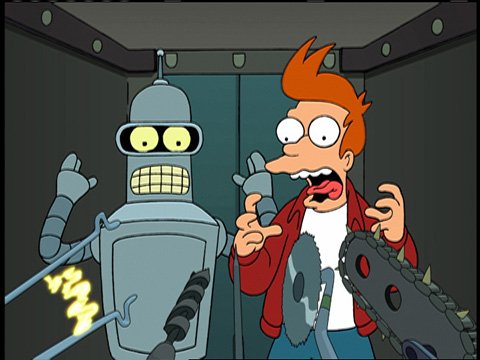
4. Bender Rodriguez (John Di Maggio) on Futurama

I don’t what is the best part of this character introduction; that there is such a thing as a suicide booth, that there is a robot in line to use the suicide booth, or that said robot wants to rip off the suicide booth with a coin on a string. On top of that, the viewer is in the same place as the protagonist, Fry: fresh out of the year 1999, with this whole new world unfolding more and more strangely by the minute. It’s funny, it’s bizarre, and it perfectly captures the tone of the show overall.

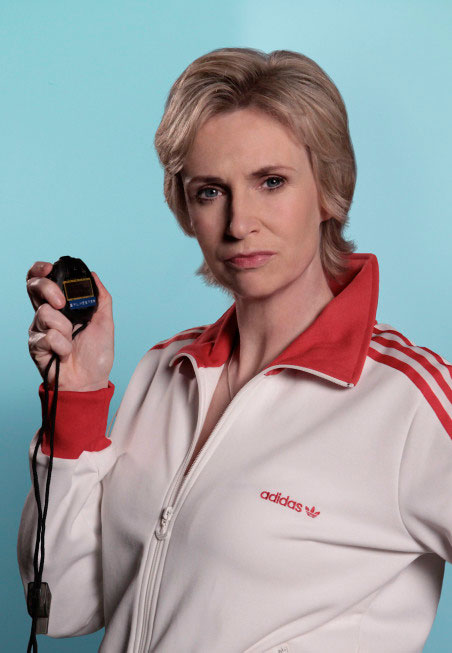
5. Sue Sylvester (Jane Lynch) on Glee

“You think this is hard? Try being waterboarded–that’s hard.” This first line by the sadistic cheerleading coach, the first, in fact, of the pilot, tells us everything we need to know. Although some unexpected complexity to the character was revealed later in the season, that uber-bitch, no-mercy exterior never faltered.

Futurama

Futurama fans are rejoicing. After being cancelled from Fox, then revived in the form of some straight-to-DVD movies, and given another shot with reruns on Comedy Central, the little animated show that could has returned with new episodes. And we didn’t even have to order any Subway footlongs. In celebration of the return (and the fact that the new episodes are hilarious, at least so far), I thought I would take an overdue look at the pilot episode of Futurama. I read once where someone referred to this as “the perfect pilot.” If not perfect, it’s pretty close.

When Futurama aired it was “the new Matt Groening show.” Fortunately for us and Matt Groening it is nothing like the Simpsons. The Simpsons does its thing—well—and Futurama does its just-as-witty- but-totally different thing. In fact, Futurama is more original. The Simpsons basically took an existing TV formula and animated it. Futurama mashed up situation comedy, science fiction, 20-something slackerdom, political satire and Y2K fear.

In the pilot we meet Philip J. Fry (Billy West), a pizza delivery boy with slouching shoulders and gravity-defying orange hair. His life is as miserable as we, the viewers, have ever thought ours were. He finds out his girlfriend is leaving him as she drives by him in a cab with her new man. He’s good at one thing at least, a 1980s-era video game that allows him to fly through space and shoot stuff. For anyone who ever fantasized that their gaming skills would come in handy in the real world someday, Fry is about to live out their fantasy.

Tonight it’s new year’s eve 1999. A newspaper headline reads, “2000. Doomsayers Cautiously Upbeat.” (It’s these simple little gags that fill every moment of the show with humor and make it worth watching over and over.) Fry, as the victim of a crank call, is delivering a pizza to a cryogenics lab when he falls into a cryogenic chamber set to thaw in 1,000 years. A montage of the next millennium shows us Groening’s satirical prophecies for the human race. New York rises, falls, rises, falls, and rises once more. There are many details worth slow-mo’ing.

Fry finds himself in the year 3000, in an unfamiliar New York City. The future has many of the things you would expect—robots, space travel, and flying cars—and many you wouldn’t. It’s got celebrity heads in jars and suicide booths. One of the funniest and weirdest scenes ever takes place when Fry meets the wisecracking robot Bender. “Well, I don’t have anything else planned for today,” Bender declares, “Let’s go get drunk!”

Next we meet Leela (Katey Sagal), whose job is to program other people with a chip that determines their vocation. Apparently their system is pretty accurate, because it labels Fry as a Delivery Boy. Leela is kinda hot considering she’s got one giant eye in the middle of her head, and there is no denying that she’ll be Fry’s love interest for the series. (We’re told she’s an alien, but a later episode will reveal otherwise.) We also meet Professor Farnsworth, who hires Fry, Leela, and Bender as his new flight crew aboard the Planet Express. And, voila, Fry is a delivery boy again. Context is everything; he couldn’t be more excited. Thus, Fry and the audience are off on a series of adventures.

It is brilliant how Groening can say so much about our own time with a story set a thousand years in the future. Bits of what happened since 1999 are filled in here and there like little warnings. And yet, some things never change. Human beings—and other species as well—will probably have the same neuroses in the future that they have now.

Angel

Spin-off pilots are their own breed. In some ways they have it easier than regular pilots, already having a waiting audience. For Joss Whedon creations, this effect is even greater. In other ways, they have it harder, since fans can be demanding. The pilot for a spin-off has to balance enough familiar information to let existing fans feel like they’re in on something, but still lay out the exposition and character introductions needed to get the series started.

In Angel, we’re reintroduced to the title character (David Boreanaz), now living in Los Angeles. He brings us into the setting with a few words describing the City of Angels (pun not spelled out but certainly implied), while he sits somberly in a dive bar. We get that the city is going to be as a much a character as anyone. Angel is drunk off his ass, and we could open a whole discussion on the chemistry of vampire intoxication, but not here. He is slobbering to the unwitting barfly next to him about the girl who got away, without naming Buffy. (For some reason, there is a giant rainbow flag hanging in the bar, but there is no other indication that it’s a gay bar. Or why Angel would be in a gay bar.)

Within moments our hero is dispatching with some evil vampires about to feed on some nubile young clubbers. It’s a big, bad comic-book style brawl that leaves Angel jonesing for blood. He heads home, to his dark basement apartment, to find a half-human Irishman named Doyle (Gleen Quinn) waiting for him. Doyle fills us in on Angel’s origin story and the Buffy-Angel relationship. Doyle is some sort of psychic with migraines. He’s got an assignment for Angel, to go meet a woman at a coffee shop who is some kind of trouble.

The girl is being hunted by a wealthy investor who turns out to be a powerful vampire named Russell. Angel tries to protect her, but she gets herself killed, and Russell decides to lure Cordelia (Charisma Carpenter), who is now an aspiring actress, into his lair. And some other stuff happens.

It’s best not to think too much about the plot. Everything happens a bit too easily: Doyle just pops in and Angel obeys without question, then Angel just happens to be at a party where Cordelia is, then the same vampire that kills the girl in the coffee shop just happens to have his sights set on Cordelia as his next victim. Angel, like Buffy the Vampire Slayer before it, succeeds more on its wit.

For all its action-packed mellowdrama, this pilot is full of laughs. Even Charisma Carpenter’s painful acting is saved by some great one-liners. My favorite is, when she calls Russell out as a vampire, she accuses: “I’m from Sunnydale. We had our own Hellmouth.”  Another one is, after Cordelia babbles on about her fabulous life and then walks away to talk to more important party-goers, Angel remarks, “It’s nice to see she’s grown as a person.” Other bits are more subtle and surprising. Angel jumps gallantly into his convertible to chase after bad guys only to realize it’s not his car.

David Boreanaz’s social awkwardness is just adorable. Lest we forget how beautiful he is, the writers remind us at least twice in this episode. As a character he is oblivious to his own hotness (vampires don’t have reflections, remember) which makes him that much more appealing. Darn it, he just wants to do the right thing.

So for Buffy fans or the uninitiated, this pilot is super entertaining. And it ends with a beginning, the launch of Angel Investigations, so it keeps the viewer coming back for more.

The Clone Wars

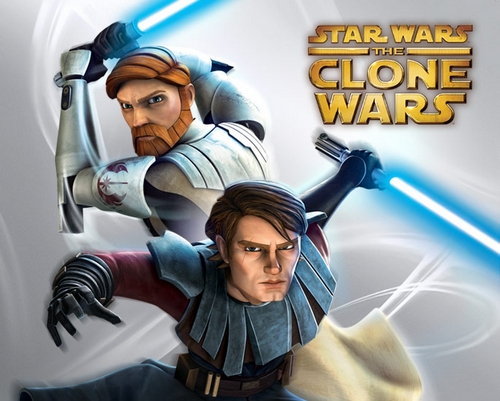
In discussing the animated series The Clone Wars, I’ve chosen to treat the movie as the pilot. It functions as one, more or less, but then this series doesn’t need a pilot in the traditional sense anyway. Anyone who hasn’t been living in a Dagobah swamp for the last 35 years has at least a passing familiarity with the Star Wars universe. There are only two signficiant new characters we need to meet here. (For purposes of this analysis I’m ignoring the 2003 TV series, Clone Wars.)

To talk about a Star Wars movie experience you have to start even before the characters appear on screen. At the opening we get the thrill of the “A long time ago…” caption followed by the triumphant appearance of the yellow title logo we know and love (modified with the new title, obviously.) We’re pumped. But instead of a crawl, we get a voiceover reminiscent of a 1940s newsreel. It’s just as boring.

As in the other films, this one doesn’t weigh us down for too long with talk of trade blockades and treaties, although it does start off that way. We jump into the action of battle as Obi-Wan (James Arnold Taylor) and Anakin (Matt Lanter) lead a corps of Clone Troopers against some spindly-legged robots (which look a lot like the robot from The Incredibles).

Once our Jedi heroes dispatch with the enemies they discuss the impending arrival of Obi-Wan’s new padawan. Right on cue, the new character Ahsoka (Ashley Eckstein) shows up–only Yoda has assigned her to train with Anakin, not Obi-Wan, much to Anakin’s chagrin. Thus we get our Reluctant Partnership, staple of cop shows and romcoms.

(I’d like something clarified. Exactly what is the age requirement to train as a Jedi? Mixed messages on this abound throughout the films.)

The first thing we notice about Ahsoka, besides that she looks like the victim of  spray tanning accident, is that she’s really freaking annoying. Sure, she’s supposed to annoy Anankin, but why us? Just thank the Force they don’t mention her midichlorian count.

The other character to be introduced is from a separtist Sinead O’Connor-looking creature called Ventress. There is not much to say about her at this stage except she’s bad.

After Act I we move on to a plotline where the Jedi have to rescue Jabba the Hutt’s infant son. (Which begs the question, how do Hutts reproduce?) It turns out the rescue mission is a frameup by Count Dooku to make it look like the Jedi are trying to kill the mini-Jabba. Padme Amidala comes along to assist. She looks and sounds pretty cool, probably the least cartoony, if that makes sense, of all the characters. There is just the briefest reminder that Padme and Anakin’s relationship is a secret, which sets up lots of possibility down the road for series plotlines. It is when her character is introduced that we get some variety to the action, cutting between her scenes and Anakin’s. You can’t even call it a subplot – the story is pretty much one thread.

So what works and what doesn’t about this pilot? The good: Obi-Wan, a consistently interesting character from all six previous films is back. Yoda looks fantasic animated. And Anthony Daniels as C3PO. The bad: Samuel L. Jackson as Mace Windu. Doesn’t he have other stuff to work on? Can’t he go away and let us forget that “This party’s over” ever happened?

Possibly the biggest problem with this is that it can’t seem to decide whether it is for kids or adults. It’s like what happened to Return of the Jedi with all the Muppets, and to Phantom Menace with all the Gungin nonsense. The best thing, though is this: After years of hearing about the Clone Wars, we actually get to see the Clone Wars! The show has certainly found success, with season 3 set to begin in fall 2010, and enough merchandise to choke a Hutt.

Neighbors from Hell

I am always up for a new animated series, especially one that is NOT by Seth MacFarlane. (Nothing against him, he just has enough airtime.) Neighbors from Hell is being promoted by TBS as “from the studio that brought you Family Guy,” but is written by Kyle McCullouch (South Park). There is little resemblance to Family Guy. Except for the dog—I”ll get to that.

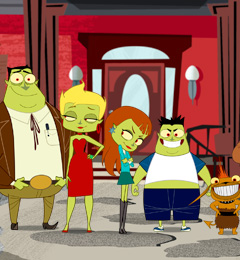
This pilot takes no time at all to introduce the premise: a demon is assigned by his boss, Satan, to transfer to Earth where he will infiltrate and bring down an oil company called Petromundo. We’ve seen the misfit-family-moves-to-new-neighborhood premise before. What makes this one a bit different is that all of the information Balthazar Hellmanneighbors from hell and his family have about Earth comes from watching television. So, we know we’re in for tons ‘o references. What I don’t get however, is why there is a 20-year delay on shows getting to Hell. I mean, it’s not England. They are watching Growing Pains, Alf, and The Cosby Show. That’s not the only thing that is out of date…

Characters are introduced with no unnecessary fanfare or backstory. The main character, Balthazar, has a wife, a son, a daughter, an uncle, and a dog that talks and seems smarter than the rest of the family, ala Brian Griffin. He winds up being the dues-ex-machina that undoes the mess the family finds itself in, and we can surmise that will be his ongoing role.

It is too perfect that this show is hitting the airwaves right now, as the villain (not Satan mind you, the real villain) is an oil company. The company is devising a giant drill that will bore to the center of the Earth, ostensibly disrupting life in Hell. Apart from that coincidence, some of these jokes seem like they have been gathering dust for a while. A demon tortures a damned man by making him listen to Britney Spears’ “Oops I Did it Again.” How old is that song? We’ve also got some jokes about Ugg boots and Criss Angle. The funnier jokes are the ones without an expiration date. Balthazar walks into the house to find bodies all over and inquires calmly, “Tina, did you kill the neighbors?”

The story seems headed for a quick resolution as Balthazar plots to destroy the engineer who is in charge of getting the drill up and running. Toward the end we find out what will give the premise an excuse to last past the first episode; the fact that Balthazar—aw, shucks— likes the guy he needs to destroy. There is also a racist neighbor how apparently practices beastiality with her poodle, and another who’s addicted to Valium. But, um, where are the TV references? The writers teased us with the possibility of Kirk Cameron jokes and there’s not a one.

The animation style is refreshing. (i.e. It doesn’t look like a Seth MacFarlane show) It’s stylized, and deceptively kid-friendly.

This pilot is all over the place. It has the feel of having been revised and rewritten to within an inch of its life. Not sure if that’s the case, but we’ll see where it goes.

Drop Dead Diva

When I saw the ad for this show on Hulu, it looked so schlocky and awful I couldn’t resist. And now various cable channels are plugging the hell out of the Season 2 premiere, guest starring—and this should be a red flag—Paul Abdul.

 The show opens with a blond bombshell nervously preparing for her big new job – as a prize model on The Price is Right. I have to admit that’s pretty funny. Her perky self-doubt is reminiscent of Elle Woods. In a parallel story with no immediately obvious connection, an ugly-by-television-standards woman is getting chewed out by her bitchy boss. Her co-worked, played by Margaret Cho, hits us over the head with some exposition.

In the show’s first five minutes both characters are unexpectedly killed and we’re vaulted into a bright white afterlife processing office, where a Scott Baio look-alike informs the blond-whose name I still haven’t been able to catch by this point-that she is completely neutral on the good/evil scale. The absence of good or evil, in this universe, is shallowness. The hot blond is shallow. He had to look that up in a database. She pushes a button on his keyboard and is beamed up into a stream of light, then wakes up in a hospital bed in the body of the unattractive character. Her name is Jane. I got that one. Plain Jane, couldn’t be more obvious.

There are too many stereotypes at work here to get through the pilot. I made it to minute 14. If you’re going to make a show about the afterlife, you have to find something creative to do with it. Call Bryan Fuller for tips. Furthermore, haven’t we made it past the assumption that brains and beauty are mutually exclusive? Did we learn nothing from Legally Blonde? Television lawyers are another area that has been hunted to extinction. High pressure, high heels, blah, blah. The ONE area where this show chose to stray from the predictable is they made Margaret Cho not funny.  How has this show lived to see a second season?

White Teeth

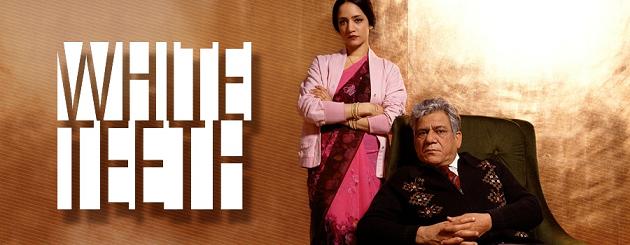
“You have picked up the wrong life in the coatroom of existence.” Who hasn’t felt that way at one time or another? This sentiment, uttered by Samad Iqbal (Om Puri) to his old war buddy Archie Jones (Philip Davis) encapsulates a theme that permeates the pilot episode of White Teeth.

The pilot of this UK drama, based on the eponymous book by Zadie Smith, is rife with moments. Like an older woman making her way along a row of apartments painting “666” on the windows. Or a man flipping a coin to decide whether to kill himself. It doesn’t matter that it’s 1974, because these oddities transcend time.

There are many characters to introduce who, in the beginning, have no clear connection. As readers of the book will know, there are many yet to come, and decades to cover. But this is one of those pilots that eschews exposition in favor of setting a tone. As relentless as the London rain, life’s dark moments wash over these characters wherever they go.

As the show opens, we’re driving through a dreary, dark neighborhood that the narrator (Archie) informs us is Willesden, “the kind of place a man goes to die.” As Archie sets up his car to asphixiate him, we flash back 3 months to meet teenager Clara (Naomie Harris). She is singing with abandon to her bedroom mirror. Her pure joy makes her instantly likeable. Described as homely in the book, she is actually quite cute save for her frumpy duds (and totally unrecognizable as Tia from Pirates of the Caribbean.)

The bleakness of the show echoes that of the book, but offers the added bonus of music, strategically used to juxtapose the action and make it that much more ridiculous. Clara’s singing moment is instantly silenced by her strictly religious mother’s entrance. Archie’s death-to-disco is interspersed with bouncy Indian music inside the meat truck that will momentarily save his life. It’s no spoiler that Archie lives — he’s the main character.

Archie’s world finally collides with Clara’s at an End-of-the-World party on New Year’s Eve. Clara, a Jehovah’s Witness has long been preparing for Doom’s Day, first by distributing warning pamplets, then by living it up having sex in public bathrooms. She has informed her ragtag band of friends of the apocalypse, and they count down to midnight dutifully. (Why does everyone assume the world will end according to their own time zone?) When our two misfits wake up in each other’s arms, they are plunged headlong into a new dawn. They have picked up new lives from the proverbial cloakroom. Thus begins their May-Decemeber romance, referenced by the episode’s title, “The Peculiar Second Marriage of Archie Jones.”

Deaths of 80s TV Stars

With the recent passing of Gary Coleman and now, Rue McClanahan, I have been hoping to locate the pilot episodes of Diff’rent Strokes or The Golden Girls. (I haven’t come across them online, so I may have to go old school and drive over to Blockbuster.) And, who can forget that Andrew “Boner” Koenig from Growing Pains took his own life not long ago? It gets you thinking about how a character can make such an impression. It is as if we all knew Arnold Jackson, Blanche Devereaux and Boner personally. When you’re a kid, especially (as I was when these shows aired) the folks you hang out with for half an hour a week can seem as real as your neighbors. We laughed with them through their daily mishaps, and cried with them in the “very special” episodes.

So without rewatching the pilot of Diff’rent Strokes, I can still share this part from memory. When the kids arrive at Philip’s house, Arnold brings along his pet fish, which is black, and which he introduces as his goldfish. Philip says, “I’ve never seen a black goldfish before.” Arnold replies, “That’s okay, he’s never seen a rich white man before.”

Okay it’s not brilliant, but it sticks with me 30 years later. Thanks, Gary, Rue, and Andrew for the memories.