Modern Family

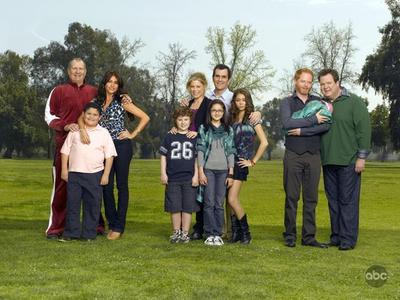
I’ve been feeling like I missed the boat on Modern Family, having pretty much ignored it last season. But since it made such a great showing at the Emmy’s and sounds like it’s here to stay, I figure I check out this pilot. If you haven’t watched it yet, maybe this will help fill you in, too.
The show opens in sit-com 101 mode, with a family starting their day with breakfast in the kitchen. It hits you with a good guffaw right at the top. The dad is yelling for the kids, and the daughter enters with, “Why are you guys yelling at us when we’re way upstairs? Why don’t you just text us?” After that there’s a bit about the daughter’s skirt being too short and the parents having baby oil on the bedside table. These may not be the most original jokes we’ve ever heard about offspring and ‘rents, but they’re delivered pretty fast and furious. This show isn’t going to waste our time. Continue reading

Raising Hope

This intent of this blog isn’t to give you reviews of all the latest shows, as there are many fine websites already doing just that. I like to look back at shows with the perspective of time, especially after they’ve been cancelled—it’s just more fun that way. That being said, with all the new shows premiering last week, only one stood out to me as not totally sucking so I figured the pilot deserved some discussion.

Anyone who has watched Fox in the past 6 weeks really didn’t need to watch this pilot for the premise, since the whole thing was spelled out in the previews. The “from the producers of My Name is Earl” angle was played up heavily and most of the great jokes were given away. So, this was one of those pilots you just want to get out of the way and start watching the show—because the show is freaking hilarious.

A quick rundown: a 25-year-old living with his parents and working a dead end job ends up solely responsible for his illegitimate daughter after the child’s mother gets the electric chair. Dark enough for you? Even without knowing about the “Earl” connection, the tone and look of the show give it away. It’s got this slightly dreary feeling, filled with objects so out of date, you can’t be sure of the time period at first. It could be 1980, or these people could just have really crappy furniture. It also has the loopiness that allows us not feel guilty as we watch a baby being flung around the backseat of a car. Yet, it retains a sweetness. It’s darker than, say, “Malcolm in the Middle,” but it’s not quite “It’s Always Sunny in Philadelphia.”

There are some unexpected moments in the pilot. After the main character, Jimmy (Lucas Neff) dramatically tells off his boss and quits his job, he comes home, where we learn that said boss is also Jimmy’s dad (Garrett Dillahunt). The other thing not seen coming in the previews is the flashback idea. Flashbacks can sometimes be used for lazy storytelling, but these are very effective, endearing us to the mother and father characters, and adding depth. The scene toward the end of the (grand)parents singing to the baby is very sweet amid all the crudeness. Not that the crudeness is bad… puking on a baby at the sight of a dirty diaper… that is some funny shznit. It’s too bad it was revealed in the preview. Here’s hoping that subsequent episodes are just as funny, and these characters will become as loveable as the Hickeys.

Web Therapy

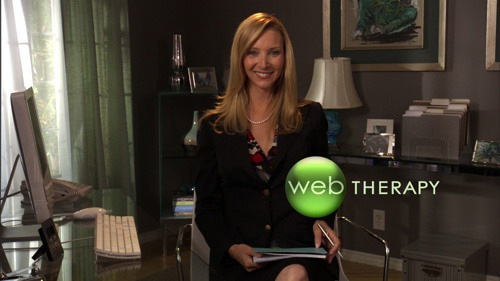
When Lisa Kudrow first looked at the camera, smiled her patronizing smile and said, “Hi, I’m…” I swear I thought she was gonna say “Regina Phalange.” It’s always an adjustment to accept an actor we’ve watched for a long time as one character, as another. And this Fiona Wallace character has the air of Phoebe Buffay putting on her Regina alter ego. In other words, she’s not exactly natural. But that’s not the idea. This pilot lets us know immediately what tone it’s going to take.

We see the desktop of Fiona’s computer as she gets to work conveying the show’s premise. She is a therapist (legitimate?) treating people via the web in three-minute sessions. The pilot is actually seven minutes long which, when we’ve been prepared for three, feels a bit long. The funny thing about media made for the web is we demand brevity.

Visually, it’s super simple, and it’s really just one joke. Fiona is treating a nerdy man named Richard. They greet each other with “it’s so nice to see you,” etc. even though it’s the first session, so we’re prepared for a history. It slowly comes out that they’ve had a relationship, possibly romantic. Each has his/her own perception of past events though, and both are a little nuts, so we’re not sure whose version of reality to buy.

Based on this first episode, the premise seems thin for an ongoing show, but somehow it’s in its third season. I haven’t watched to find out, but hopefully a season arc emerges, keeping the viewer coming back. Perhaps we haven’t seen the last of Richard; but how much sexual tension can you build showing two characters who aren’t even in the same room? Web shows tend to figure these things out as they go.

Friends

How have I not written about this before? I practically have it memorized. But let’s be honest , the first season (or 2) of Friends was pretty bad. But clearly it resonated way, way back in 1994 despite all those atrocious hairstyles and the need to shove each character into a stereotyped package. (Ross is a nerd, Rachel is spoiled, Phoebe’s a flake, Joey is a womanizer, etc.) It took until season 4 to round it out to “married a lesbian, left a man at the altar, fell in love with a gay ice dancer, threw a girl’s wooden leg in a fire, lives in a box.” 

Eventually, each Friend become a well-rounded human being who we watched grow over a decade, but it was like the writers didn’t give us viewers credit for having the patience to get to know them. Who knows, maybe we wouldn’t have.

This pilot is so pilot-y. We are bombarded with back story, character quirks, and strained jokes. Everything is over the top: the hairstyles, the coffee cups, Joey’s accent. On the off chance that you haven’t seen it, the plot is that Ross (David Schwimmer) has just split from his wife, just as Monica’s (Courteney Cox) old high school friend Rachel (Jennifer Aniston) leaves her husband-to-be at the altar and runs off to Manhattan to get away from her suffocating suburban existence. Ross has had a thing for Rachel since puberty, and now the possibility of a relationship finally exists.

One thing we can observe from the pilot of Friends is that, although it’s purported to be an ensemble show, it’s really about Ross and Rachel. Always was, always will be. In this opening episode the other four are basically just comic relief. The jokes were pretty bad, too. Even Chandler is unfunny, for Chandler (Matthew Perry). The only part that makes me laugh out loud is when Rachel is on the phone to her father. She is all disheveled, still in her wedding dress, pleading with him for understanding. To paraphrase, she describes how everyone has always told her she’s a shoe and today she’s realized she’s a hat. There’s a pause, then: “No I don’t want you to buy me a hat. It’s a metaphor, Daddy!” So although she’s an ingénue, she’s wacky, and a solid comic actress (who gets funnier each season). You may have heard the story about how she originally auditioned to play Monica.

If for some reason you haven’t seen this, just watch one of the 500 channels that carry the show in syndication and you’re bound to catch it.

WKRP in Cincinnati

You might remember this sitcom from 1978. If you’ve ever lived in Cincinnati, you probably remember it better than most. The pilot launches straight into an opening sequence, with a person’s hand adjusting a car radio, searching around before landing on what will be the show’s theme. We’re led to understand that the city itself will play a part. There are lots of shots of iconic Cincinnati landmarks: Fountain Square, skywalks, the Suspension Bridge, Riverfront Coliseum, Riverfront Stadium… there’s even a billboard for Frisch’s Big Boy in the background of one shot. Interestingly, only two actors’ names are given during this sequence (Gary Sandy and Gordon Jump).

The story is motivated by the introduction of Andy Travis (Gary Sandy), the new program manager at a lagging, independent radio station. Starting with what we can surmise is a typical morning, we see the buxom receptionist (Loni Anderson) water the plants as sleazy salesman Herb (Frank Bonner) hits on her. Andy arrives, with a hint of a southwest accent, wearing a cowboy hat, and we know he’s different. We soon discover that he’s smart and articulate, traits which further separate him from the Midwestern hodgepodge.

The characters go on entering, one by one, each full of warnings for Andy about the high turnover of program managers at WKRP. Les Nesman (Richard Sanders) is the uber-dorky newsman. Arthur Carlson (Gordon Jump), the boss, cares more for fishing—in his office, no less—than actually working. Johnny (Howard Hesseman) makes the grandest entrance as a confused, sleep-deprived, cool guy (today we’d call him a hipster) who has gone by a different moniker in every city where he’s worked. Drug use is implied though not spelled out. Bailey Quarters (Jan Smithers) is the mousy office assistant, who may have potential to do bigger things. If anyone is going to hook up, it’s going to be Bailey and Andy.

The station desperately needs an update in format to survive, despite the wishes of its owner, Carlson’s conservative mother. Andy boldly changes the format, in an exciting and funny scene with Johnny. The chronically tired DJ comes alive with the switch over from elevator music to contemporary rock-and-roll. We enjoy his triumph as he rocks out, rechristening himself Johnny Fever.

As in many shows of this era, the laugh track is used to exhaustion. The thing is, the show’s a riot on its own. The jokes are pretty lowbrow, ranging from sight gags like Carlson’s casting a fishing line over his desk, to funny song titles (How Can I Miss You if You Won’t Go Away?), to plain old stupidity.

Today, there’s the added humor of, well, the 70s. Records! Eight-tracks! And scarily, the clothes don’t look that out of style. The real humor, though, comes from the characters. In some ways, WKRP is a predecessor to The Office, following people who manage to get through their workday by doing next to nothing. If computer solitaire had been invented in 1978, you can bet these guys would be playing it. Andy is Jim. Carlson in Michael. Bailey is Pam. Johnny is a male Meredith. Les is Dwight. No such comparison exists for Venus Flytrap, the charismatic DJ, who looks for all the world like a pimp, introduced at the very end as the episode’s final button. Les calls him a Negro – can you still say that on TV?

The Donna Reed Show

Remember how, for a while in the 80s, the 50s were super cool? I guess it was brought about by Back to the Future, possibly Grease 2, and most definitely Nick at Nite. I was all about that trend, dressing as a “50s girl” for Halloween complete with saddle shoes, and I wanted to be Mary (Shelly Fabares) on The Donna Reed Show.

Some pilot traditions remain unchanged for decades. This one opens with the getting-ready- in-the-morning sequence. The teen daughter, Mary, and younger brother, Jeff, are complaining to their mother over breakfast about how little they see of their pediatrician father. The tone seems pretty naturalistic. In fact, the dialogue is a little rambly by today’s standards. But I can imagine a viewer in the 1950s thinking “Gee whiz, this is a regular family like mine.”

Mr. (Dr.) Donna Reed practices medicine out of his home. In this episode, Donna (whose last name in the show is Stone) wants Dr. Stone’s colleague, Bo, to cover his practice for the weekend so that the family can take a much-needed holiday. Bo and Donna are a little flirty, and if this were on the air today, we would swear they were destined for a hook-up.

Dr. Stone has to cancel the vacation so he can testify for a friend in traffic court. Right away, Donna is off to see the friend in question and solve that one. A pattern is staring to form; Donna is a meddling wife. The men around her tend to fall for her charms. Next, the joke is on Donna when it turns out she is supposed to host a luncheon over the weekend in question, once again putting the family plans in jeopardy. Her husband forgot to give her a phone message, a deed she punishes by making him fix his own dinner. They solve that conundrum, only to run into another one in the form of a sick patient. Donna meddles some more, and that’s solved. Finally, their weekend is cancelled once and for all when Jeff comes down with Chicken Pox. The moral is that all the meddling in the world can’t stop the everyday challenges life throws at parents.

The pilot gives broad brushstrokes of the family and their lifestyle. Through it all, Donna is never wrong, never admits a mistake. It doesn’t look as if the problems of the Stone family are going to be serious ones. While the show is filled with corny jokes and laugh tracks, it’s not all that funny, either. The main characters are so sweet and charming, we can anticipate that the conflicts will arise from other families doing bad stuff. Really, the Stones aren’t much different from the Huxtables or the Seavers. Donna Reed wasn’t breaking new ground at the time, either. Leave it to Beaver and several other family sitcoms were already on the air. That being said, there is obviously something timeless about this show, or we wouldn’t still be watching it.

Futurama

Futurama fans are rejoicing. After being cancelled from Fox, then revived in the form of some straight-to-DVD movies, and given another shot with reruns on Comedy Central, the little animated show that could has returned with new episodes. And we didn’t even have to order any Subway footlongs. In celebration of the return (and the fact that the new episodes are hilarious, at least so far), I thought I would take an overdue look at the pilot episode of Futurama. I read once where someone referred to this as “the perfect pilot.” If not perfect, it’s pretty close.

When Futurama aired it was “the new Matt Groening show.” Fortunately for us and Matt Groening it is nothing like the Simpsons. The Simpsons does its thing—well—and Futurama does its just-as-witty- but-totally different thing. In fact, Futurama is more original. The Simpsons basically took an existing TV formula and animated it. Futurama mashed up situation comedy, science fiction, 20-something slackerdom, political satire and Y2K fear.

In the pilot we meet Philip J. Fry (Billy West), a pizza delivery boy with slouching shoulders and gravity-defying orange hair. His life is as miserable as we, the viewers, have ever thought ours were. He finds out his girlfriend is leaving him as she drives by him in a cab with her new man. He’s good at one thing at least, a 1980s-era video game that allows him to fly through space and shoot stuff. For anyone who ever fantasized that their gaming skills would come in handy in the real world someday, Fry is about to live out their fantasy.

Tonight it’s new year’s eve 1999. A newspaper headline reads, “2000. Doomsayers Cautiously Upbeat.” (It’s these simple little gags that fill every moment of the show with humor and make it worth watching over and over.) Fry, as the victim of a crank call, is delivering a pizza to a cryogenics lab when he falls into a cryogenic chamber set to thaw in 1,000 years. A montage of the next millennium shows us Groening’s satirical prophecies for the human race. New York rises, falls, rises, falls, and rises once more. There are many details worth slow-mo’ing.

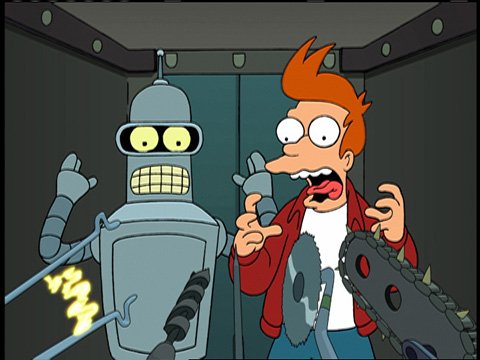
Fry finds himself in the year 3000, in an unfamiliar New York City. The future has many of the things you would expect—robots, space travel, and flying cars—and many you wouldn’t. It’s got celebrity heads in jars and suicide booths. One of the funniest and weirdest scenes ever takes place when Fry meets the wisecracking robot Bender. “Well, I don’t have anything else planned for today,” Bender declares, “Let’s go get drunk!”

Next we meet Leela (Katey Sagal), whose job is to program other people with a chip that determines their vocation. Apparently their system is pretty accurate, because it labels Fry as a Delivery Boy. Leela is kinda hot considering she’s got one giant eye in the middle of her head, and there is no denying that she’ll be Fry’s love interest for the series. (We’re told she’s an alien, but a later episode will reveal otherwise.) We also meet Professor Farnsworth, who hires Fry, Leela, and Bender as his new flight crew aboard the Planet Express. And, voila, Fry is a delivery boy again. Context is everything; he couldn’t be more excited. Thus, Fry and the audience are off on a series of adventures.

It is brilliant how Groening can say so much about our own time with a story set a thousand years in the future. Bits of what happened since 1999 are filled in here and there like little warnings. And yet, some things never change. Human beings—and other species as well—will probably have the same neuroses in the future that they have now.

Neighbors from Hell

I am always up for a new animated series, especially one that is NOT by Seth MacFarlane. (Nothing against him, he just has enough airtime.) Neighbors from Hell is being promoted by TBS as “from the studio that brought you Family Guy,” but is written by Kyle McCullouch (South Park). There is little resemblance to Family Guy. Except for the dog—I”ll get to that.

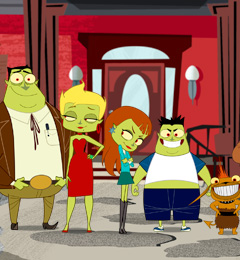
This pilot takes no time at all to introduce the premise: a demon is assigned by his boss, Satan, to transfer to Earth where he will infiltrate and bring down an oil company called Petromundo. We’ve seen the misfit-family-moves-to-new-neighborhood premise before. What makes this one a bit different is that all of the information Balthazar Hellmanneighbors from hell and his family have about Earth comes from watching television. So, we know we’re in for tons ‘o references. What I don’t get however, is why there is a 20-year delay on shows getting to Hell. I mean, it’s not England. They are watching Growing Pains, Alf, and The Cosby Show. That’s not the only thing that is out of date…

Characters are introduced with no unnecessary fanfare or backstory. The main character, Balthazar, has a wife, a son, a daughter, an uncle, and a dog that talks and seems smarter than the rest of the family, ala Brian Griffin. He winds up being the dues-ex-machina that undoes the mess the family finds itself in, and we can surmise that will be his ongoing role.

It is too perfect that this show is hitting the airwaves right now, as the villain (not Satan mind you, the real villain) is an oil company. The company is devising a giant drill that will bore to the center of the Earth, ostensibly disrupting life in Hell. Apart from that coincidence, some of these jokes seem like they have been gathering dust for a while. A demon tortures a damned man by making him listen to Britney Spears’ “Oops I Did it Again.” How old is that song? We’ve also got some jokes about Ugg boots and Criss Angle. The funnier jokes are the ones without an expiration date. Balthazar walks into the house to find bodies all over and inquires calmly, “Tina, did you kill the neighbors?”

The story seems headed for a quick resolution as Balthazar plots to destroy the engineer who is in charge of getting the drill up and running. Toward the end we find out what will give the premise an excuse to last past the first episode; the fact that Balthazar—aw, shucks— likes the guy he needs to destroy. There is also a racist neighbor how apparently practices beastiality with her poodle, and another who’s addicted to Valium. But, um, where are the TV references? The writers teased us with the possibility of Kirk Cameron jokes and there’s not a one.

The animation style is refreshing. (i.e. It doesn’t look like a Seth MacFarlane show) It’s stylized, and deceptively kid-friendly.

This pilot is all over the place. It has the feel of having been revised and rewritten to within an inch of its life. Not sure if that’s the case, but we’ll see where it goes.

Drop Dead Diva

When I saw the ad for this show on Hulu, it looked so schlocky and awful I couldn’t resist. And now various cable channels are plugging the hell out of the Season 2 premiere, guest starring—and this should be a red flag—Paul Abdul.

 The show opens with a blond bombshell nervously preparing for her big new job – as a prize model on The Price is Right. I have to admit that’s pretty funny. Her perky self-doubt is reminiscent of Elle Woods. In a parallel story with no immediately obvious connection, an ugly-by-television-standards woman is getting chewed out by her bitchy boss. Her co-worked, played by Margaret Cho, hits us over the head with some exposition.

In the show’s first five minutes both characters are unexpectedly killed and we’re vaulted into a bright white afterlife processing office, where a Scott Baio look-alike informs the blond-whose name I still haven’t been able to catch by this point-that she is completely neutral on the good/evil scale. The absence of good or evil, in this universe, is shallowness. The hot blond is shallow. He had to look that up in a database. She pushes a button on his keyboard and is beamed up into a stream of light, then wakes up in a hospital bed in the body of the unattractive character. Her name is Jane. I got that one. Plain Jane, couldn’t be more obvious.

There are too many stereotypes at work here to get through the pilot. I made it to minute 14. If you’re going to make a show about the afterlife, you have to find something creative to do with it. Call Bryan Fuller for tips. Furthermore, haven’t we made it past the assumption that brains and beauty are mutually exclusive? Did we learn nothing from Legally Blonde? Television lawyers are another area that has been hunted to extinction. High pressure, high heels, blah, blah. The ONE area where this show chose to stray from the predictable is they made Margaret Cho not funny.  How has this show lived to see a second season?

The Oblongs

I think this animated show was on the air for a couple of weeks before it was cancelled. The story goes that it was actually cancelled mid-episode in Australia, because the network got so many outraged calls. It has recently resurfaced on Cartoon Network (and it’s available on DVD), so I thought I’d revisit it.

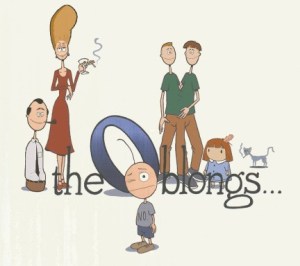
The first image we see as the pilot begins is a clean-cut man stepping out of a huge, fancy house. He reads the headline of his newspaper, Rich Get Richer, and smiles. Then he flushes his toilet and we, the viewer follow along a pipe down the side of the hill to where the sewage empties into a cesspit. This show is not about the rich people.

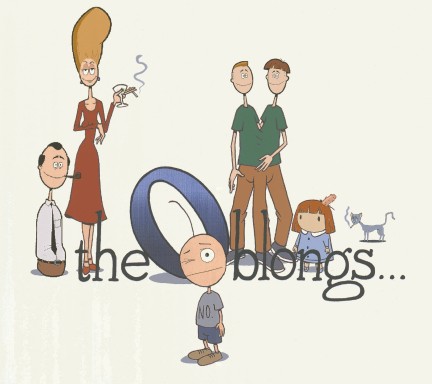
One by one, we meet the members of the family living at the bottom of the pipe. Bob Oblong (Will Ferrel) rises and shines. He is very cheerful for a guy with no arms or legs. He notes how cute his wife, Pickles (Jean Smart), is. She has no hair and wakes up still drunk enough that she’s not sure where she is. There are teenage conjoined twins in the shower. Bob reminds them to be thankful for their extra buttock. There’s a daughter who has something that resembles a cross between a penis and a pickle growing out of her head. We know the younger son, Milo, is the real focus since he’s introduced last. He’s busy sawing the foot board of his bed. We’re not told the exact nature of his ailment, but one eye is bigger than the other and he attends a special school. Where he needs a muzzle. Is this ridiculous enough yet? No? The cat smokes. Before you can even process any sense of plotline you are almost overwhelmed with over-the-top, bizarre images. You might be offended, if there were time.

As we head out to the bus stop it only gets worse. Everyone in this valley is some kind of mutant. The kids who go to “normal” school have too many abnormalities to take in at one glance. There are about four of them in assorted shapes and sizes, who hang out with Milo.

At the factory where Bob works he is surrounded by more valley freaks, and the rich guy from the opening, Mr. Climber, is his boss. Bob’s job is using his mouth to screw tops onto bottles of poison. (“The poison tastes different today,” he notes matter-of-factly.) The boss tells Bob that he has filed too many health insurance claims, and if he files any more he will lose his coverage. So, when the twins get in an accident, the family can no longer afford to send Milo to public school. There’s a pretty tasteless joke where the doctor is informed that the boys are conjoined twins. “Oh,” he says, “then it’s not as bad as I thought.” The jokes are like that; so out of left field you can’t help but laugh, tasteless as they may be.

Now that Milo has to transfer, the episode takes on a new-kid-at-school storyline. Like the Karate Kid before him, he falls for one of the popular girls, and gets beaten up by the popular guys. But the story is familiar for all of five seconds. It turns out the popular girl is an alien. She removes Milo’s brain for a quick look-see and then sends him on his way, smitten and outfitted with a tracking device.

We learn that Pickles is from the Hills, but relocated for love. She has a rival in Pristine, a mother of one or more of the popular girls. The popular girls come in a package deal; they all dress and talk the same and have the same name, Debbie.

The fun of this show is how sickeningly cheerful the Oblongs are in the face of adversity. They express worry and frustration at their day-to-day problems, but they don’t dwell on their big problems – the really big ones that are in your face the whole time you’re watching the show. Even the people from the Hills, although they think the Valley dwellers are icky, seem to have adapted to this way of life. That kind of juxtaposition makes the jokes spring up all over the place, like whack-a-moles. If you can get your head around how freaking weird this show is, it’s absolutely hilarious.

Spoiler alert. Milo doesn’t get the girl. His goth little friend burns down his club house, and thinking Milo is dead, the alien girl vaporizes herself.

Memorable quote: “I think I’ll hang around for a while and poke my first love’s remains with a stick.”