Firefly

I have been putting off writing this entry for a long time, which is in no way a reflection on my opinion of the show. It’s more like I’m afraid I can’t do Firefly justice, especially considering the rapturous devotion of its fans. If you’re a loyal browncoat you probably know the pilot backwards and forwards. If you’re not, it may be that you blinked and missed it before Fox canceled it. (I won’t rehash the whole fan outcry/Serenity story.)

It’s not like Joss Whedon invented a new genre here; we’ve seen space anti-heroes before. And I, for one, was not a Whedon fan prior to this, so I wasn’t like “Hooray, a new show from the creator of Buffy.” The show just hit all the right notes with cool setting, fascinating characters, great dialogue, and a healthy dose of dark humor.

The show opens with an in-the-trenches war scene, which could be out of any number of movies. The clue that something is different is that the aircraft flying overhead look like nothing we’ve seen before. A man (Mal, played by Nathan Fillion) and a woman (Zoe, played by Gina Torres) are leading a shell-shocked contingent against an attack. Their language is slightly heightened; in fact, the whole scene is a bit confusing the first time around. All we really need to know is that the troops are forced to lay down arms when their back-up abandons them. The look on Mal’s face and the music playing tell us all we need.

Music is huge in this pilot. The score is a twangy, gritty collection of music reminiscent of old westerns. Its juxtaposition with high-tech space travel gives Firefly its own unique tone.

We jump ahead six years from the battle scene to a spacewalk by a crew of three. The striking quality of this scene is that it is very quiet—opposite the previous scene—with sound seemingly sucked up by the vastness of space. Meanwhile the pilot of the ship, who seems to be keeping an eye on the mission, is actually playing with dinosaur toys on his console. (I may have to add this to my list of best character introductions.) “Curse your sudden but inevitable betrayal,” cries the Stegosaurus to the Tyrannosaurus.

From there, we start to meet the rest of the crew. There is the ever-cheerful mechanic, Kaylee (Jewel Staite). There is a “companion,” or prostitute, Inara (Morena Baccarin). And there’s Jayne (super-dreamy Adam Baldwin), all-around tough guy. The pilot is Wash (Alan Tudyk), Zoe’s husband.

The crew has to quickly shut down the ship’s power as they pass an enemy, and we find out a few details. The ship our crew flies is an out-of-date model called a Firefly. Its name is Serenity, and it becomes a character unto itself over the course of the series. The ship and its crew are, for lack of a better term, off the grid. They’re clearly hiding from something.

Captain Mal and company land on a dusty planet and pick up some new passengers, a preacher, a doctor, and a third man. A lot of characters and a lot of information are introduced very fast. The show demands your attention and is worth watching over and over, because so much happens. The dialogue is layered with character revelations and plenty of wit. The basics are, they’re short on cash, carrying stolen cargo, and on their way to seek help from a woman who once shot Mal. This is not going to go smoothly.

If you haven’t seen this, watch and enjoy the twists and turns for yourself. No one is who they seem. They all have secrets. Some violence beaks out now and again. And the doctor is transporting some very unusual cargo. Our protagonist, Mal, seems cool on the surface, even when angry, but clearly that war experience—and maybe a lot of other pain—is seething beneath the surface. Oh, and there are enemies out there in space called Reavers, to whom the crew’s reaction is bone-chilling. Just watch it.
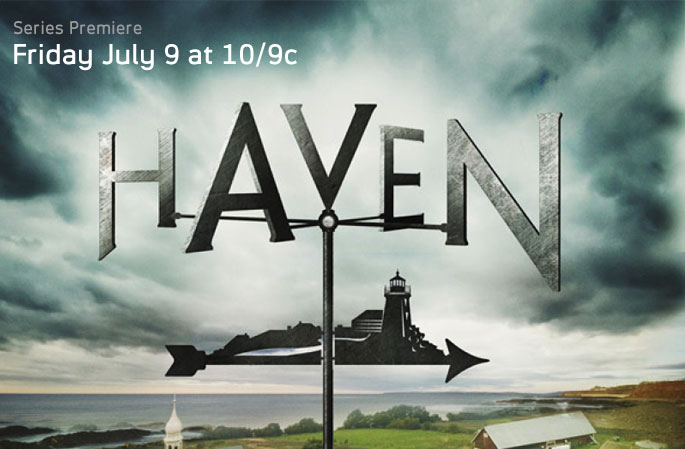
Haven

Some pilots don’t have to work very hard. Even if you don’t know that Haven, a new show on SyFy, is based on a book by Stephen King, you’ll likely figure it out pretty fast. A lone cop is sent to a small Maine town filled with colorful characters where something of a vaguely sinister super-nature is going on. Other things we already know: FBI agents and local police officers don’t get along. Female cops work super hard and don’t have time for dating. People who live on boats are odd.

So, putting all of those givens into place, let’s get to know Agent Audrey Parker (Emily Rose). A quick couple of aerial shots show us she lives in a big city. Her boss shows up with an assignment, pausing to comment on a teen vampire novel on her table. “FBI is nonfiction work,” he pontificates. Huh?

Agent Parker gets to Haven, a small harbor town with exceedingly strange weather. You know when a town on TV has a quaint, cozy-sounding name like Haven, bad things are going to happen there. (Point Pleasant, Wisteria Lane.)  She’s driving along when a chasm opens in the road in front of her, forcing her through a guardrail. We never get an explanation for that. It’s funny though, when her car is hanging half-way off a cliff, that she takes the time to turn off the radio so she doesn’t have to die to an annoying 70s song. Her first confrontation with local cop—and soon-to-be love interest, no doubt—is likewise pretty amusing.

The show succeeds with witty dialogue more so than in other areas. There are some truly funny moments. The banter between the cop, Nathan, and Audrey is delivered with the requisite cynicism. The jokes kind of pop up out of nowhere, making them the one element of the unexpected in a show that is supposed to be suspenseful.

The reason Audrey is in Haven is forgettable in light of everything that ends up happening, but she’s supposed to locate an escaped convict. The problem is, he’s already dead. Like a good television FBI agent in heels, she doesn’t let that deter her. She starts nosing around the town, meeting its various denizens.

The stand-out for creep of the year is a handyman named Conrad with “personal space issues.” Whenever this guy gets pissed off there’s bad weather. You would think every school kid in town would be vandalizing his house hoping for a snow day. Spoiler alter. It turns out, though, that it’s not really him that’s affecting the weather. It’s the pretty antique store owner who he hangs around. Audrey wraps this one up nice and neat, so possibly each episode will revolve around a different resident with a bizarre power.

The A plot is that Audrey is an orphan (paging Temperance Brennan) and there is an old photo in the town newspaper of a woman that looks just like her. A quick scene of Audrey’s boss at the FBI having a cryptic phone conversation reveals that she was sent to Haven for a reason we’ve yet to discover.

This pilot is so pilot-y it’s just boring. It could have had a later point of attack and possibly been much more interesting. I for one, probably won’t continue watching to see what becomes of Audrey.

Angel

Spin-off pilots are their own breed. In some ways they have it easier than regular pilots, already having a waiting audience. For Joss Whedon creations, this effect is even greater. In other ways, they have it harder, since fans can be demanding. The pilot for a spin-off has to balance enough familiar information to let existing fans feel like they’re in on something, but still lay out the exposition and character introductions needed to get the series started.

In Angel, we’re reintroduced to the title character (David Boreanaz), now living in Los Angeles. He brings us into the setting with a few words describing the City of Angels (pun not spelled out but certainly implied), while he sits somberly in a dive bar. We get that the city is going to be as a much a character as anyone. Angel is drunk off his ass, and we could open a whole discussion on the chemistry of vampire intoxication, but not here. He is slobbering to the unwitting barfly next to him about the girl who got away, without naming Buffy. (For some reason, there is a giant rainbow flag hanging in the bar, but there is no other indication that it’s a gay bar. Or why Angel would be in a gay bar.)

Within moments our hero is dispatching with some evil vampires about to feed on some nubile young clubbers. It’s a big, bad comic-book style brawl that leaves Angel jonesing for blood. He heads home, to his dark basement apartment, to find a half-human Irishman named Doyle (Gleen Quinn) waiting for him. Doyle fills us in on Angel’s origin story and the Buffy-Angel relationship. Doyle is some sort of psychic with migraines. He’s got an assignment for Angel, to go meet a woman at a coffee shop who is some kind of trouble.

The girl is being hunted by a wealthy investor who turns out to be a powerful vampire named Russell. Angel tries to protect her, but she gets herself killed, and Russell decides to lure Cordelia (Charisma Carpenter), who is now an aspiring actress, into his lair. And some other stuff happens.

It’s best not to think too much about the plot. Everything happens a bit too easily: Doyle just pops in and Angel obeys without question, then Angel just happens to be at a party where Cordelia is, then the same vampire that kills the girl in the coffee shop just happens to have his sights set on Cordelia as his next victim. Angel, like Buffy the Vampire Slayer before it, succeeds more on its wit.

For all its action-packed mellowdrama, this pilot is full of laughs. Even Charisma Carpenter’s painful acting is saved by some great one-liners. My favorite is, when she calls Russell out as a vampire, she accuses: “I’m from Sunnydale. We had our own Hellmouth.”  Another one is, after Cordelia babbles on about her fabulous life and then walks away to talk to more important party-goers, Angel remarks, “It’s nice to see she’s grown as a person.” Other bits are more subtle and surprising. Angel jumps gallantly into his convertible to chase after bad guys only to realize it’s not his car.

David Boreanaz’s social awkwardness is just adorable. Lest we forget how beautiful he is, the writers remind us at least twice in this episode. As a character he is oblivious to his own hotness (vampires don’t have reflections, remember) which makes him that much more appealing. Darn it, he just wants to do the right thing.

So for Buffy fans or the uninitiated, this pilot is super entertaining. And it ends with a beginning, the launch of Angel Investigations, so it keeps the viewer coming back for more.

The Clone Wars

In discussing the animated series The Clone Wars, I’ve chosen to treat the movie as the pilot. It functions as one, more or less, but then this series doesn’t need a pilot in the traditional sense anyway. Anyone who hasn’t been living in a Dagobah swamp for the last 35 years has at least a passing familiarity with the Star Wars universe. There are only two signficiant new characters we need to meet here. (For purposes of this analysis I’m ignoring the 2003 TV series, Clone Wars.)

To talk about a Star Wars movie experience you have to start even before the characters appear on screen. At the opening we get the thrill of the “A long time ago…” caption followed by the triumphant appearance of the yellow title logo we know and love (modified with the new title, obviously.) We’re pumped. But instead of a crawl, we get a voiceover reminiscent of a 1940s newsreel. It’s just as boring.

As in the other films, this one doesn’t weigh us down for too long with talk of trade blockades and treaties, although it does start off that way. We jump into the action of battle as Obi-Wan (James Arnold Taylor) and Anakin (Matt Lanter) lead a corps of Clone Troopers against some spindly-legged robots (which look a lot like the robot from The Incredibles).

Once our Jedi heroes dispatch with the enemies they discuss the impending arrival of Obi-Wan’s new padawan. Right on cue, the new character Ahsoka (Ashley Eckstein) shows up–only Yoda has assigned her to train with Anakin, not Obi-Wan, much to Anakin’s chagrin. Thus we get our Reluctant Partnership, staple of cop shows and romcoms.

(I’d like something clarified. Exactly what is the age requirement to train as a Jedi? Mixed messages on this abound throughout the films.)

The first thing we notice about Ahsoka, besides that she looks like the victim of  spray tanning accident, is that she’s really freaking annoying. Sure, she’s supposed to annoy Anankin, but why us? Just thank the Force they don’t mention her midichlorian count.

The other character to be introduced is from a separtist Sinead O’Connor-looking creature called Ventress. There is not much to say about her at this stage except she’s bad.

After Act I we move on to a plotline where the Jedi have to rescue Jabba the Hutt’s infant son. (Which begs the question, how do Hutts reproduce?) It turns out the rescue mission is a frameup by Count Dooku to make it look like the Jedi are trying to kill the mini-Jabba. Padme Amidala comes along to assist. She looks and sounds pretty cool, probably the least cartoony, if that makes sense, of all the characters. There is just the briefest reminder that Padme and Anakin’s relationship is a secret, which sets up lots of possibility down the road for series plotlines. It is when her character is introduced that we get some variety to the action, cutting between her scenes and Anakin’s. You can’t even call it a subplot – the story is pretty much one thread.

So what works and what doesn’t about this pilot? The good: Obi-Wan, a consistently interesting character from all six previous films is back. Yoda looks fantasic animated. And Anthony Daniels as C3PO. The bad: Samuel L. Jackson as Mace Windu. Doesn’t he have other stuff to work on? Can’t he go away and let us forget that “This party’s over” ever happened?

Possibly the biggest problem with this is that it can’t seem to decide whether it is for kids or adults. It’s like what happened to Return of the Jedi with all the Muppets, and to Phantom Menace with all the Gungin nonsense. The best thing, though is this: After years of hearing about the Clone Wars, we actually get to see the Clone Wars! The show has certainly found success, with season 3 set to begin in fall 2010, and enough merchandise to choke a Hutt.

White Teeth

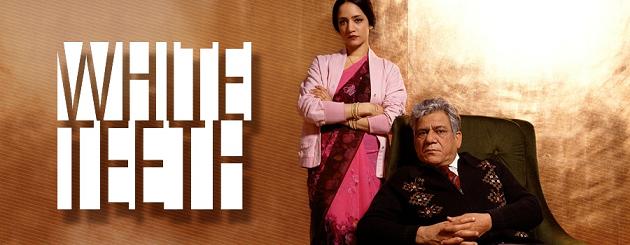
“You have picked up the wrong life in the coatroom of existence.” Who hasn’t felt that way at one time or another? This sentiment, uttered by Samad Iqbal (Om Puri) to his old war buddy Archie Jones (Philip Davis) encapsulates a theme that permeates the pilot episode of White Teeth.

The pilot of this UK drama, based on the eponymous book by Zadie Smith, is rife with moments. Like an older woman making her way along a row of apartments painting “666” on the windows. Or a man flipping a coin to decide whether to kill himself. It doesn’t matter that it’s 1974, because these oddities transcend time.

There are many characters to introduce who, in the beginning, have no clear connection. As readers of the book will know, there are many yet to come, and decades to cover. But this is one of those pilots that eschews exposition in favor of setting a tone. As relentless as the London rain, life’s dark moments wash over these characters wherever they go.

As the show opens, we’re driving through a dreary, dark neighborhood that the narrator (Archie) informs us is Willesden, “the kind of place a man goes to die.” As Archie sets up his car to asphixiate him, we flash back 3 months to meet teenager Clara (Naomie Harris). She is singing with abandon to her bedroom mirror. Her pure joy makes her instantly likeable. Described as homely in the book, she is actually quite cute save for her frumpy duds (and totally unrecognizable as Tia from Pirates of the Caribbean.)

The bleakness of the show echoes that of the book, but offers the added bonus of music, strategically used to juxtapose the action and make it that much more ridiculous. Clara’s singing moment is instantly silenced by her strictly religious mother’s entrance. Archie’s death-to-disco is interspersed with bouncy Indian music inside the meat truck that will momentarily save his life. It’s no spoiler that Archie lives — he’s the main character.

Archie’s world finally collides with Clara’s at an End-of-the-World party on New Year’s Eve. Clara, a Jehovah’s Witness has long been preparing for Doom’s Day, first by distributing warning pamplets, then by living it up having sex in public bathrooms. She has informed her ragtag band of friends of the apocalypse, and they count down to midnight dutifully. (Why does everyone assume the world will end according to their own time zone?) When our two misfits wake up in each other’s arms, they are plunged headlong into a new dawn. They have picked up new lives from the proverbial cloakroom. Thus begins their May-Decemeber romance, referenced by the episode’s title, “The Peculiar Second Marriage of Archie Jones.”

Beverly Hills 90210

Forget that mellow-drama running on the CW called simply 90210. This is where it all began. The pilot for Beverly Hills 90210 opens with a typical pilot premise: It’s the first day of school. Two teens, Brandon (Jason Preistley) and Brenda (Shannen Doherty) Walsh are waking up, getting dressed, and preparing to face a new start in a new town. As we learn in some awkward but mercifully brief exposition, they’re from Minnesota. Dad got a new job, and the family moved to Beverly Hills.

We notice a few things right away. Kids from Minnesota get along with their siblings. Teenagers are slobs universally. And the 80s lasted at least until fall of 1990.

The opening credits are endless by today’s standards, comprising a montage of rich kids doing rich kid stuff. Brenda caps it with, “I think we’re going to need a raise in our allowance.” The one small twist is the chick getting off of a City bus. She’s got serious girl hair and glasses, so we know she’s smart. She’s kind of a bitch, too, when Brandon goes to her to offer his talent writing for the student paper, which she edits. Her name’s Andrea, and she’s set up to be either Brandon’s love interest or nemesis.

Brenda instantly befriends Kelly (Jennie Garth), the quintessential SoCal girl with white blond hair and a recent nose job. Kelly emphasizes to Brenda that this is “definitely not your normal high school.” I have to wonder, how would she know? This line sounds more like it’s directed at the networks asked to pick up the show than to the character Brenda. But, despite the underscoring of everything that makes West Beverly so unique, it’s refreshing to see how decidedly normal these kids were in Season 1. The freshmen are awkward. The girls worry about their weight. The jocks pick on the weaklings.

Brandon and Brenda are really likeable characters. They’re a little unsure of themselves, but far more secure than their Beverly Hills counterparts. Loveably down-to-earth. I love when a hot girl asks Brandon what he’s wearing that smells so good and he replies, “Tide?”

The obligatory party scene gives us all we need to know about the key players. Steve Sanders (Ian Ziering) looks like he came straight from playing the rich asshole in a John Hughes movie. The optimistic freshman David (baby-faced Brian Austin Green) provides some comic relief. And the poor little rich girl, Maryann, flirts shamelessly with Brandon. (And, WTF, are those people in the background of this scene playing tennis?) What is surprising, with the benefit of hindsight, is how little we hear out of Donna (Tori Spelling). She’s little more than Jenny Garth’s shadow.

A word must be said about the clothes. At the time this aired I’m sure they were the height of fashion. But today, whoo! Let’s hear it for blazers with shorts. And the hair! What is the semi-mullet thing Brandon is sporting?

By the end of the pilot we know everyone we need to know, save for one… Dylan is yet to be introduced. We pretty much know what we’re in for, and it’s got a nice blend of drama and humor. One wonders how this show morphed into a soap opera dealing with drug overdoses and whatever else went on in the later years. Not to mention the CW nonsense.

John Doe

John Doe debuted in 2002, airing on Friday nights at 9pm on Fox, a timeslot that is apparently where perfectly good sci-fi shows go to die.

The show opens with a square-jawed, naked man (Dominic Purcell, more recently of Prison Break, and so much cuter with hair) stumbling confusedly around an island. A few quick cuts and horror movie-style sound clips later, he is plucked out of the ocean by a fishing vessel off the coast of Seattle. Despite speaking Khmer and being able to tell the date and time, down to the second, by the position of the sun, he doesn’t know who he is or how he wound up in the water. As the audience, we’re as lost as the character.

Walking aimlessly down the street, Mr. Square Jaw notices a scar or a brand of some sort on his neck (which, although this show came first, reminds me of those marks the characters on Heroes used to find on themselves in Season 1.) It’s sort of a C-shaped thing with a couple of slashed through it. For reasons not yet explained, he sees only in black and white.

The nameless man quickly discovers, as do we, that he is a genius, or a human encyclopedia, or both. He puts his uncanny smarts to work in short order, first dazzling a crowd at a library by answering any question they can imagine. And, I may be over-thinking this, but there is an overhead shot of the library desk and the crowd around it that vaguely resembles the scar.

He gets himself a social security number and names himself John Doe. Before long, John is on his way to financial largesse, putting his brain to work on horse races and foreign currency. But wait, there’s more! Not only is he a brainiac, he’s musically talented, and soon stumbles into a gig playing piano in a bar. So we’re thinking he’s going to land on his feet.

At last through the set-up, we’re vaulted into action when John sees a missing little girl on TV, and her photo is the only thing he sees in color. Figuring that must mean something, he offers his services to the local police. The cop in charge of the missing person’s case lets him help pretty much right off the bat, while maintaining the requisite skepticism.

The mystery unfolds, with John seeing key people and items in color. The question that propels us through is, will John find the girl, or will the girl help him find himself?

With the forensics skills of Temperence Brennan, the learning ability of Chuck Bartowski, and the looks of – wow, I don’t know who – John has it all, as a character. The supporting characters come off as superficial, like the head-scratching cop and the really annoying-yet artistic-young woman who works at the bar with John. Everyone else introduced in this episode is a throw-away.

This isn’t the official pilot of John Doe. There was an unaired version with a different cast. But this one finds the balance needed for an action/sci-fi pilot between giving us enough to be intrigued but not enough to know what the hell is going on. Other shows have done this successfully, only to nosedive (Dollhouse, Journeyman, Defying Gravity) and this show’s fate was no better. Perhaps it was ahead of its time, predating themore successful shows referenced above. Or perhaps it got sucked into the great black hole of cop show stereotypes. I haven’t watched beyond this episode, but if it ended up being just another mystery-of-the-week show, the originality of the premise may not have held up.

Being Erica

Okay, so this show looked a little cheesy when I saw it advertised while catching reruns of Gilmore Girls on the Soap network. It turns out the show, from the CBC, is a little cheesy, but it has several characteristics that intrigue me. It’s a little bit Wonderfalls (highly educated but dissatisfied chick suddenly has supernatural things happening, pointing her in the direction of her true calling); a little bit Journeyman (lots of sudden trips to the 90s); and a little bit Reaper (protagonist has frequent, unexpected visits from a jerk with supernatural powers who doesn’t feel the need to explain much). Also, Tyron Leitso, who played the recently jilted hottie in Wonderfalls, plays the recently jilted hottie in this. So off we go…

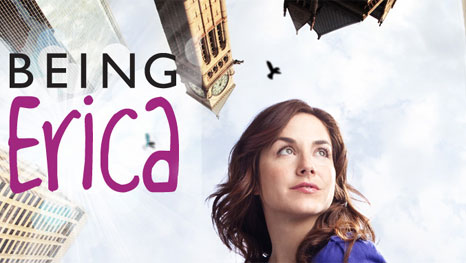
Erica Strange (Erin Karpluk) is 32. She works for an insurance company. She mentions that she still sleeps with her cat, although I can’t recall seeing a cat at any point during Season 1. And, she tells us, she has made an unending series of mistakes that have left her unfulfilled. She gets fired. The guy she has a date with cancels at the last minute. She gets caught in the rain, then has an allergic reaction to some hazelnut coffee. Your basic suck-ass day.

Erica is visited in the hospital by a mysterious therapist who appears out of nowhere and has an uncanny understanding of her sad life alone with her cat (again with the cat). “In the middle of difficulty lies opportunity,” he quotes. Thus begins a long series of quotes that make up the bulk of this guy’s conversation. He leaves his card, but one has to wonder why she would even keep it. Personally I can’t stand those elusive mentor-figure characters who speak in riddles and expect protagonists to follow their instructions without question. In a similar situation I’m sure I’d walk away, but then my story wouldn’t be a television series…

We next meet Erica’s family and friends. For complaining about how much her life sucks, she certainly has a good support system. At least half a dozen people rush over to brunch following her showdown with hazelnuts. It seems though, that she senses strong disappointment from these folks for not having a career or relationship. She runs off to find the therapist, Dr. Tom (Michael Riley). He’s waiting in a typical shrink’s office, dimly lit and lined with books. It could easily be the same set from the shrink’s office in Wonderfalls.

Dr. Tom is a little abrasive, a lot vague, and has no visible credentials. But he promises happiness. And he doesn’t charge. While it’s easy to criticize this story introduction as simplistic, one must admit the need to find happiness can eclipse skepticism, even in a reportedly smart woman like Erica. The show is fantasy – accept it and go along for the ride.

Tom instructs Erica to make a list of all her regrets, and it’s long. It ends with “Leo died.” That’s important later in the series, but we don’t get any details here.

The heart of the show is this. Tom can send Erica back in time to redo events that she regrets. We see by her trip back to a high school dance that these experiences won’t be easier to control the second time around. It’s not really going to be about changing the outcome of certain events. It’s about Erica learning things about herself. In this episode, she has to overcome worrying about what people think of her; a tall order for a high school junior. The flashback stuff is fun, with fashion, music, and slang from the early 90s. “Teenagers are idiots,” Erica declares. What a trip to reflect on yourself as a high schooler with 16 added years of wisdom.

This is just supposed to be a discussion of a pilot, but this is one show where you really have to hang with it. There are deliberate details everywhere that come together later in the season. For a show about time travel, Being Erica is completely devoid of science fiction. No flux capacitors, no Bridge Device. Dr. Tom quickly brushes off Erica’s question about the Butterfly Effect. This a soap opera that just happens to have time travel in it. Though I wasn’t blown away by the pilot, it was different and entertaining enough to keep watching. Let’s be honest. The real hook was, I know a few things about being a 30-something woman who graduated high school in the 90s, earned a literary BA and MA, and can’t find a profitable use for said degrees. And has a cat. (Where the hell is that cat?) So there. Erica is my new best friend.

Pilot Episode of… wait for it… Doogie Howser M.D.

Oh, the multitudes of pop culture jokes this show spawned. But once upon a time in 1989, it made its debut. The show opens with a 16-year-old kid taking his driving test in a Volvo station wagon. His overbearing mother has tagged along. When they see an accident ahead of them, the kid speeds up and jumps out of the car to assist. He amazes the police officers on the scene by taking charge and adjusting the victim’s leg to restore circulation. It’s a great, surprising opener that lets the viewer know all he or she needs to know. The opening credits fill in the details, with newspaper headlines about the child prodigy, Doogie Howser (Neil Patrick Harris), acing the SATs, graduating from Princeton, and becoming an M.D. all by age 14. And for an extra flourish of heroism, there’s one about how he delivered a baby in a mall. Nothing says 80s teenagerhood like a mall.

Next, Doogie is at the hospital, and we get a feel for the workplace dynamic. This is followed by a scene at home, where we see Doogie’s life as a normal teenager, goofing around with his buddy and making big plans for the upcoming school dance.

It’s a story of contrasts; the “regular” kid living in the same body with the genius medical professional. The poor kid gets pressure from all sides. His parents hassle him like all parents of teenagers, plus patients and other doctors don’t always take him seriously. (And he’s cute as a button!) Over dinner, his father speaks the theme of the show: “Emotional maturity is not a function of genius, it’s a function of experience.” We, the viewers, are going to be along for the ride as this young man gains some of that experience.

It’s got it’s amusing moments; Doogie’s horny boy banter with friend Vinnie (Max Casella) is, if not predictive of the Bro Code, at least typical of adolescent boys, and what’s not funny about that? And Doogie and Vinnie’s revenge scheme on doctor who embarrassed Doogie is a good chuckle. But this isn’t a laugh-out-loud kind of show. We get a sad story about how Doogie had leukemia as a child and went through chemo. He shares his experience with a sick child in need of a heart transplant. The tone is actually quite Scrubs-like, humorous moments contrasted with serious ones. There’s even a goofball musical sequence of Doogie getting dressed for the dance to Tone Loc’s “Wild Thing.” It’s followed soon by, in real Scrubs fashion, a heart-wrenching patient death. Doogie ends the episode typing into his computerized diary, “Kissed my first girl. Lost my first patient.” Again, contrasts. Also these experiences being firsts, it’s the right place in this character’s life to start telling his story.

I think I only ever watched this show once or twice when it aired, and I’m sure I had never seen the pilot. As a NPH fan, I was so excited to find that it’s now on Hulu. It’s fun looking at it through the lens of subsequent shows, but even standing alone, the pilot promises a sweet, touching, and unusual show.

Journeyman

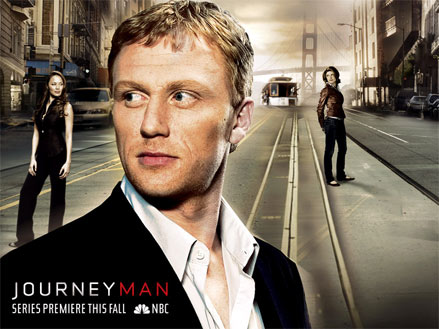
It’s 2007. A San Francisco reporter and loving family man is having a strange day. When Dan (Kevin McKidd) arrives at a restaurant to meet his wife for their anniversary dinner, a football game from 8 years earlier is playing on television. Then he wakes up in a cab, disoriented, but continues with his evening. The next morning, he wakes up in Golden Gate Park. He goes to his house to find a strange man living there. It’s 1987. His wife wakes up to find him missing, and his brother, a cop, hasn’t heard from him.

Time travel into the recent past is always fun, since we get to enjoy laughing about old music (10,000 Maniacs, anyone?), movies (Less Than Zero) and, of course, technology (giant, bricklike mobile phones). In Journeyman, however, the laughs are few, as eerie lighting and music build a sense of foreboding. Dan saves the life of a man about to let himself be hit by a streetcar. He continues to suspect that it’s all a dream. You can feel his fear when he returns to his wife to learn that he has been away for two days, and his wife’s as she wonders where he’s been.

Soon, our traveler is off again. He is in a car accident and disappears from the scene. (Something similar happened this season on Fringe.) He always seems to stay in San Francisco, although he pops up in various locations. There is no immediately visible pattern. People seem to be the unifying factors: Neil, the guy whose life he saved and Olivia (Moon Bloodgood), an ex-girlfriend.

Little details are introduced gradually, leaving the viewer to enjoy the mystery as it unfolds. In a show where the main character doesn’t know what’s going on, it’s more fun if the audience is just as lost. We’re also learning the character’s past. His wife used to date his brother. His girlfriend died in a plane crash. You share his frustration in the fact that he never knows when he will pop back in time, or where (when) he will land. And think what it would be like if you had to exist pre-internet now that you’re dependent on it for so many things.

The pilot brings more questions than answers; like, what if Dan talks to himself in the past? Or prevents the conception of his son? And if he sleeps with his old girlfriend, is that cheating?

This is the kind of stuff that will keep a viewer watching. You would think. Apparently, not too many people did keep watching, though, as the show only lasted 13 episodes.

The pilot comes to a satisfying conclusion. We learn, if not why Dan has been selected for this mission, at least what this group of journeys was meant to accomplish. He causes the death of the guy who he first saved, preventing that guy from killing his son, who grows up to save eight lives in a bus crash. So it looks like he is going to be evening out the balance between life and death, and possibly, finding out what really happened to Olivia. There’s a kind of feel-good ending where Dan promises his wife, “I’ll always come home.” The line sets the stage for a series of similar adventures.