Slings and Arrows

No one ever thanks the stage manager. If you have ever worked in theatre, you know that when the stage manager gives you a cue backstage, such as “five minutes,” you respond, “thank you five minutes,” or at least “thank you.”It’s not only polite but it’s practical, as it lets the stage manager know that he/she has been heard, and that everyone is on the same page. Never, ever is this done on TV or in movies. It drives me nuts. Slings and Arrows, a now-cancelled Canadian dramedy seems like a show that would get this detail right, but maybe they do things differently in the land of Rod Stewart and Robin Sparkles. The show is pretty authentic in other ways.

The pilot plot is a tale of two theatres. One is desperately poor, with plumbing issues and unpaid electric bills. It’s actually called Theatre Sans Argent. The other one is a big ol’ commercial theatre complete with a corporate sponsor. Both are getting ready to open works by Shakespeare. It’s not immediately clear what the relationship between the two is, but we get to that.

Geoffrey (Paul Gross), the cockeyed optimist who runs the broke company fancies himself an artiste. He’s full of bombast about the ability of theatre to rise above mundane problems like money. “A theatre is an empty space,” he declares, making a Peter Brook reference only theatre geeks would get. He backs up his claims, though, with a realistic onstage tempest created using only sound and lights on a bare stage.

At the helm of the fancy theatre, New Burbage Theatre Festival, is Oliver (Stephen Ouimette), also a pompous airbag but meaner. He abuses his backstage staff as well as his actors. He is directing a production of A Midsummer Night’s Dream while simultaneously navigating administrative politics. The company sponsoring his season has a new CEO, and though she’s as chipper as a protocol droid, we’re not sure if she’s a friend of the arts or The Man.

The show goes on for the latter. At the former, the landlord tries to evict the company, so the artistic director chains himself to the building in protest making the evening news. Oliver catches the coverage—in the middle of his opening—and the connection begins to become clear.

Geoffrey and Oliver are a classic example of Foe Yays. (For a full explanation of HoYays, FoeYays and their relatives check out TV Tropes.) They’re a bit like Dr. X and Magneto. Peter Parker and Harry Osborn. Guys who used be bros and now they hate each to the point of obsession. There is a lot of back story going on and a lot of set-up for future relationships. The women in these men’s lives are introduced, as are a few other company members.

It’s not easy to predict where the season is going to go, because it’s not easy to even label this show. It’s kinda funny, but not in a ROTFL way. And it’s dramatic, but without being too heavy. And it’s about a subject that is anything but mainstream. So it’s not an easy thing to sum up. That should be a good thing, but in this case, the pilot is an amorphous blob. Maybe multiple viewings will reveal new layers. It ran for 3 years so maybe they get it in Canada

Ghost Whisperer

I’ve watched various episodes of Ghost Whisperer over time, in no particular order. I’m always slightly confused because there are different characters on it every time I happen to catch it. Sometimes Camryn Manheim is on it, sometimes Jamie Kennedy, sometimes Jay Mohr and, in the episode I caught today, Aisha Tyler. So I had to get to the bottom of this and see the original cast in action. A lot of shows switch actors and characters over time, in response to ratings or whatever, but we must assume that the pilot is the closest thing to the creator’s real vision.

To introduce Melinda (Jennifer Love Hewitt) the writers present her to us as a little girl. At a funeral for an old man, she has a predictable interaction with the deceased’s ghost, sharing a secret message with his widow. If you came into this viewing with no idea what the show is about, that takes care of it quickly and cleanly.

We then find the adult Melinda at her wedding reception, perhaps suggesting some parallel between this day and the one at the long ago funeral. She has a heart-to-heart with her new brother-in-law that reveals a few details about her husband Jim (David Conrad). He is a paramedic who recently lost a patient.

The newlyweds move into a new house, the house becoming the source of things creepy that will form the plot of the episode. Melinda immediately starts seeing weird stuff, but since that ghost in the cold open was such a sweetie it’s not quite clear why these new ones are scary.

The show’s “rules” are spelled out through a coffee house conversation Melinda has with her best friend Andrea (Aisha Tyler).  She utters an adage that seems to carry great weight: “Places aren’t haunted. People are haunted.”  Yet, the new house certainly seems haunted, and Melinda claims that ghosts don’t usually make house calls.

The pilot plot revolves around the ghost of an M.I.A. Vietnam soldier (Jensen Ackles) who is looking for his wife. He—or someone—yells at her in a dream, something that apparently happens to her regularly. She tracks down the soldier’s son (Balthazar Getty). Although Melinda has been assisting sprits for most of her life, she’s really awkward and embarrassed when it comes time to talk to the living relatives.

By this point, I’m wondering why the writers bothered with the cold open of Melinda as a child. If they were telling us that the talking to ghosts thing is old hat for her, then why does it seems so fresh and scary in her adulthood? Why did they choose her wedding day as the point of attack for this story?

The other unexplained circumstance is that Melinda has recently promised her husband she’ll cut back on the ghost counseling business. Yet her husband seems okay with her vocation, at least until he has his own crisis of faith about being a paramedic. Finally, a Shamylan-style twist keeps this pilot from completely dying on the vine.

Eventully, of course, she reunities father and son through a tearful exchange one-sided exchange. She paraphrases what the ghost says—something I’ve noticed she does in other episodes as well—going to far as to correct his grammar. But I guess you’d be smug, too, if you had supernatural powers.

When all is done and the dead have gone into the light, this pilot doesn’t leave me feeling that I’ve gotten to know these characters. It has been more about how life, death, and afterlife work, and we’ve had that spelled out at least a thousand times since Carol Anne got sucked into the TV. The next episode could just as well be about a different ghost whisperer, solving another ghost’s quest for closure. So, as a pilot I wouldn’t say this episode carries its weight. And with all the subsequent changes one feels like there must have been a lot of “this show would be pretty good if only…” Although it ran for 5 seasons, the network finally threw in the towel last year. (A rumor that ABC is going to pick it up was apparently unfounded.) Jennifer Love Hewitt says an emotional good-bye here.

Modern Family

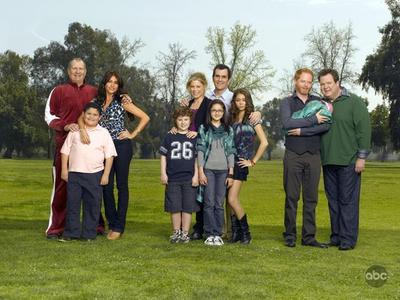
I’ve been feeling like I missed the boat on Modern Family, having pretty much ignored it last season. But since it made such a great showing at the Emmy’s and sounds like it’s here to stay, I figure I check out this pilot. If you haven’t watched it yet, maybe this will help fill you in, too.

The show opens in sit-com 101 mode, with a family starting their day with breakfast in the kitchen. It hits you with a good guffaw right at the top. The dad is yelling for the kids, and the daughter enters with, “Why are you guys yelling at us when we’re way upstairs? Why don’t you just text us?” After that there’s a bit about the daughter’s skirt being too short and the parents having baby oil on the bedside table. These may not be the most original jokes we’ve ever heard about offspring and ‘rents, but they’re delivered pretty fast and furious. This show isn’t going to waste our time. Continue reading

Raising Hope

This intent of this blog isn’t to give you reviews of all the latest shows, as there are many fine websites already doing just that. I like to look back at shows with the perspective of time, especially after they’ve been cancelled—it’s just more fun that way. That being said, with all the new shows premiering last week, only one stood out to me as not totally sucking so I figured the pilot deserved some discussion.

Anyone who has watched Fox in the past 6 weeks really didn’t need to watch this pilot for the premise, since the whole thing was spelled out in the previews. The “from the producers of My Name is Earl” angle was played up heavily and most of the great jokes were given away. So, this was one of those pilots you just want to get out of the way and start watching the show—because the show is freaking hilarious.

A quick rundown: a 25-year-old living with his parents and working a dead end job ends up solely responsible for his illegitimate daughter after the child’s mother gets the electric chair. Dark enough for you? Even without knowing about the “Earl” connection, the tone and look of the show give it away. It’s got this slightly dreary feeling, filled with objects so out of date, you can’t be sure of the time period at first. It could be 1980, or these people could just have really crappy furniture. It also has the loopiness that allows us not feel guilty as we watch a baby being flung around the backseat of a car. Yet, it retains a sweetness. It’s darker than, say, “Malcolm in the Middle,” but it’s not quite “It’s Always Sunny in Philadelphia.”

There are some unexpected moments in the pilot. After the main character, Jimmy (Lucas Neff) dramatically tells off his boss and quits his job, he comes home, where we learn that said boss is also Jimmy’s dad (Garrett Dillahunt). The other thing not seen coming in the previews is the flashback idea. Flashbacks can sometimes be used for lazy storytelling, but these are very effective, endearing us to the mother and father characters, and adding depth. The scene toward the end of the (grand)parents singing to the baby is very sweet amid all the crudeness. Not that the crudeness is bad… puking on a baby at the sight of a dirty diaper… that is some funny shznit. It’s too bad it was revealed in the preview. Here’s hoping that subsequent episodes are just as funny, and these characters will become as loveable as the Hickeys.

Hellcats

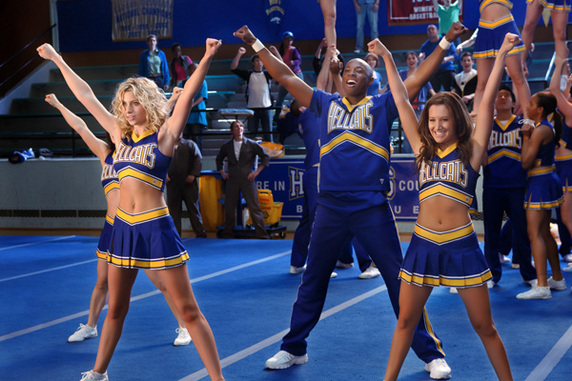
You might call it lazy to have the entire setting and premise of a show laid out via voiceover from the protagonist right at the start of your pilot, but it’s not as bad as having cheerleaders practice in front of a really obviously green screened college campus. Hellcats does these two things in its first minute. Not a good first impression. The protagonist in this case is a gorgeous blond law student who we should take seriously because she rides a bike everywhere and helps her mom make ends meet during these rough economics times. But we’re shown that she has a heart because she acts slightly concerned when a cheerleader eats it during practice.

Lest you think that I watched this pilot just to hate on it, know that I had hopes. I love cheerleader related stuff—Bring It On is one of my faves—and as a huge Veronica Mars fan, I do not believe that a low budget CW show can’t be great. Getting into the predictable story, Hotty McBicycle (still haven’t caught her name) is about to lose her scholarship and has to find a new one stat. She expresses her desperation to someone in the administrative office thus: “You know what gets me through? Hope.” It gets worse: “You kill my hope, you kill me.” The dialogue hurts. It hurts. But not as much as the way she teaches herself to cheer. Are you ready for this? She watches Bring It On. For the uninitiated, this underrated San Diego-filmed movie is all about how cheering should be taken seriously as a sport. Hotty must have fast forwarded to the cheering parts.

Hotty gets into it with the head cheerleader, Savannah (Ashley Tisdale) early. This gives the plot a conveniently-placed obstacle. But at the try-outs, Hotty, oh yeah, it’s Marti, wows the coach by ignoring the choreography and busting out her own routine. She doesn’t know gymnastics terminology but can tumble like Mary Lou Retton. She makes an offhanded reference to “training” since she was 16, but it’s not remotely believable that she gets put on a college cheerleading squad. Later it comes out that she did gymnastics in high school, but it’s too little too late.

Marti has to move into cheerleader housing called Cheer Town, leaving her devoted but obviously irresponsible mother behind. This sets up potential future mother-daughter strife story lines. We get to know the coach, her boyfriend, and her ex-lover who is also the new football coach. Their story holds some at least some possibility for being interesting.

Marti makes nice with the head cheerleader, and her real nemesis turns out to be the girl who got injured in the opening. So that’s kind of a twist. Marti attacks her with, “Do you invent your own catty metaphors, or is there like a book?” Ow. Ow, it hurts. At the other end of the spectrum, she catches the eye of strapping male cheerleader Lewis.

Glee has convinced us that cheerleaders live in their uniforms. The Hellcats wear their uniforms to practice. Why is this necessary? Yeah, they look good in them. But do the producers have to spoon feed us everything in the pilot? What’s even more annoying is that they spontaneously, somehow, know a complicated routine complete with lifts, at their first practice. Speaking of Glee, this show is its antithesis. Do we really think that a whole group of high school kids have the pipes of Broadway stars and can learn 3 or 4 songs a week, and always have appropriate costumes at the ready? Yes! Because Glee draws us in and convinces us that we’re watching a musical, where the joy of the moment overrides our skepticism. Hellcats is just plain contrived. I don’t care how plucky you are or how small your waist is, you can’t just be a cheerleader because you watch a movie. Gahhh!

Cleopatra 2525

This show, which could have been called “Boobs in Space,” was brought to my attention by a former roommate who watched it to fill up the space between Baywatch episodes. It is so campy and awful, I was delighted to find it on Hulu. What I didn’t remember was that one of the main three actresses is Gina Torres, Zoe from Firefly!

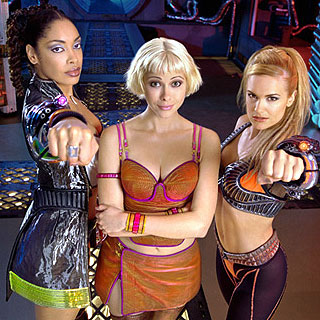
You have to hand it to these writers—they need all of a minute and a half to show us just what a  joyride in the cheesmobile we’re in for. We open on an interior shot of the now-dilapidated Sistine Chapel. Shot of a bunch of hot people in really skimpy, “futuristic” looking out fits. Some talk about going to “the surface.” A disembodied voice prodding them to go up there. The main character snapping her buggy-looking goggles into place, saying defiantly, “Let’s do it.”

Here’s the premise: a woman in 2001 went in for a boob job. Something went wrong with the anesthesia, and she was cryogenically frozen until they could find a cure (for anesthesia?) She is now waking up—spontaneously—in the year 2525. She’s been brought to a medical lab that looks like something out of Barbarella to be harvested for spare organs, wearing a costume reminiscent of the chick in The Fifth Element. Oh, and spoiler alert, she’s a stripper.

Before we meet our heroine, Cleopatra (Jennifer Sky – who?), we follow her soon-to-be new BFFs, Helen and Sarge (Victoria Pratt), in battle. They tromp around underground in the most uncomfortable looking space armor I’ve ever seen. Their cleavage, midriffs and legs are in some serious danger should a laser battle take place. By the end of the first scene the man has turned on the women. They discover him to be a cleverly-named “betrayer robot.” Clearly the women are the only heroes here, nothing unexpected in the era of Xena Warrior Princess.

The enemies in this underground future are robotic creatures called bailies. Before they get to the level boss, though the women still have to fight off the betrayer bot. He’s got laser vision that makes Superman look like a punkass. Defeating him involves some snazzy moves designed to show off the women’s hot bods. After that, Cleo attacks Sarge for no discernable reason other than that chick fights are hot.

When Sarge asks Cleopatra, “You’re very concerned about the way you look, aren’t you?” you have to laugh. And hope that the show’s creators are not actually taking this stuff seriously. The plot of this particularly story is resolved pretty easily, thanks to a handy talent of Cleo’s that has nothing to do with her cleavage. Aaaand, by the end of 22 minutes everyone is happy and ready to fight evil together. Cleo is surprisingly accepting of her circumstances. So if she’s not going to take this seriously, why should we? Answer: we shouldn’t. If you abandon all sense of reality and logic, you might have fun with this show.

IKEA Heights

Sometimes a new show is wonderful just for its weirdness. Just hearing the background of IKEA Heights  (created by Channel 101) got me saying, “must watch!” A group of young, enterprising filmmakers and actors shot a mini soap opera for the web in IKEA. Genius! You’ve got all your sets right there: bedrooms, kitchens, a restaurant. The best part however, is that they did it during regular business hours without IKEA knowing what was going on. They’re already my heroes. This may or may not have been inspired by a scene in 500 Days of Summer, but it’s pretty original.

The show begins where any melodrama should; in bed. A couple wakes up, they have some words. The words aren’t that important. There’s some tension in the relationship, blah, blah. The important thing about the scene is to get your head around the setting. The guy is in his clothes. The lighting is awful. There’s one of those signs on the bedside table telling you how much the Frngl costs.

The opening credits are fun, too. If you’ve ever shopped at IKEA you know the sights, from the Japanese ceiling lamps to the posters of meatballs. The filmmakers take advantage of all the possible “sets,” with moving on to a kitchen scene, where no water flows from the tap, to an office where the desk is clearly priced at $300, and then the pillow department, which stands in for a factory.

The main character is James, and he’s got some pretty big problems. His glamorous wife is cheating, he’s not doing so well at work, and he’s got a missing brother. Or something. Like I said, it doesn’t really matter what’s going on. The actors enjoy every second of this, milking the silliness for all it’s worth. The show wouldn’t work any other way. There actually is a plot, too, complete with a cliffhanger ending enticing us to keep watching. This is the kind of thing that wouldn’t exist without the web and the whole DIY ethos it brings.

Web Therapy

When Lisa Kudrow first looked at the camera, smiled her patronizing smile and said, “Hi, I’m…” I swear I thought she was gonna say “Regina Phalange.” It’s always an adjustment to accept an actor we’ve watched for a long time as one character, as another. And this Fiona Wallace character has the air of Phoebe Buffay putting on her Regina alter ego. In other words, she’s not exactly natural. But that’s not the idea. This pilot lets us know immediately what tone it’s going to take.

We see the desktop of Fiona’s computer as she gets to work conveying the show’s premise. She is a therapist (legitimate?) treating people via the web in three-minute sessions. The pilot is actually seven minutes long which, when we’ve been prepared for three, feels a bit long. The funny thing about media made for the web is we demand brevity.

Visually, it’s super simple, and it’s really just one joke. Fiona is treating a nerdy man named Richard. They greet each other with “it’s so nice to see you,” etc. even though it’s the first session, so we’re prepared for a history. It slowly comes out that they’ve had a relationship, possibly romantic. Each has his/her own perception of past events though, and both are a little nuts, so we’re not sure whose version of reality to buy.

Based on this first episode, the premise seems thin for an ongoing show, but somehow it’s in its third season. I haven’t watched to find out, but hopefully a season arc emerges, keeping the viewer coming back. Perhaps we haven’t seen the last of Richard; but how much sexual tension can you build showing two characters who aren’t even in the same room? Web shows tend to figure these things out as they go.

Web Pilots

Web shows have become a genre unto themselves. And, like other shows, they need pilots that draw in the audience and set the stage for the series. They have some unique challenges, though. I’ve just started mulling this over, and am wondering if anyone else has any observations. (If so, hit me up!)

Web shows generally have short episodes, ranging from one to ten minutes or so. Perhaps because of our conditioning with YouTube and viral videos, we have limited patience with content designed to be viewed online (despite the fact that we’re now watching network and cable TV online as well). So it has to grab us and grab us fast. Also, it seems we haven’t grown a taste for dramas online. Generally, this stuff has to be funny.

Not only do web show have to accomplish more in a shorter time, there are expectations of edginess. Maybe it’s the medium that dictates it; the internet is younger than TV so it must be edgier. Or, perhaps it’s the audience. People who go digging online for new stuff to watch probably aren’t satisfied with the same old-same old.

Conversely, expectations are lower when it comes to production values. Because we love to see the Chad Vaders of the world make good, we are very forgiving of poor lighting or wonky edits. We still want good acting, though. (Or do we? Do you feel differently?) It’s not all unknowns trying to get noticed; big name actors are treading the pixels.

Stay tuned as I’ll be reviewing pilots of Ikea Heights, FCU: Fact Checkers Unit, and Web Therapy.

New Amsterdam

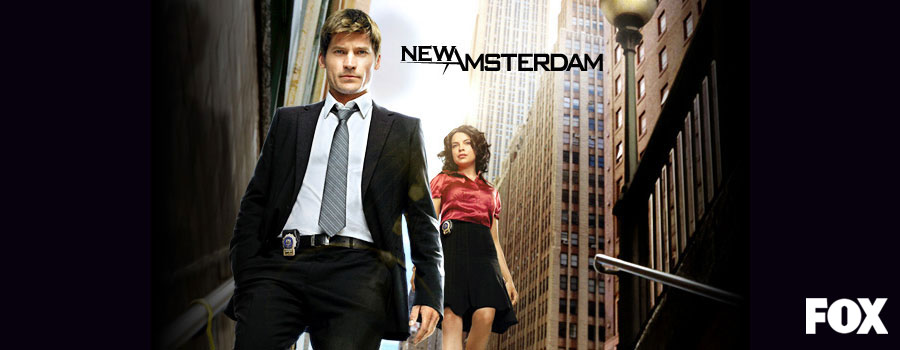
Since I tend to love shows cancelled by Fox, I had to check out New Amsterdam, which I vaguely remember being advertised. It’s about a cop with unique knowledge due the fact that he’s been alive a long time… like, a supernaturally long time. If John Doe and Journeyman didn’t last, what made them think this would?

From the get-go the city is a character. We open with a noir-ish voiceover by the main character, John (Nikolaj Coster-Waldau) describing New York and all that he’s seen happen in it over the years. It’s reminiscent of Angel describing Los Angeles at the beginning of that pilot.

The show sets up a juxtaposition of romance and violence that could become a theme. While John tangos with, and then makes love with, a woman we don’t really meet, flashbacks of a battle scene are interspersed. In the battle, which appears to be set in colonial America*, John is run through with a sword while defending a Native American woman.

Once we have a feel for the character and his story, we learn what he’s doing in the present day. Naturally, he’s a cop. What supernatural being residing in a major metropolitan area wouldn’t spend his days fighting crime? And, naturally, he’s got a mismatched partner of the opposite sex, as TV cops tend to have. She tells us her name twice in the space of a minute: Eva Marquez (Zuleikha Robinson). Perhaps we’re supposed to hate her. We do.

As the odd couple is investigating a crime scene, John takes off after a suspect, chasing him into a subway station. John is doing this whole smooth cop thing, disarming the suspect with his fearlessness, when a certain woman steps off the train. John collapses to the ground for no visible reason, and is rushed to the hospital where the doctors try in vain to revive him. To the resounding ER chants of “clear!” we see a parallel memory of John lying among a group of Native Americans. The oxygen mask in the present is contrasted with the burning sage from the past. The Native American woman who he defended earlier explains that John will never die until he finds “the one” and their souls are wed. In the present, John dies, has his toe tagged, and then wakes up and walks out of the morgue. We surmise this has happened before.

John has a confidante, Omar (Stephen Henderson) who is in on this story. He’s a wise, old, African American bartender… can we have a bigger cliché, please? With everyone else, we assume John’s immortality is a secret, although he is pretty loose with the clues. He casually mentions 609 ex-girlfriends, or five-thousand-some-odd days sober. Apparently he doesn’t care whether anyone knows, either because they wouldn’t believe him anyway, or there is nothing anyone can do to hurt him.

John and Eva (god, she’s a bitch) continue working their case, seeking the killer of a celebutante named Chloe. This mystery-of-the-week is pretty standard, existing to let us, or the network execs, know what to expect in the coming season. John drops bombshells of personal information at the right moments, like when he tells the victim’s mother, “He was six, my son.”

The twist that sets the show apart from other cop dramas is, of course, John’s extensive knowledge of New York. He has a lot of contacts, having been around a while. There is a creepy encounter with an ex-girlfriend, now pushing 90, who holds a clue to the case.

In the meantime, a doctor from the hospital where John died—the woman from the subway—is curious where her corpse got to. She’s doing her own little investigation. Sooner or later the two are bound to meet, and perhaps that will lift the spell. The question is, does the viewer want to slog through cheesy weekly cases to get there?

Some behind the scenes information and interviews can be found here.

*According to the show’s description this scene is set in 1642, but you wouldn’t necessarily know that.