Unknown's avatar

About meekthegeek

Writer, animal lover, environmentalist, pop culture fanatic, and Star Wars fan.

Cleopatra 2525

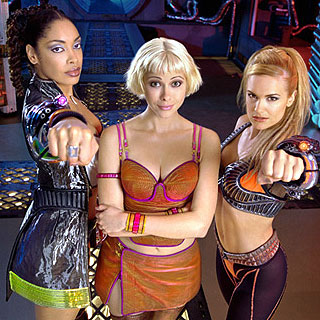
This show, which could have been called “Boobs in Space,” was brought to my attention by a former roommate who watched it to fill up the space between Baywatch episodes. It is so campy and awful, I was delighted to find it on Hulu. What I didn’t remember was that one of the main three actresses is Gina Torres, Zoe from Firefly!

You have to hand it to these writers—they need all of a minute and a half to show us just what a  joyride in the cheesmobile we’re in for. We open on an interior shot of the now-dilapidated Sistine Chapel. Shot of a bunch of hot people in really skimpy, “futuristic” looking out fits. Some talk about going to “the surface.” A disembodied voice prodding them to go up there. The main character snapping her buggy-looking goggles into place, saying defiantly, “Let’s do it.”

Here’s the premise: a woman in 2001 went in for a boob job. Something went wrong with the anesthesia, and she was cryogenically frozen until they could find a cure (for anesthesia?) She is now waking up—spontaneously—in the year 2525. She’s been brought to a medical lab that looks like something out of Barbarella to be harvested for spare organs, wearing a costume reminiscent of the chick in The Fifth Element. Oh, and spoiler alert, she’s a stripper.

Before we meet our heroine, Cleopatra (Jennifer Sky – who?), we follow her soon-to-be new BFFs, Helen and Sarge (Victoria Pratt), in battle. They tromp around underground in the most uncomfortable looking space armor I’ve ever seen. Their cleavage, midriffs and legs are in some serious danger should a laser battle take place. By the end of the first scene the man has turned on the women. They discover him to be a cleverly-named “betrayer robot.” Clearly the women are the only heroes here, nothing unexpected in the era of Xena Warrior Princess.

The enemies in this underground future are robotic creatures called bailies. Before they get to the level boss, though the women still have to fight off the betrayer bot. He’s got laser vision that makes Superman look like a punkass. Defeating him involves some snazzy moves designed to show off the women’s hot bods. After that, Cleo attacks Sarge for no discernable reason other than that chick fights are hot.

When Sarge asks Cleopatra, “You’re very concerned about the way you look, aren’t you?” you have to laugh. And hope that the show’s creators are not actually taking this stuff seriously. The plot of this particularly story is resolved pretty easily, thanks to a handy talent of Cleo’s that has nothing to do with her cleavage. Aaaand, by the end of 22 minutes everyone is happy and ready to fight evil together. Cleo is surprisingly accepting of her circumstances. So if she’s not going to take this seriously, why should we? Answer: we shouldn’t. If you abandon all sense of reality and logic, you might have fun with this show.
IKEA Heights

Sometimes a new show is wonderful just for its weirdness. Just hearing the background of IKEA Heights  (created by Channel 101) got me saying, “must watch!” A group of young, enterprising filmmakers and actors shot a mini soap opera for the web in IKEA. Genius! You’ve got all your sets right there: bedrooms, kitchens, a restaurant. The best part however, is that they did it during regular business hours without IKEA knowing what was going on. They’re already my heroes. This may or may not have been inspired by a scene in 500 Days of Summer, but it’s pretty original.

The show begins where any melodrama should; in bed. A couple wakes up, they have some words. The words aren’t that important. There’s some tension in the relationship, blah, blah. The important thing about the scene is to get your head around the setting. The guy is in his clothes. The lighting is awful. There’s one of those signs on the bedside table telling you how much the Frngl costs.

The opening credits are fun, too. If you’ve ever shopped at IKEA you know the sights, from the Japanese ceiling lamps to the posters of meatballs. The filmmakers take advantage of all the possible “sets,” with moving on to a kitchen scene, where no water flows from the tap, to an office where the desk is clearly priced at $300, and then the pillow department, which stands in for a factory.

The main character is James, and he’s got some pretty big problems. His glamorous wife is cheating, he’s not doing so well at work, and he’s got a missing brother. Or something. Like I said, it doesn’t really matter what’s going on. The actors enjoy every second of this, milking the silliness for all it’s worth. The show wouldn’t work any other way. There actually is a plot, too, complete with a cliffhanger ending enticing us to keep watching. This is the kind of thing that wouldn’t exist without the web and the whole DIY ethos it brings.

Web Therapy

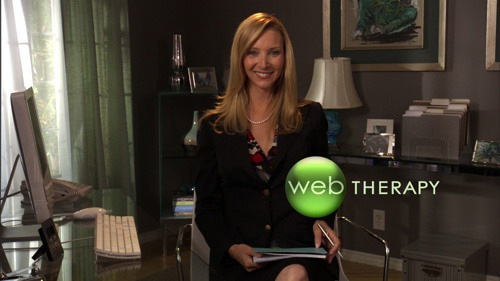
When Lisa Kudrow first looked at the camera, smiled her patronizing smile and said, “Hi, I’m…” I swear I thought she was gonna say “Regina Phalange.” It’s always an adjustment to accept an actor we’ve watched for a long time as one character, as another. And this Fiona Wallace character has the air of Phoebe Buffay putting on her Regina alter ego. In other words, she’s not exactly natural. But that’s not the idea. This pilot lets us know immediately what tone it’s going to take.

We see the desktop of Fiona’s computer as she gets to work conveying the show’s premise. She is a therapist (legitimate?) treating people via the web in three-minute sessions. The pilot is actually seven minutes long which, when we’ve been prepared for three, feels a bit long. The funny thing about media made for the web is we demand brevity.

Visually, it’s super simple, and it’s really just one joke. Fiona is treating a nerdy man named Richard. They greet each other with “it’s so nice to see you,” etc. even though it’s the first session, so we’re prepared for a history. It slowly comes out that they’ve had a relationship, possibly romantic. Each has his/her own perception of past events though, and both are a little nuts, so we’re not sure whose version of reality to buy.

Based on this first episode, the premise seems thin for an ongoing show, but somehow it’s in its third season. I haven’t watched to find out, but hopefully a season arc emerges, keeping the viewer coming back. Perhaps we haven’t seen the last of Richard; but how much sexual tension can you build showing two characters who aren’t even in the same room? Web shows tend to figure these things out as they go.

Web Pilots

Web shows have become a genre unto themselves. And, like other shows, they need pilots that draw in the audience and set the stage for the series. They have some unique challenges, though. I’ve just started mulling this over, and am wondering if anyone else has any observations. (If so, hit me up!)

Web shows generally have short episodes, ranging from one to ten minutes or so. Perhaps because of our conditioning with YouTube and viral videos, we have limited patience with content designed to be viewed online (despite the fact that we’re now watching network and cable TV online as well). So it has to grab us and grab us fast. Also, it seems we haven’t grown a taste for dramas online. Generally, this stuff has to be funny.

Not only do web show have to accomplish more in a shorter time, there are expectations of edginess. Maybe it’s the medium that dictates it; the internet is younger than TV so it must be edgier. Or, perhaps it’s the audience. People who go digging online for new stuff to watch probably aren’t satisfied with the same old-same old.

Conversely, expectations are lower when it comes to production values. Because we love to see the Chad Vaders of the world make good, we are very forgiving of poor lighting or wonky edits. We still want good acting, though. (Or do we? Do you feel differently?) It’s not all unknowns trying to get noticed; big name actors are treading the pixels.

Stay tuned as I’ll be reviewing pilots of Ikea Heights, FCU: Fact Checkers Unit, and Web Therapy.

New Amsterdam

Since I tend to love shows cancelled by Fox, I had to check out New Amsterdam, which I vaguely remember being advertised. It’s about a cop with unique knowledge due the fact that he’s been alive a long time… like, a supernaturally long time. If John Doe and Journeyman didn’t last, what made them think this would?

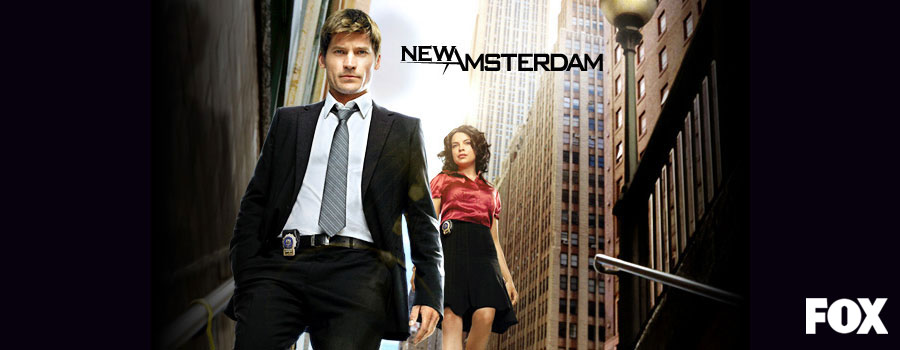
From the get-go the city is a character. We open with a noir-ish voiceover by the main character, John (Nikolaj Coster-Waldau) describing New York and all that he’s seen happen in it over the years. It’s reminiscent of Angel describing Los Angeles at the beginning of that pilot.

The show sets up a juxtaposition of romance and violence that could become a theme. While John tangos with, and then makes love with, a woman we don’t really meet, flashbacks of a battle scene are interspersed. In the battle, which appears to be set in colonial America*, John is run through with a sword while defending a Native American woman.

Once we have a feel for the character and his story, we learn what he’s doing in the present day. Naturally, he’s a cop. What supernatural being residing in a major metropolitan area wouldn’t spend his days fighting crime? And, naturally, he’s got a mismatched partner of the opposite sex, as TV cops tend to have. She tells us her name twice in the space of a minute: Eva Marquez (Zuleikha Robinson). Perhaps we’re supposed to hate her. We do.

As the odd couple is investigating a crime scene, John takes off after a suspect, chasing him into a subway station. John is doing this whole smooth cop thing, disarming the suspect with his fearlessness, when a certain woman steps off the train. John collapses to the ground for no visible reason, and is rushed to the hospital where the doctors try in vain to revive him. To the resounding ER chants of “clear!” we see a parallel memory of John lying among a group of Native Americans. The oxygen mask in the present is contrasted with the burning sage from the past. The Native American woman who he defended earlier explains that John will never die until he finds “the one” and their souls are wed. In the present, John dies, has his toe tagged, and then wakes up and walks out of the morgue. We surmise this has happened before.

John has a confidante, Omar (Stephen Henderson) who is in on this story. He’s a wise, old, African American bartender… can we have a bigger cliché, please? With everyone else, we assume John’s immortality is a secret, although he is pretty loose with the clues. He casually mentions 609 ex-girlfriends, or five-thousand-some-odd days sober. Apparently he doesn’t care whether anyone knows, either because they wouldn’t believe him anyway, or there is nothing anyone can do to hurt him.

John and Eva (god, she’s a bitch) continue working their case, seeking the killer of a celebutante named Chloe. This mystery-of-the-week is pretty standard, existing to let us, or the network execs, know what to expect in the coming season. John drops bombshells of personal information at the right moments, like when he tells the victim’s mother, “He was six, my son.”

The twist that sets the show apart from other cop dramas is, of course, John’s extensive knowledge of New York. He has a lot of contacts, having been around a while. There is a creepy encounter with an ex-girlfriend, now pushing 90, who holds a clue to the case.

In the meantime, a doctor from the hospital where John died—the woman from the subway—is curious where her corpse got to. She’s doing her own little investigation. Sooner or later the two are bound to meet, and perhaps that will lift the spell. The question is, does the viewer want to slog through cheesy weekly cases to get there?

Some behind the scenes information and interviews can be found here.

*According to the show’s description this scene is set in 1642, but you wouldn’t necessarily know that.

Friends

How have I not written about this before? I practically have it memorized. But let’s be honest , the first season (or 2) of Friends was pretty bad. But clearly it resonated way, way back in 1994 despite all those atrocious hairstyles and the need to shove each character into a stereotyped package. (Ross is a nerd, Rachel is spoiled, Phoebe’s a flake, Joey is a womanizer, etc.) It took until season 4 to round it out to “married a lesbian, left a man at the altar, fell in love with a gay ice dancer, threw a girl’s wooden leg in a fire, lives in a box.” 

Eventually, each Friend become a well-rounded human being who we watched grow over a decade, but it was like the writers didn’t give us viewers credit for having the patience to get to know them. Who knows, maybe we wouldn’t have.

This pilot is so pilot-y. We are bombarded with back story, character quirks, and strained jokes. Everything is over the top: the hairstyles, the coffee cups, Joey’s accent. On the off chance that you haven’t seen it, the plot is that Ross (David Schwimmer) has just split from his wife, just as Monica’s (Courteney Cox) old high school friend Rachel (Jennifer Aniston) leaves her husband-to-be at the altar and runs off to Manhattan to get away from her suffocating suburban existence. Ross has had a thing for Rachel since puberty, and now the possibility of a relationship finally exists.

One thing we can observe from the pilot of Friends is that, although it’s purported to be an ensemble show, it’s really about Ross and Rachel. Always was, always will be. In this opening episode the other four are basically just comic relief. The jokes were pretty bad, too. Even Chandler is unfunny, for Chandler (Matthew Perry). The only part that makes me laugh out loud is when Rachel is on the phone to her father. She is all disheveled, still in her wedding dress, pleading with him for understanding. To paraphrase, she describes how everyone has always told her she’s a shoe and today she’s realized she’s a hat. There’s a pause, then: “No I don’t want you to buy me a hat. It’s a metaphor, Daddy!” So although she’s an ingénue, she’s wacky, and a solid comic actress (who gets funnier each season). You may have heard the story about how she originally auditioned to play Monica.

If for some reason you haven’t seen this, just watch one of the 500 channels that carry the show in syndication and you’re bound to catch it.

Rubicon

Rubicon, a new show on AMC has a cool title (a metaphor for a point of no return) and a cool tag line: “Not every conspiracy is a theory.” So I decided to see what they mean by that.

Things start off simply. A quote appears: “An invisible empire has been set up above the forms of democracy.” We’re asked to guess who said it, Ted Kacyzinski or Woodrow Wilson. Naturally the answer is the less obvious, and by extension, the more eerie, Wilson.

Next we see some kids running happily through the show. They’re shot from above, lending a starkness that says their happiness will be short-lived. A woman, we assume their mother (Miranda Richardson), joins in their game, while inside the stately manse, a man (their father? grandfather?) reads his morning newspaper. A four-leaf clover is pressed into the paper, giving him pause. He proceeds upstairs and blows his brains out.

The opening credits speak to anyone who is a fan of Dan Brown and the like. Numbers, symbols, words, and images are circled or connected, hinting at sinister hidden messages all around us. One of the images is of a freeway off/on-ramp “clover,” and immediately in the next scene people are sorting out a crossword clue about a four-leaf clover. So we’ve got a theme that is none too subtle.

Our protagonist is Will Travers (James Badge Dale), a moody academic. He is apathetic when a female co-worker reminds him it’s his birthday and offers to buy lunch. Will attends a staff meeting, which serves as an introduction to the other characters. Tanya, the most junior staff member, is chastised by Grant for forgetting the doughnuts. Grant is a jerk. Miles is a bearded version of Will. David, their boss (Peter Gerety), looks the part of esteemed university professor, complete with elbow patches. He gives each member of the team a cryptic assignment, starting with observing missile silos. It’s not entirely clear what this workplace is, or what the characters do. But that’s okay, because the real story seems to be Will’s obsession with a particular set of crossword puzzles.

Will brings the puzzles to David, for the elder gentleman’s expertise. There seems to be a pattern in the puzzles hinting at a mysterious fourth branch of government, the branches being symbolized by—you guessed it—clover leaves. It seems like a huge stretch to the viewer, but we have to buy that these guys are smart enough to see meaning where we laypeople would not. David gives him the brush off, only to pounce on the puzzles himself once Will is out the door. He in turn shows them to his boss, Kale (Arliss Howard).

A big reveal comes at lunchtime when Tanya asks Miles why Will walks around looking like his cat died. Miles replies, sanctimoniously, “Try wife and child. Try 9-11.” It’s a little ham-handed but adds an important layer to Will’s character. Another detail, this one handled with welcome subtlety is the revelation that David is Will’s father-in-law. “They’re gone,” he says. “It’s just something both of us have to accept.”

[SPOILER ALERT] David, we find is carrying the burden of knowing whatever Big Event is about to happen that will set off the storyline for the series. He warns Will to leave town, and then is killed in a train accident. Will, like any good conspiracy theorist, doesn’t accept that it was an accident. He reluctantly takes David’s job when it is rather insistently offered.

He enlists the help of a colleague, introducing us to another key character, Ed. Ed has that whole wise old hermit thing going on, so we figure he’s going to know some things.

So will the show be about solving David’s murder? Or about the crossword puzzle plot? Or both? And what of the man who killed himself in the opening? The pilot, though it has an arc, doesn’t really have an ending; and that’s a good thing. We’re in for some mellow-drama, to be sure, but it’s got the necessary hook.

WKRP in Cincinnati

You might remember this sitcom from 1978. If you’ve ever lived in Cincinnati, you probably remember it better than most. The pilot launches straight into an opening sequence, with a person’s hand adjusting a car radio, searching around before landing on what will be the show’s theme. We’re led to understand that the city itself will play a part. There are lots of shots of iconic Cincinnati landmarks: Fountain Square, skywalks, the Suspension Bridge, Riverfront Coliseum, Riverfront Stadium… there’s even a billboard for Frisch’s Big Boy in the background of one shot. Interestingly, only two actors’ names are given during this sequence (Gary Sandy and Gordon Jump).

The story is motivated by the introduction of Andy Travis (Gary Sandy), the new program manager at a lagging, independent radio station. Starting with what we can surmise is a typical morning, we see the buxom receptionist (Loni Anderson) water the plants as sleazy salesman Herb (Frank Bonner) hits on her. Andy arrives, with a hint of a southwest accent, wearing a cowboy hat, and we know he’s different. We soon discover that he’s smart and articulate, traits which further separate him from the Midwestern hodgepodge.

The characters go on entering, one by one, each full of warnings for Andy about the high turnover of program managers at WKRP. Les Nesman (Richard Sanders) is the uber-dorky newsman. Arthur Carlson (Gordon Jump), the boss, cares more for fishing—in his office, no less—than actually working. Johnny (Howard Hesseman) makes the grandest entrance as a confused, sleep-deprived, cool guy (today we’d call him a hipster) who has gone by a different moniker in every city where he’s worked. Drug use is implied though not spelled out. Bailey Quarters (Jan Smithers) is the mousy office assistant, who may have potential to do bigger things. If anyone is going to hook up, it’s going to be Bailey and Andy.

The station desperately needs an update in format to survive, despite the wishes of its owner, Carlson’s conservative mother. Andy boldly changes the format, in an exciting and funny scene with Johnny. The chronically tired DJ comes alive with the switch over from elevator music to contemporary rock-and-roll. We enjoy his triumph as he rocks out, rechristening himself Johnny Fever.

As in many shows of this era, the laugh track is used to exhaustion. The thing is, the show’s a riot on its own. The jokes are pretty lowbrow, ranging from sight gags like Carlson’s casting a fishing line over his desk, to funny song titles (How Can I Miss You if You Won’t Go Away?), to plain old stupidity.

Today, there’s the added humor of, well, the 70s. Records! Eight-tracks! And scarily, the clothes don’t look that out of style. The real humor, though, comes from the characters. In some ways, WKRP is a predecessor to The Office, following people who manage to get through their workday by doing next to nothing. If computer solitaire had been invented in 1978, you can bet these guys would be playing it. Andy is Jim. Carlson in Michael. Bailey is Pam. Johnny is a male Meredith. Les is Dwight. No such comparison exists for Venus Flytrap, the charismatic DJ, who looks for all the world like a pimp, introduced at the very end as the episode’s final button. Les calls him a Negro – can you still say that on TV?

The Donna Reed Show

Remember how, for a while in the 80s, the 50s were super cool? I guess it was brought about by Back to the Future, possibly Grease 2, and most definitely Nick at Nite. I was all about that trend, dressing as a “50s girl” for Halloween complete with saddle shoes, and I wanted to be Mary (Shelly Fabares) on The Donna Reed Show.

Some pilot traditions remain unchanged for decades. This one opens with the getting-ready- in-the-morning sequence. The teen daughter, Mary, and younger brother, Jeff, are complaining to their mother over breakfast about how little they see of their pediatrician father. The tone seems pretty naturalistic. In fact, the dialogue is a little rambly by today’s standards. But I can imagine a viewer in the 1950s thinking “Gee whiz, this is a regular family like mine.”

Mr. (Dr.) Donna Reed practices medicine out of his home. In this episode, Donna (whose last name in the show is Stone) wants Dr. Stone’s colleague, Bo, to cover his practice for the weekend so that the family can take a much-needed holiday. Bo and Donna are a little flirty, and if this were on the air today, we would swear they were destined for a hook-up.

Dr. Stone has to cancel the vacation so he can testify for a friend in traffic court. Right away, Donna is off to see the friend in question and solve that one. A pattern is staring to form; Donna is a meddling wife. The men around her tend to fall for her charms. Next, the joke is on Donna when it turns out she is supposed to host a luncheon over the weekend in question, once again putting the family plans in jeopardy. Her husband forgot to give her a phone message, a deed she punishes by making him fix his own dinner. They solve that conundrum, only to run into another one in the form of a sick patient. Donna meddles some more, and that’s solved. Finally, their weekend is cancelled once and for all when Jeff comes down with Chicken Pox. The moral is that all the meddling in the world can’t stop the everyday challenges life throws at parents.

The pilot gives broad brushstrokes of the family and their lifestyle. Through it all, Donna is never wrong, never admits a mistake. It doesn’t look as if the problems of the Stone family are going to be serious ones. While the show is filled with corny jokes and laugh tracks, it’s not all that funny, either. The main characters are so sweet and charming, we can anticipate that the conflicts will arise from other families doing bad stuff. Really, the Stones aren’t much different from the Huxtables or the Seavers. Donna Reed wasn’t breaking new ground at the time, either. Leave it to Beaver and several other family sitcoms were already on the air. That being said, there is obviously something timeless about this show, or we wouldn’t still be watching it.

Firefly

I have been putting off writing this entry for a long time, which is in no way a reflection on my opinion of the show. It’s more like I’m afraid I can’t do Firefly justice, especially considering the rapturous devotion of its fans. If you’re a loyal browncoat you probably know the pilot backwards and forwards. If you’re not, it may be that you blinked and missed it before Fox canceled it. (I won’t rehash the whole fan outcry/Serenity story.)

It’s not like Joss Whedon invented a new genre here; we’ve seen space anti-heroes before. And I, for one, was not a Whedon fan prior to this, so I wasn’t like “Hooray, a new show from the creator of Buffy.” The show just hit all the right notes with cool setting, fascinating characters, great dialogue, and a healthy dose of dark humor.

The show opens with an in-the-trenches war scene, which could be out of any number of movies. The clue that something is different is that the aircraft flying overhead look like nothing we’ve seen before. A man (Mal, played by Nathan Fillion) and a woman (Zoe, played by Gina Torres) are leading a shell-shocked contingent against an attack. Their language is slightly heightened; in fact, the whole scene is a bit confusing the first time around. All we really need to know is that the troops are forced to lay down arms when their back-up abandons them. The look on Mal’s face and the music playing tell us all we need.

Music is huge in this pilot. The score is a twangy, gritty collection of music reminiscent of old westerns. Its juxtaposition with high-tech space travel gives Firefly its own unique tone.

We jump ahead six years from the battle scene to a spacewalk by a crew of three. The striking quality of this scene is that it is very quiet—opposite the previous scene—with sound seemingly sucked up by the vastness of space. Meanwhile the pilot of the ship, who seems to be keeping an eye on the mission, is actually playing with dinosaur toys on his console. (I may have to add this to my list of best character introductions.) “Curse your sudden but inevitable betrayal,” cries the Stegosaurus to the Tyrannosaurus.

From there, we start to meet the rest of the crew. There is the ever-cheerful mechanic, Kaylee (Jewel Staite). There is a “companion,” or prostitute, Inara (Morena Baccarin). And there’s Jayne (super-dreamy Adam Baldwin), all-around tough guy. The pilot is Wash (Alan Tudyk), Zoe’s husband.

The crew has to quickly shut down the ship’s power as they pass an enemy, and we find out a few details. The ship our crew flies is an out-of-date model called a Firefly. Its name is Serenity, and it becomes a character unto itself over the course of the series. The ship and its crew are, for lack of a better term, off the grid. They’re clearly hiding from something.

Captain Mal and company land on a dusty planet and pick up some new passengers, a preacher, a doctor, and a third man. A lot of characters and a lot of information are introduced very fast. The show demands your attention and is worth watching over and over, because so much happens. The dialogue is layered with character revelations and plenty of wit. The basics are, they’re short on cash, carrying stolen cargo, and on their way to seek help from a woman who once shot Mal. This is not going to go smoothly.

If you haven’t seen this, watch and enjoy the twists and turns for yourself. No one is who they seem. They all have secrets. Some violence beaks out now and again. And the doctor is transporting some very unusual cargo. Our protagonist, Mal, seems cool on the surface, even when angry, but clearly that war experience—and maybe a lot of other pain—is seething beneath the surface. Oh, and there are enemies out there in space called Reavers, to whom the crew’s reaction is bone-chilling. Just watch it.