Breaking In, or Trying to Speak Geek

Some pilots want nothing more than to convey to the viewer what the creators imagine to be the unique style and tone of the show. Breaking In, which debuted last night on Fox, wants you to know it’s for geeks. They really, really want you to know it. I can just hear the pitch meeting: “It’s a show about smart geeks who work together to foil security systems and have a crazy boss. It’s like Chuck, meets Archer, meets The Office! With a dash of The Big Bang Theory!”

I won’t rehash the entire plot since there are any number of reviews out there. Basically, a smart but understated guy named Cameron (Brett Harrison of Reaper and The Loop) is not so much recruited by as coerced into working for a security company. The gang at the company, led by Christian Slater as Oz, pull off creative and highly challenging heists for a living.

Star Wars references seem to pop up in everything these days. How I Met Your Mother and Bones incorporate them really well, making you believe the characters think of Star Wars as part of their lives. (Marshall will cut a Thanksgiving turkey with a light saber one day.) In Breaking In, the character Cash (Alphonso McAuley) is introduced wearing a Han Solo costume. His first joke wraps up a nerd joke with a race joke–about how black guys don’t always have to play Lando. It would have been funnier if he just went around dressed as Han Solo with no explanation, leaving it for the audience to notice. (Does it matter what race he is? Meg played a freaking worm in Family Guy’s Star Wars universe.)

That bit is quickly followed by one in which Cash references Avatar then asserts that he speaks Klingon. We get it-you’re a geek!

As the New York Times points out, Christian Slater’s leering coercion of Bret Harrison looks an awful lot like the goings-on on Harrison’s previous geek-friendly show Reaper. Another more subtle geek reference, and one of the episode’s bright spots, was the appearance of the nearly-unrecognizable Michael Rosenbaum (Smallville’s Lex Luthor) as Dutch. He is hilariously doofy in his trailer trash-duds and monster-sized truck. When this show crashes and burns, he could have a future on Raising Hope.

It’s not that this pilot wasn’t entertaining or have it’s funny moments. It just seems like it’s trying way too hard to tell us what it is and what it is not, without allowing us to figure it out over a few episodes. It wants geeks to know they’re the intended audience, but it doesn’t know how to talk to them.

I feel pandered to. Raise your hand if you feel pandered to.

Pilots that Never Flew

There are more pilots that never get picked up than most people ever stop to think about. It can be funny or horrifying, or in the case below, a bit sad, to imagine a show that the world was robbed of seeing. 

A couple of days ago, Bleeding Cool posted a clip from a 1969 clip of a Jim Henson-created Wizard of Id series, based on the comic strip by Johnny Hart. It looks like the plan for the show was simply to recreate individual comic strips with Muppets, rather than to create half-hour plotlines. Still, you can see the creativity at work here from Henson’s mind. And see if the Wizard’s voice doesn’t tug at your heart strings.

Here’s a list of seven other pilots that never got picked up, from OMG Lists. (It’s a couple years old, but there are some gems.)

Traffic Light

Traffic Light on HuluMaybe it’s just me, but Traffic Light seemed to slip in under the radar in early February. There was little fanfare for this comedy that airs on Fox after Raising Hope, but it had some funny moments, so checking out the pilot was in order.

The show takes full advantage of hands-free telephone technology now widely available in newer cars. The pilot opens with all three of the main characters talking to one another as they drive, and gets really funny when one of them gets pulled over. This turns out to be more than just a one-off bit. This angle allows the writers a fresh, modern take on friendly conversation—does the world need another sit-com where everyone hangs out in a bar? It also underscores an element of the zeitgeist; we’re all connected, all the time, even when we’re ‘alone.’

The three main characters are introduced as they speak, with subtitles giving their names and relationship statuses; these are completely unnecessary, as the dialogue does a perfectly fine job of filling us in.

Mike (David Denman, The Office) is married with a baby. Adam (Nelson Franklin, also The Office) is just moving in with his girlfriend. Ethan (Kris Marshall)’s only significant relationship is with his dog. Three different guys are in three different stages of life, giving the writers ample opportunity to riff on singlehood and relationships alike. One other piece of information is worked into the conversation. The 27th (of whatever month we’re in) is “Ben’s day.” There are a few more brief mentions of Ben throughout, but we have to wait until the end of the episode for payoff.

The two women rounding out the cast are Mike’s wife, Lisa (Liza Lapira, Dollhouse) and Adam’s girlfriend, Callie (Aya Cash). Lisa gets a great introduction. Mike is hiding out in his car, parked a block from his house, in order to sneak in alone time from his family. He explains this to his friends on the phone in such a way that we, the audience, don’t see him as an irresponsible jerk but rather as just a guy who wants to watch Ironman in peace. Lisa surprises us—and him—by showing up at the car to nonchalantly hand off the baby. She then heads off for a jog, shouting, “love you!”

It’s refreshing that Lisa’s not a stereotype; either a nagging wife who beats her husband into service or a hysterical prima donna who cries when he bails. So far, so good. Then, however, things start to spiral into sit-com 101. Of course, one of the characters has to be a lawyer and one has to be a journalist. Lisa starts nagging Mike to go to some work function with her, and even if she lacks in nagging capacity, Callie more than makes up for it. Nagging leads to lying and manipulating when Adam has to get out from under her thumb to hang out with the guys.

The plot devolves further with some nonsense about Mike having to dress as a wrestling clown for Adam’s boss’s son’s bar mitzvah. Finally, we get to a resolution that reveals who Ben is, or rather was, and thus the bond shared by the three guys. It’s a nice, sensitive moment, ala How I Met Your Mother, albeit with a strained metaphor for the “traffic light of the title.” Once can only hope that the attempted tear jerker won’t become the hallmark of each episode.

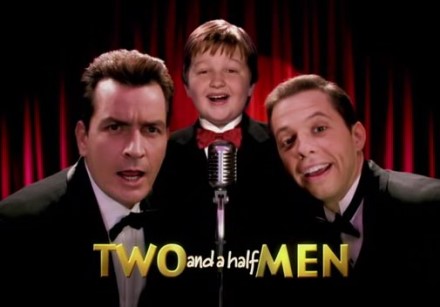
Two and a Half Men

Let’s play pretend. Let’s pretend that we don’t know Charlie Sheen has gold teeth or what he truly thinks of Chuck Lorre. Charlie Sheen is a movie star who made an unfortunate foray into television taking over for Michael J. Fox on Spin City. And Jon Cryer is just Duckie. And these two guys who we last cared about in the 80s are co-starring on a new show called Two and a Half Men.

Charlie Sheen’s character, Charlie Harper is painted as a womanizer literally from the first seconds of the pilot. He’s in the bedroom with a woman. When she leaves the room to change into a lacy negligee, another woman calls the answering machine to tell Charlie off. The laugh track is kept busy with sex jokes for the first minute and a half.

The next voice on the answering machine is that of Alan (Cryer), Charlie’s brother, who announces that his wife has thrown him out. Thus the premise for the show—Alan wants to stay with Charlie, where he will surely be in the way of Charlie’s love life. In fact, he’s already there on the other side of the bedroom door. In the conversation that follows, we find that Alan, the brother who has been married for 12 years seems to know far less about women than the single Charlie. Also, it’s slipped Charlie’s mind that Alan has a 10-year-old son, Jake.

The jokes fly fast and furious. Alan has brought his own sheets to sleep over. He’s been named Chiropractor of the Year. Charlie gives a rundown of his cush life, which includes midday margaritas and sundeck naps.

The next morning Charlie opens his eyes to find a pasty little boy face hovering over his bed. Jake (Angus T. Jones) is not a cute TV kid. He’s a pudgy, dorky kid, one used to structure—eating lunch at a certain time, drinking a specific brand of milk. Charlie doesn’t do structure. Jake’s presence sets up some no-duh commentary on adult life, i.e., “If [wine] makes you feel bad, why do you drink it”? Charlie quickly learns of another advantage; the kid is a babe magnet. “You’re better than a dog,” Charlie delights in telling him.

In this episode we meet Judith (Marin Hinkle), Alan’s uptight wife who believes she might be gay and Evelyn (Holland Taylor), the guys’ well-dressed, no-nonsense mother. We also learn early on that Charlie has a stalker who calls him “monkey man.” She’s a cute neighbor, Rose (Melanie Lynskey) who claims to be the maid and does nonsensical things like gluing the kitchen cupboards shut. We know to expect a lot more of her.

The revelations of Charlie’s degradation continue throughout the episode. “Charlie is great with kids,” Alan assures Judith. Cut to Jake playing poker with a bunch of men in a smoke-filled room. In retrospect, it’s easy to wonder if Charlie Sheen is even acting; he doesn’t even have to respond to a different name.

A lot of Alan’s humor comes from his pained facial expressions. He naively clings to the belief that he and Judith are just “working things out.” He’s so uptight one wonders how he fathered a child in the first place. There is no end of potential jokes in this odd couple scenario. (As a side note, Alan’s character bears an uncanny resemblance to Felix in the 1968 film The Odd Couple.) It takes a new tone, though, one that was perhaps more irreverent than network sit-coms tended to be in 2003.

Alan and Jake try living with Evelyn, but Charlie asks them back. It seems that the love of a kid has put a tiny crack in the walls around his party boy heart. Clearly things don’t work the same way in real life.

UPDATE: 5/13/11 Ashton Kutcher has officially been cast in Two and a Half Men.

Project G.e.e.K.e.R.

You’d be forgiven for having never heard of Project G.e.e.K.e.r., an animated sci-fi series that aired for just three months in 1996. And, you wouldn’t be crazy for thinking that the protagonist kinda looks like a worm; or that he sounds an awful lot like Philip J. Fry. Actually, the only two reasons worth watching this little show are that Doug TenNapel of Earthworm Jim fame created it and Billy West voices Geeker.

The animation is after school quality. After school in the mid-90s quality. We didn’t demand much from our animated series until later in the decade when we started to see more of it in prime time, with shows like Futurama and King of the Hill. Futurama fans watching Project Geeker today may get a brief second of déjà vu; both pilots open with a voiceover by the main character (played by the same dude, you remember) pontificating, “The future…” before explaining things to the audience. (Of course, in Futurama, it’s a goof, as it turns out that Fry is explaining a video game. Have I mentioned that Futurama rocks?)

As with a lot of kids’ shows—I’m assuming kids were the target audience—the premise is explained fully in the opening so the pilot could just as well be any random episode. The plot of this one doesn’t matter. Something about a destruct sequence. The overall plot of the series is that an evil genius, Moloch (Jim Cummings, most recently of Gnomeo and Juliet), is trying to track down the AI he created. The AI is Geeker, or Project GKR, and he wasn’t quite fully baked when he was stolen. Now he is in the hands of a voluptuous cyborg whom he calls Becky but who calls herself Lady MacBeth (Cree Summer, of a million different projects including Dragon Age: Origins). Brad Garrett, who I didn’t even realize has done a ton of animation, plays a big talking Tyrannosaurus who hangs out with them. The trio runs around trying to escape the reach of Moloch, while Geeker shape-changes, getting them in and out of various scrapes.

What else can I say? It’s a kids’ show. There’s a lot of noise and color and predictable jokes. The bad guy talks like a Bond villain. Geeker is kind of loveable, though. He’s one of those unlikely heroes who succeeds by screwing up. Kind of like Jar-Jar Binks. Wait, I said loveable. I don’t know, it’s a weird show. In prime time it could have been edgier and echoed the brilliance of the original Earthworm Jim game.

Square Pegs

Sarah Jessica ParkerGiven the current surge in nostalgia for the 80s, it’s a good time for Hulu to reintroduce the world to Square Pegs. From 1982, the show centers around two geeky high school girls trying to fit in. It stars Sarah Jessica Parker, even before Footloose and Girls Just Wanna Have Fun. Her co-star is Amy Linker who, according to IMDB hasn’t done anything since 1985. What I remember about this show is that the two lead actresses were on the cover of Dynamite magazine. Anyone? Dynamite magazine?

The show begins with the two of them talking, in voiceover, about their intentions to infiltrate the right cliques. “This year we’re gonna be popular,” the one with a slight Northern accent declares, “Even if it kills us.”

The pilot opens, as you might expect, on the first day of school. As the opening scene unfolds, at a pep rally, we learn that the one offering popularity instructions was braces-wearing Lauren (Linker). Glasses-wearing Patty (Parker) is her willing follower on the road to coolness. (See that? Glasses and braces are universal shorthand for geeky. Apparently Linker was also wearing padding to make her look fat, but she is only Hollywood fat, if anything.)

Lauren’s superior knowledge of who’s who gives the audience a chance to learn some names and ranks. The dreamiest guy in school is Larry Simpson. The most popular girl is Jennifer (Tracy Nelson – one of those Nelsons), who has a Princess Diana thing going on. Being popular also means talking with a Valley Girl accent, peppered with ‘like’s and ‘ya know’s. “Gross me out the door” she declares in once scene, prompted by nothing.

The pep rally scene also introduces Jami Gertz as Muffy Tepperman, the Patty Simcox of the group, and the token black student, L.D. The latter performs a song-and-dance number with the hideousness only the 80s could conjure.

For some reason the kids are dressed like it’s February, but forgetting that, the fashion paints us squarely in the 80s. Not in the send-up way that shows depict the 80s today, but realistically. )Seriously, we didn’t wear Madonna gloves and stirrup pants every day.) There are some really specific references to pop culture of the time too, like to a particular Budweiser commercial.

It takes a few scenes to get a feel for the tone of this show. Although it’s a half-hour comedy, it doesn’t feel like a sit-com. It’s single camera, with a lightly used laugh track. There’s a weightiness to it that would be seen in later shows like Freaks and Geeks and My So-Called Life, and still later, Glee. It’s nice to see high school girls drawn as intelligent and articulate, even if they do still turn to butter in the presence of dreamy senior boys. Although Patty is heartbroken to learn that Larry isn’t into her, she responds with, “Larry, you needn’t reproach yourself.” Actually, much of the episode’s humor derives from her intense seriousness.

Oddly, we never see any of the characters’ home lives. In a show of this kind, we expect to see fights with parents, rule breaking and groundings. The pilot takes us from the pep rally, to lunch, to gym class, and finally to a school dance. As a side note and further sign of the times, the Waitresses appear as the band playing the school dance. It’s as if the writers are letting us know that school is these characters’ whole world, which is how it often feels at age 14. “My life is over,” Patty observes at the end. And we know her life will end in some little way every week, because that what happens in high school.

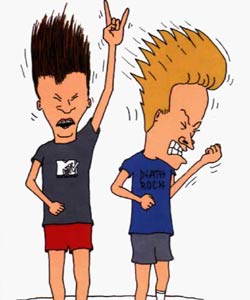
Beavis and Butthead

MTV is going to reboot the 1990s animated series Beavis and Butthead, so it’s a good time to revisit the original. Beavis and Butthead got its start at Spike and Mike’s Festival of animation, which is no surprise; it’s weird and disgusting, and really edgy for a time when the edgiest animated series on TV was The Simpsons. The episode that aired at the festival, the pilot, was “Frog Baseball.” The episode labeled 1.01 on the DVDs now available is something different, apparently from about a year later.

The show, as it aired, interspersed short snippets of story with longer stretches of Beavis (creator Mike Judge) and Butthead just sitting on the couch commenting on music videos. The DVDs seem to contain only the in-between stories, which are pretty weak on their own, and not even that funny. (I’m guessing this is an issue with the rights to the music videos.) The couch sections were what made the show different and, dare I say, relatable, to anyone who grew up with afternoons that grew long and boring as summer vacation wore on, in the era when MTV played videos. Who doesn’t enjoy making fun of Milli Vanilli?

The “plot,” to use the term loosely, isn’t important in this pilot. It’s about, well, frog baseball, which is pretty self-explanatory. It gives us a chance to meet these two slacker kids who love blood and hard rock. They wear T-shirts emblazoned with the names AC-DC and Metallica. When the game goes well—well meaning bloody—the characters air guitar anthems like “Iron Man.” Butthead is the ersatz leader of the pair, and Beavis is even dumber than him, if that’s possible. The outdoor landscape is dried out and bleak, and knowing now that Mike Judge tends to set things in Texas… it’s probably Texas.

When they’re back home in front of the tube, nothing else in life seems to matter. There is nary a parent in sight and, in the pilot, we don’t meet any other characters at all. (Later there are various neighbors and classmates, including the inspiration for the spinoff Daria.) The slacker ethos pervades every aspect including the crappy animation. But, for all their apathy, B & B have strong opinions about music. They don’t articulate these opinions with any grace; stuff either sucks or rocks. If it really rocks it warrants lifting one’s hands in devil horns and headbanging. The animation quality actually seems to tick up a notch as the characters’ hair flies back and forth in heavy metal abandon. When, before 1992, did we see an animated character headbang? The videos alternate between terrible and what is now terrible but was then cool. If you ever liked Axl Rose, even a little, you can probably find something to like here.

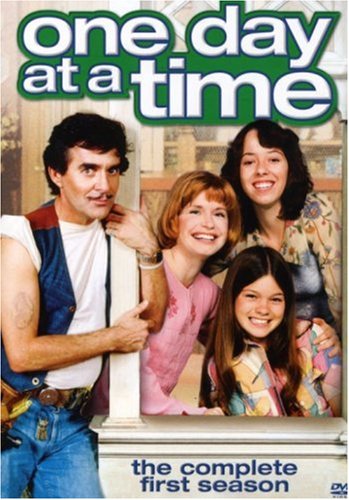
One Day at a Time

Since I recently wrote about Hot in Cleveland, I thought it would be fun to look back at an earlier Valerie Bertinelli vehicle, One Day at a Time. She was just 15 when she started playing Barbara Cooper in 1975.

The pilot gives a slice-of-life picture of the Romano/Cooper family of Indianapolis. It’s not their first day in town, it’s no one’s first day on the job, and no characters are meeting for the first time. The writers could have chosen to start the story with Ann leaving her husband, or with her breaking the news to the girls that they were moving, or with their first day in the apartment. But since that transitional period is behind us, we have more opportunity to see the relationships among the characters as they function on a relatively normal day.

We open with a typical family discussion, in which older daughter Julie (Mackenzie Phillips), tries to manipulate her mother into letting her go on a co-ed camping trip. Like most teenage girls, she considers her social engagements the highest household priority and can storm out of a room as well as any modern day reality “star.”

While Julie is stomping around in self-pity, younger sister Barbara has just become the first girl on the school basketball team. Her tomboyish attitude stands in stark contrast to Julie’s girlishness, setting up for plenty of future conflicts. Valerie doesn’t get a ton of screen time, but her snarky strength here is little like what she displays in Hot in Cleveland.

The show finds its edge in exploring the age of the liberated woman. Ann jokes about—and struggles with—wearing the mantle of both mother and father to two headstrong teenage girls. She’s a strong woman and lets her daughters be strong women, too. Independent though she may be, Ann is pursued by two men; her younger, charming divorce lawyer, David (Richard Masur), and the smarmy, married building superintendent, Schneider (Pat Harrington, Jr.).

The show was taped in front of a live audience, so we get our cues when to laugh and how hard. However, the jokes arise naturalistically out of the dialogue. The only time the jokes get ham-handed is in the banter between the two sisters. Barbara calls Julie “the pits,” like that’s the worst insult ever. Was that a thing in the 70s?

Importantly, in addition to laughs, the show has heart. At the mid-point we finally learn what is the “first” that makes this day pilot-worthy. Ann makes her first crucial solo parenting decision , calling Julie’s bluff on a threat to move out. As Julie disappears down the hall, Ann makes the speech on which the pilot rests: “For the first 17 years of my life, my father made the decisions. For the next 17, my husband the decisions. The first time in my life I make a decision on my own, I blew it.” Bonnie Franklin gives an versatile performance, moving easily from glib to passionate, from funny to moving. Her face when Julie returns speaks volumes.

Other feminist ideas are woven in, like when Ann ponders whether God is a woman, and when she mentions that she has returned to using her maiden name. Though they were probably uncommon at the time, such ideas are treated as matter-of-fact. Today, in contrast, “feminism” is often treated as a dirty word and such ideas are lampooned—my, how far we’ve come. Unfortunately the Julies on television seem to have outnumbered the Barbaras; just look at the women on Hot in Cleveland.

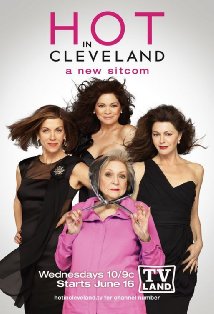
Hot in Cleveland

It’s a pretty safe bet if a series opens on a plane, the plane is going down. This one goes down in Cleveland. Three beautiful middle-aged women, all familiar faces from earlier sitcoms, are headed to Paris for some gal pal time. The very first line speaks to the theme of body image insecurity. “Airplane mirrors aren’t accurate, are they?” asks Valerie Bertinelli’s character, Melanie. Her loyal friends are quick to assure here that they most definitely are not.

The in-air conversation doesn’t get much more complex than that, but gives us a taste for each character. Melanie has written a book listing things a woman should do before she dies. She is going through a divorce, and hasn’t abandoned hope of a reunion, until finding out her ex is already engaged. Joy (Frasier’s Jane Leeves) is an eyebrow… um, stylist? And Victoria (Wendie Malick) is a longtime soap opera actress who loves being recognized. She’s basically her character from Just Shoot Me so we don’t have to work hard there.

The joke is pretty simple. Women who feel old, fat, and ugly in L.A. can feel gorgeous in Cleveland. It’s a set-up for a million jokes, particularly biting if you happen to have traded a Midwest life for one filled with palm trees (and there are a lot of us). You know what’s coming; the women are amazed at real estate costs, at the attention they receive from men, at the fact that there are museums in Ohio!

The pilot is brimming with funny—if not completely unpredictable—lines, like “Friends don’t let friends move to Cleveland,” and “That price has got to missing a zero.” Personally, and again perhaps it’s personal experience talking, I about fell on the floor when one of the women exclaimed, “Plumbers in Ohio can afford boats?”

It’s easy to believe that Melanie instantly wants to set up home and hearth in the Buckeye state, especially when she points out that a month in the large 2-story house she’s renting costs the same as a night in a Paris hotel. What’s harder to buy is that her friends want to stay, too, and that the creators are going to stretch out that stay long enough to make a whole series.

Surely a key to the show’s success (Season 2 starts January 19) is Betty White. She plays Elka, the 80-year-old caretaker who lives on the premises. Granted, Betty White is amazing, but these jokes, too, are low-hanging fruit. You can’t go wrong with an elderly-person-smoking-weed bit. Elka is delightfully bitter and wry and particularly hates Joy. She can wither even these hardened L.A. babes with a look, and she dispenses wisdom like, “When you’re 80 you dress for the bathroom.”

Basically, Hot in Cleveland doesn’t ask much of its audience but the situation in the pilot has built-in humor. I watched a couple other episodes, and it seems to evolve into just another show about single people trying to get dates. The pilot may have been the high point.

Slings and Arrows

No one ever thanks the stage manager. If you have ever worked in theatre, you know that when the stage manager gives you a cue backstage, such as “five minutes,” you respond, “thank you five minutes,” or at least “thank you.”It’s not only polite but it’s practical, as it lets the stage manager know that he/she has been heard, and that everyone is on the same page. Never, ever is this done on TV or in movies. It drives me nuts. Slings and Arrows, a now-cancelled Canadian dramedy seems like a show that would get this detail right, but maybe they do things differently in the land of Rod Stewart and Robin Sparkles. The show is pretty authentic in other ways.

The pilot plot is a tale of two theatres. One is desperately poor, with plumbing issues and unpaid electric bills. It’s actually called Theatre Sans Argent. The other one is a big ol’ commercial theatre complete with a corporate sponsor. Both are getting ready to open works by Shakespeare. It’s not immediately clear what the relationship between the two is, but we get to that.

Geoffrey (Paul Gross), the cockeyed optimist who runs the broke company fancies himself an artiste. He’s full of bombast about the ability of theatre to rise above mundane problems like money. “A theatre is an empty space,” he declares, making a Peter Brook reference only theatre geeks would get. He backs up his claims, though, with a realistic onstage tempest created using only sound and lights on a bare stage.

At the helm of the fancy theatre, New Burbage Theatre Festival, is Oliver (Stephen Ouimette), also a pompous airbag but meaner. He abuses his backstage staff as well as his actors. He is directing a production of A Midsummer Night’s Dream while simultaneously navigating administrative politics. The company sponsoring his season has a new CEO, and though she’s as chipper as a protocol droid, we’re not sure if she’s a friend of the arts or The Man.

The show goes on for the latter. At the former, the landlord tries to evict the company, so the artistic director chains himself to the building in protest making the evening news. Oliver catches the coverage—in the middle of his opening—and the connection begins to become clear.

Geoffrey and Oliver are a classic example of Foe Yays. (For a full explanation of HoYays, FoeYays and their relatives check out TV Tropes.) They’re a bit like Dr. X and Magneto. Peter Parker and Harry Osborn. Guys who used be bros and now they hate each to the point of obsession. There is a lot of back story going on and a lot of set-up for future relationships. The women in these men’s lives are introduced, as are a few other company members.

It’s not easy to predict where the season is going to go, because it’s not easy to even label this show. It’s kinda funny, but not in a ROTFL way. And it’s dramatic, but without being too heavy. And it’s about a subject that is anything but mainstream. So it’s not an easy thing to sum up. That should be a good thing, but in this case, the pilot is an amorphous blob. Maybe multiple viewings will reveal new layers. It ran for 3 years so maybe they get it in Canada