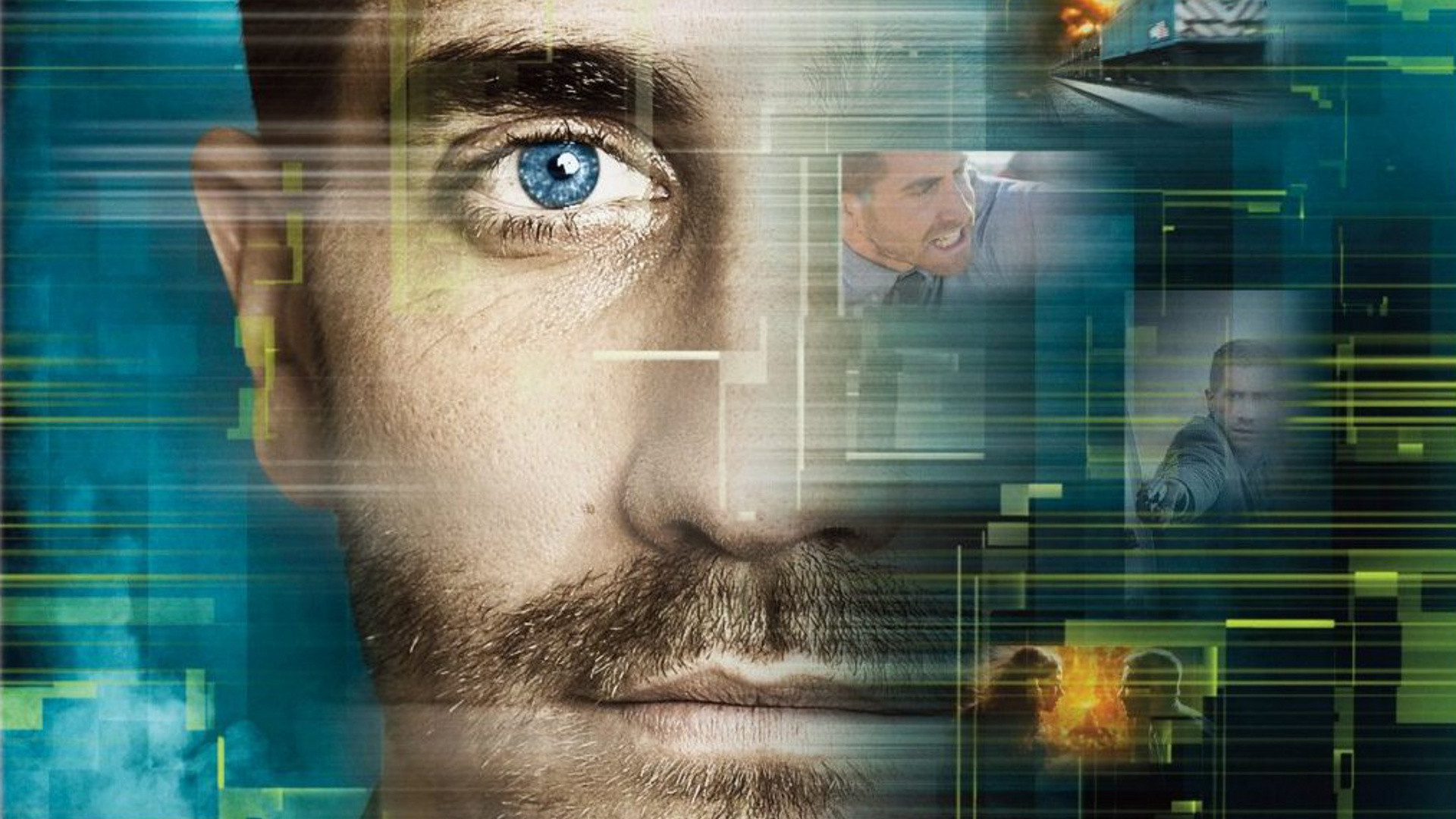
When I first heard that the movie Source Code, which I haven’t seen but which looks pretty cool, is being developed for TV, my instinctive first question was, “What network?” (The answer is CBS.) Because, with sci-fi and genre TV, the network is everything. It will largely determine how the material will be handled and whether it will succeed. Continue reading
Category Archives: Dramas
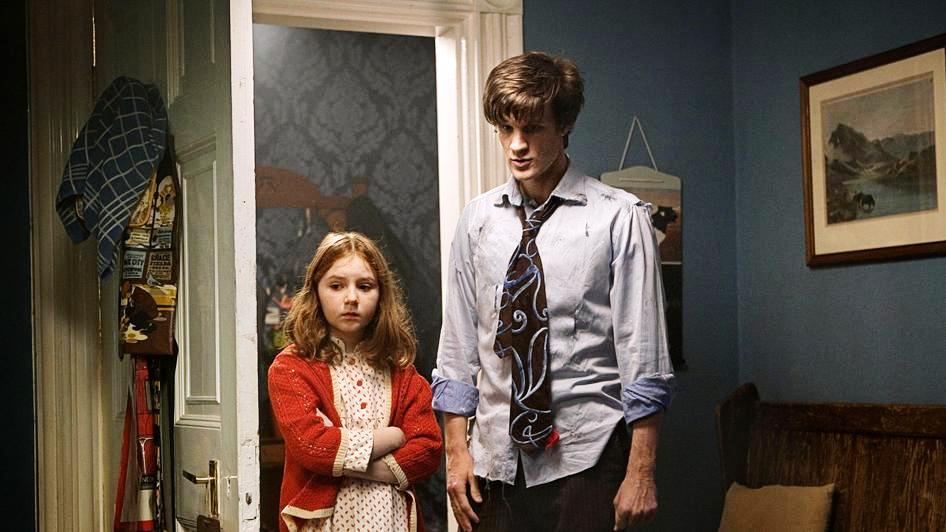
Dr. Who: The Eleventh Hour
I’ve never watched Dr. Who. I have a passing familiarity with who The Doctor is and what a TARDIS is, mainly via geek osmosis (geekmosis?), having a lot of friends and Tweeps who are fans. I’ve caught bits and pieces of a few episodes since it began airing on BBC America, but the whole thing seemed too overwhelming to try and jump in mid-stream. I mean, the show is in the Guiness Book of World Records as the longest running science fiction show and its lead has been played by eleven different actors. Where do you start?
You start, I’ve discovered, with The Eleventh Hour.
This is the first episode of season 5 (of the show’s modern incarnation) and the introduction to Matt Smith as The Doctor. It functions very much as a pilot, and I highly recommend it to any Doctor Who virgin. It is a continuation from the end of season 4 and includes many significant updates and references for loyal viewers, but you don’t have to know that to enjoy it.
It’s action-packed from the first moment. The Doctor–in this case a gangly 20-something in a shirt and necktie–clings precariously to his police call box, hurtling across the London night sky, narrowly missing Big Ben. He crash lands in the backyard (the garden, as they say in the U.K.) of a young red-headed Scottish girl, just as she is praying to Santa Claus for someone to fix the crack in her bedroom wall. He climbs from the box, soaking wet and demanding an apple. Though these two characters have never met, neither is the slightest bit shy about speaking his or her mind.
“I’m the Doctor,” he announces. “Do everything I tell you, don’t ask stupid questions, and don’t wander off.” Though the girl, Amelia Pond, (Caitlin Blackwood) isn’t a particularly docile kid, she’s game to go along with whatever he says. They banter like a brother and sister as they bounce around the kitchen trying to find something he likes to eat. From this we learn that the Doctor is not himself. He has just acquired a new body, which he is still getting used to, and he’s not even sure of his own tastes. This is part is not explained but, according to Wikipedia, The Doctor regenerates a new body when mortally wounded; a convention that protects the show against jumping the shark even after 5 decades.
The Doctor and Amelia inspect the crack with the help of a gadget that’s something like a Swiss Army laser pointer (an iconic Doctor prop known as the Sonic Screwdriver). The crack is a crack in the fabric of the world and, though it, an alien being is searching for an escapee called Prisoner Zero. Before The Doctor can catch Prisoner Zero, though, he has to secure a glitch with his police box, explaining to Amelia as he climbs aboard that it’s a time machine. He makes a heartfelt promise that he will return in five minutes. She packs a suitcase and plops down on top of it to await his return.
These first 15 minutes is an absolute delight. It has fun, fairy tale-like air with a hint of foreboding; that crack is scary, especially when considered through the eyes of a child. And her complete acceptance of The Doctor as her friend and protector is completely endearing.
The Doctor returns in daylight and runs to the house. We’re led to believe a few hours have passed. Then, wait, it’s six months. There are clues that it’s longer–the house looks a bit worse for wear and the foliage has grown up in the yard. But he said five minutes. Inside the house, a police woman whacks The Doctor with a cricket bat and handcuffs him to a radiator. Her outfit is a little to sexy to be believable as a standard issue police uniform, and she eventually admits that it’s a “kiss-o-gram” costume.
Here we find the twist that–if you somehow have not seen the show since Matt Smith took on the role of The Doctor–just might take you by surprise. Ready?
This cheeky young woman (Karen Gillan) is Amelia, and twelve years have passed.
“I grew up.”
“You never want to do that.”
Caitlin Blackwood and Karen Gillan are real-life cousins, which brings a true family resemblance, and both girls just light up the screen with their charisma. The monster-of-the-week arc provides a wealth of background about the characters and the world of the show. The escaped alien is still living in her house. Its jailer has resumed an active and aggressive search for it, spurred by The Doctor’s return.
It is revealed that Amelia, now going by Amy, held out hope for the return of the man she called “The Raggedy Doctor” for years. She told friends and neighbors about him, drew pictures of their adventures, and even role played their relationship. It’s enough to break your heart, but the action doesn’t stop long enough.
The aliens are about to incinerate the Earth if Prisoner Zero is not handed over, so The Doctor and Amy, with help from her boyfriend and a couple of neighbors, must scramble to save it.
The Eleventh Hour has everything a pilot needs: a great episode arc, along with a hook into a season arc; characters we want to get to know better; enough back story to pique curiosity without slowing the pace; and endless possibilities for where the story can go–quite literally in this case.
Did I mention I recommend it? It’s available on Amazon if you need to catch up.
Eureka
When a character in TV or film stumbles into a Town with a Dark Secret… or Cleveland… they do so one of two ways: by relocating to make a fresh start, usually following a tragedy, (Secret Circle, Manhattan, AZ, Locke and Key) or by getting stranded there (Lost, Hot in Cleveland). Eureka‘s Jack Carter (Colin Ferguson) falls into the latter category.
The show opens, however, with a wife calling her husband to bed. We pan down to the basement to find the husband tinkering with a large mechanical device reminiscent of the launchpad from the movie Contact. As its concentric circles spin the nerdy-looking man exclaims, “Susan, it works!” The sinister score lets us know that, whatever the gadget is doing isn’t good.
We meet Jack, a U.S. Marshall, as he is driving along an otherwise deserted road in his police car, with a mouthy young girl riding in back. Zoe (Jordan Hinson) and Jack are presented as prisoner and arresting officer, but bicker more like smartass teenager and protective but frustrated father. So it’s not really a big reveal when we later learn that he is, in fact her father.
They run off the road trying to avoid a dog, But not before Zoe witnesses a supernatural sight: She sees a duplicate of Jack’s car, with duplicate passengers inside, passing them on the road. Jack doesn’t believe her.
While he sets off to get the car repaired, Jack hands Zoe over to the local police station for incarceration. There, we meet Sheriff Bill Cobb and Deputy Jo Lupo (Erica Cerra), a bitter overgrown tomboy. Up to this point the characters seem relatively normal if slightly standoffish. The only major hint that something is unusual in this picturesque Oregon town is a boy of no more than nine, carrying a book on theoretical physics, gives oddly articulate directions.
As tends to happen in these situations, the car cannot be repaired right away. Local mechanic Henry Deacon (Joe Morton) informs an exasperated Jack that the job will take a few days. So, in the meantime, Jack winds up helping solve a local mystery of national interest. A big hole has been blown in the back of an RV belonging to Walter, the nerdy man from the opening scene. While he is clearly hiding something, he seems well liked by the townspeople.
Next Jack meets Allison Blake (Salli Richardson-Whitfield) who trumps his U.S. Marshall status by announcing she represents the Department of Defense. The RV isn’t the only thing blown apart–there has been mysterious damage to other locales and some cows. We find that whatever can of worms Walter has opened is causing a lot of trouble, and that representatives from a local research agency are trying to cover it up.
Each scene takes us a little deeper into WTF territory. This town is definitely hiding something. As Jack and Allison enter a secured area he askis, “Where are you taking me, Area 51?” She replies, “Please, they wish they had our security.” At the midpoint, we finally get some explanation: Eureka was founded by President Truman, at the request of Albert Einstein, to house the greatest scientific minds in the country. We’re still not sure just what they’re up to at the moment or why explosions from Henry’s garage are treated as commonplace. The town has an isolationist nature that begins to get creepy; it reminds me of the corporate-run communities in Margaret Atwood’s Oryx and Crake.
As Jack delves deeper into the mystery–he has nothing else to do–we get to know him a little better. He is recently separated from his wife. From Zoe’s snarky remarks we glean that he is a workaholic who hasn’t made time for his wife and child.
…And some other stuff happens. This pilot is little rambly and long (2 hours) as the writers attempt to introduce–it seems–the whole freaking town. And on top of setting up characters and conventions, the episode still basically follows a mystery-of-the-week formula. The problem is solved, the world is saved, and Jack and Zoe seem to be on their way out. But just as we reach end, we witness a murder. And it turns out Jack has been appointed Sheriff of Eureka and will be hanging around for a while.
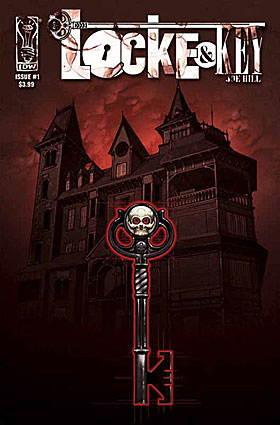
The Secret Circle and Locke & Key
So far at Comic-Con I have seen two pilots, which bear several similarities. The Secret Circle and Locke and Key each begin with a parent gruesomely murdered by a mysterious villain, and children going to live with relatives in old family homes harboring secrets. Both involve elements of the supernatural. That’s about where the similarities end.
The Secret Circle has lots of pretty girls and high school rivalries and a budding grandmother-granddaughter bonding story. Locke and Key is terrifying, set in a remote manor, and raises more questions than it answers. Which one do you think got picked up for the fall schedule? Yep… If you didn’t see Locke and Key at one of its two Comic-Con screenings today, you probably never will. And it’s a damn shame, because it’s awesome. Fox (who passed on it) probably wasn’t the right network. It looks like something one would see on AMC or even HBO. One of the concerns from fans of the comics was that the emphasis of the show would be too much on the mother character and less on the children. That fear turned out to be unfounded, and the audience in the screening room seemed delighted by the pilot.
I’ll write descriptions of both of these later. Too busy geeking out!
Breaking Bad
Breaking Bad is gearing up for Season 4 this Sunday, which is sort of a spoiler in and of itself if you’ve never seen the show, but perhaps, like me, you are behind the curve. If so, here’s a look at where it started.
This pilot opens in media res–an intense scene where the hero is in deep s**t–before flashing back to tell us how he got here. It’s a technique used in everything from The Odyssey to Ratatouille. I must say, though, Breaking Bad threw me for a loop. Our hero, Walter’s (Bryan Cranston) life is such a mess when we open, I thought we were going to take a whole season to get there. It only takes one episode.
As the show opens, a pair of pants fly through the air just as an RV careens into view. It is driven by a pants-less man in a gas mask while another man is passed out or dead in the passenger seat and two others roll around the floor. The driver loses control and runs off the road, then grabs a video camera to record what we expect may be his final words.
No-pants is Walter Hartwell White of Albequerque, NM. He tells his family he loves them and, he says, despite what they are about to learn about him, “I only had you in my heart.” He leaves his wallet and the camera on the ground and steps into the dusty road aiming the gun at whatever is headed his way.
We then flash back three weeks, into “a day in the life” mode. It’s Walter’s 50th birthday and he shares a simple, low-cholesterol breakfast with his wife Skyler (Anna Gunn) and son Walter Jr. (RJ Mitte) Other than the fact that Skyler is a bit of a nag and teenage Walter Jr. is a bit of a smartass, they seem like a pretty loving middle-class family.
The next succession of scenes gives us a taste for how mundane Walter’s life is, but it’s not tragic. The writers could have made Walter into a Lester Burnham (American Beauty), and there are parallels, but Walter’s even more middle-of-the-road, if that’s possible. And, we have to like him to make this show work. Walter teaches a high school chemistry class, giving a presentation that you can see he thinks is snazzy and hip, which his students receive as if Ben Stein is teaching.
Next, Walter moves on to his night job at a car wash, where his boss bullies him into staying late–after Skyler has specifically asked that Walter not let this happen. He arrives home late to find a surprise birthday party in progress. Here we meet his brother-in-law, a loud-mouth cop who just made a big meth bust. Walter’s curiosity about the bust, specifically the amount of money involved, is the first spark we see in him that he just might hold aspirations for something else.
As if to top off–or put into perspective–his sad existence, Walter soon learns that he has inoperable lung cancer. But for a guy who’s just gotten really shitty news, his luck seems to be changing. A series of serendipitous events including bumping into one of his former students while on a ride-along with his brother-in-law, leads him on a fast spiral into making crystal meth. He blackmails the former student, Jesse Pinkman (Aaron Paul), into help him, snags some lab equipment from the school and buys an RV, and there’s no looking back.
While Jesse is an arrogant, punkass kid who prides himself on the artistry of his “cooking,” Walter is his antithesis. Walter’s methods are meticulous and thorough. He’s the kind of guy who, if he’s going to commit crime, he’s going to do it the best he can. And that’s why we like him. He may be “breaking bad,” but he’s got fierce integrity and devotion to his family. A scene where he stands up to some bullies picking on his son in a store is inspired. It gives us a sense that being faced with death is giving Walter a new-found confidence. Walter turns out to be a genius at making meth, which leads him and Jesse to run afoul of some drug dealers, eventually leading to the chase scene we see at the beginning. But Walter doesn’t die. Or get arrested. Or suffer any consequences at all. It’s as if a condemned man is suddenly leading a charmed life; it’s a fascinating premise to kick off a highly original show.
Check out this post on how AMC has become a force to be reckoned with where TV drama is concerned.
Veronica Mars Season 4
So this has nothing at all to do with pilots, aside from the fact that the show in question has one of the best pilots ever, but it is so completely awesome that I had to post it. It’s unaired footage from Season 4 of Veronica Mars. No, there never was a Season 4, but this gives us a little taste of what might have been after that incredibly frustratingly open-ended series finale. I guess it’s been hanging around the web a while, but I just discovered it.
Our little girl made it to the FBI–and what a great frakking premise for her first assignment!
I guess the world will never know whether Keith was elected sheriff.
Pilot Titles
How well do you know the titles of episodes of your favorite shows? Do you even give them a thought? Some shows get pretty creative. Some naming conventions are discussed here.
Pilot episodes are usually just called “Pilot,” possibly because the creators don’t know quite where the show is headed. But some shows have really cool pilot titles. Often, titles are added after the fact, possibly when the show is released on DVD.
Here are some of my favorite pilot titles I’ve come across. See if you can guess what shows they belong to. Answers are after the jump.
- Chuck Versus the Intersect
- Welcome to the Hellmouth
- Simpsons Roasting on an Open Fire
- Pie-lette
- Genesis
- Days Gone Bye
- Space Pilot 3000
- The One Where Monica Gets a Roommate, a.k.a. The First One
- Sex and Violence (actually a second pilot, whatever that means)
- Everybody Lies
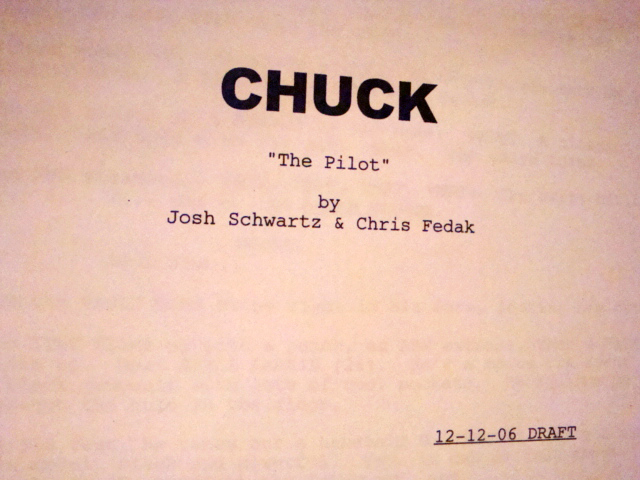
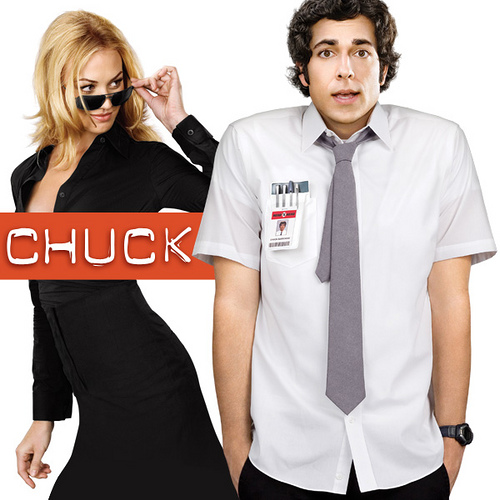
Chuck
Following a couple weeks of lackluster season finales, I’m contemplating shows that start out great and then go off the rails somewhere. Sometime it happens in a moment, like when a couple finally gets together and dissolves all of the show’s sexual tension, or sometimes it happens over time as the characters just run out of funny and interesting things to do. Sometimes you even know it’s going to happen before it happens, the way we know that Barney Stinson is going to get married. In a church.
Don’t get me wrong. Shows–and characters–have to evolve. But sometimes you look back on a pilot wistfully, longing for the way things used to be. Such is the case with Chuck.
Chuck really hit its stride in Season 2, with a finale so good that we were willing to eat at Subway just to resolve the cliffhanger. But you can see the seeds of that greatness in the pilot. It has it all.
We meet Chuck Bartowski as he and best friend Morgan Grimes are playing spy–attempting to sneak out a bedroom window to escape a birthday party Chuck’s sister Ellie is throwing for him. One look at these guys hanging half out a window and we know they’re total dorks. Somewhere around Season 3, Chuck (Zachary Levi) got hot, and that’s just weird. Even Morgan (Joshua Gomez) got better looking. It’s their awkwardness that makes them so loveable.
Chuck’s unease with women is illustrated nicely as he attempts to chat up women at the party, lamenting the loss of a girl who dumped him back in college. She dumped him for a guy named Bryce Larkin (Matt Bomer), who we meet in short, interspersed scenes. Despite Chuck’s assertion that “I think he’s an accountant now,” Bryce is covered in blood and running across rooftops doing somthing very un-accountant-like.
Since you probably know the story, I’ll zip though it. Bryce emails Chuck a shitload of images encrypted with CIA secrets and they become seared into Chuck’s brain. A hot girl named Sarah comes into the store where Chuck works and asks him on a date. She’s really a super-spy trying to get the secrets back, assuming they’re sitting on a hard drive. When she and her NSA counterpart, Colonel John Casey (Adam Baldwin *drool*), realize that the secrets are in Chuck’s head, they use him to help disarm a bomb and save the day.
Here are the cool things to note. In saving said day, Chuck uses a combination of the intersect (the data in his head) and his own skills (knowledge of DOS, a particular model of laptop, and the existence of a certain computer virus). That’s what makes Chuck awesome. If the intersect ended up in someone else, this story could not have existed. (It gets even better when he flies a helicopter in Ep. 2.) Also, we’re never sure who are the “good” guys and who are the “bad” guys. Bryce is killed–apparently–by the CIA. Was he a good guy? Can Chuck trust the CIA? And what’s the relationships between the CIA and the NSA in this case? The question of who Chuck can trust lasts throughout the season, as we wonder at times whether Sarah or Casey is really on his side.
This pilot is also brilliant at giving us just what we need to know about each character, no matter how minor. We get a good sense of loving big sister Ellie and her boyfriend Awesome. The scenes at Buy More are hysterical, despite being slowed to a snail’s pace at one point while Chuck helps a dad film his daughter doing ballet. But we get a taste for Anna, Lester, Jeff, and for a moment at the end–Big Mike.
The pilot showed us that this show had heart, suspense, and tons of humor (e.g. Chuck singing “Vick-vi-vicki Vale” as Sarah enters. “It’s from Batman,” he says. She replies “Cuz that makes it better.”)
You know what it doesn’t have? Jeffster. As funny as that was once, maybe even twice, Jeffster got completely out of control. And one long-lost parent who’s really an underground spy, I can take. But not two. And, for all her talk about spies not falling in love with spies, that’s kinda all Sarah does. Sometimes shows run their course in a season or two and this one has done it. So let’s appreciate the early days.
Three Moons Over Milford
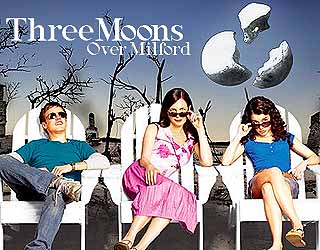
Since the world didn’t end last weekend, a surprisingly fun, light-hearted show about impending doom seems fitting this week. Three Moons Over Milford aired for all of 8 episodes on ABC Family in 2006. Although the pilot has a happy, shiny tone, I suspect the show was too quirky even for the network home of Kyle XY.
We first hear, via radio broadcast (a handy plot device for opening pilot episodes), about how people around the world are increasingly engaging in risky behaviors like skydiving and running with the bulls. Elizabeth McGovern, who has a whole Lauren Graham thing going on, trots out of her ridiculously cool, modern house and jogs around the town to give the viewer a once-over of Milford, VT, founded in 1738.
Milford looks for all the world like Stars Hollow, CT but despite its New England charm we get hints that things are amiss. An elderly man joyously rides a scooter, a woman waters her lawn in the nude, and a newlywed couple displays some fun-with-gender-swapping.
We get the set-up via the opening credits: A meteor struck the moon, splitting into three pieces now hovering precariously on the horizon, threatening to destroy the Earth at any moment. One interesting element of the episode is that, until the climax, we’re only show the moon(s) in reflections. Images of the three jigsaw piece chunks show up in a swimming pool, in puddles and in windows.
We get to know Laura Davis (McGovern) and her family, which looks like it would be perfect in a world with an intact moon. Only now, her white collar husband Carl (Henry Czerny) parks his Porshe in front of his yurt, where he is getting in touch with… something. It’s not quite clear, as his lifestyle seems to be a generic jumble of Eastern and new age mysticism. When Laura goes to see him, the two debate which one of them is “missing mankind’s last, greatest opportunity.”
Back story on the family is parcelled out little by little, but we learn the most when Laura goes to see a small-time lawyer about her daughter’s indiscretion with a open flame (more on that in a moment). The lawyer, Mark (Rob Boltin) is destined to be the love interest from the moment we meet him and this point is underscored when we learn that he harbors hatred for the Davis family. (Enemies in the pilot=making out by season finale.) It seems the Davises came to town to launch a company with the nondescript name Syndek in an ultra-modern glass building, bringing a more worldly type of citizen to this backwoods town and driving up the price of coffee (among other things, presumably).
Mark has his own problems. His overbearing mother tells him, “Sarah Louise called for you,” with a strain in her voice warning him against this person. We finally catch a glimpse of her at the very end of the episode. Her mysterious introduction serves as the hook to urge the viewer back for episode 2.
Laura’s teen daughter, Lydia (never-seen-before-or-since-but-not-half-bad Teresa Celentano) is dabbling in witchcraft. She and her friends gather in the school gym to take part in a worldwide ceremony to reunite the moons. Their mission ends in the aforementioned fire. Lydia talks like a Gilmore Girl. (Do you see where I’m going with this? According to the blogosphere, the similarities to Gilmore Girls only got stronger as the series went on.)
The son, Alex (Sam Murphy) is celebrating his 16th birthday and looking forward to owning car. In the meantime he’s lying about his age and hooking up with a neighbor in her 20s, Claire (Samantha Quan). Claire typifies the pervasive worldview. She has vowed to grab what/who she wants in life, but once she throws herself at Alex she keeps repeating, “This isn’t me.” It’s as though everyone is trying to reinvent themselves, and is unsure how, in light of the looming Armageddon.
It’s odd, when you think about it, that someone needed to make a show about a world that could end at any moment. Because, really, the world could end at any moment—whether you believe it will be by an act of the divine, nuclear holocaust or zombie apocalypse. Only a handful of people seemed inspired to act on the warnings of May 21, but let’s face it, the guy behind it seemed like a nut. If the moon was split in three (however physically improbable; I’d love to hear Sheldon Cooper’s take) you couldn’t help but consider the reality. Maybe the premise was too much for ABC Family’s demo to process.
One Step Beyond
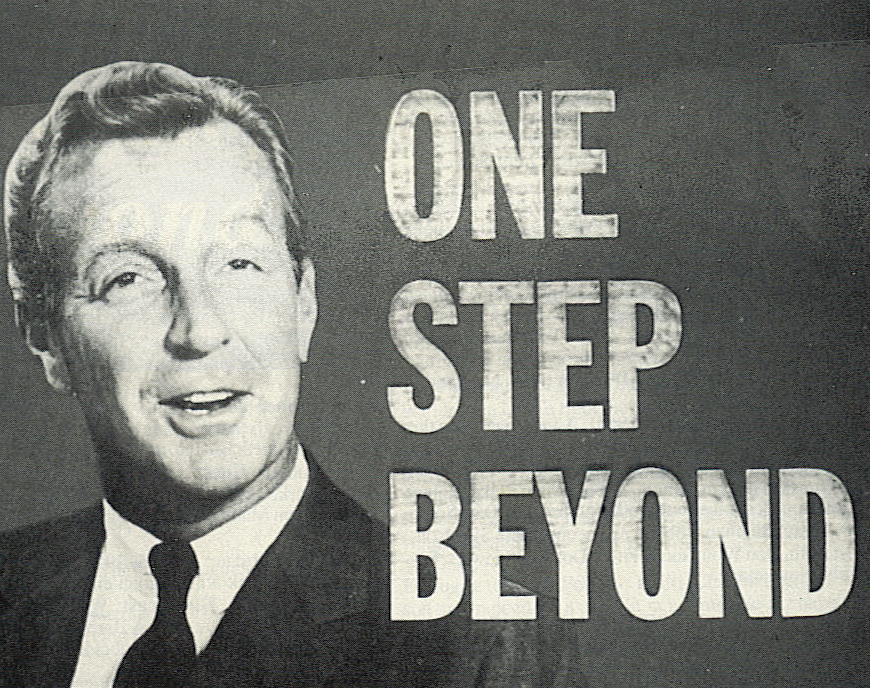
Shows like One Step Beyond and the better-remembered Twilight Zone are, in many ways, the entertainment ancestors of The X-Files, Fringe, and numerous other science fiction series featuring a mystery-of-the-week. So it’s informative to explore where sci-fi (or SyFy) television came from. Although the show doesn’t appear to be widely known, it had a reboot (The Next Step Beyond) in the 70s has been available on DVD since 2009.
One Step Beyond hit the airwaves in January 1959. In the episodic dramas of today we generally follow along with investigators as they try to solve the mystery at hand. Back then, we just had things laid out before us by a narrator. John Newland, who was a well-known actor and director at the time, claims that these stories are true. Whether we’re really meant to believe that is unclear. Newland introduces and concludes each one with measured gravitas. He’s not given to flashlight-under-the-chin mellowdrama. Each half-hour episode tells a single, stand-alone story, with different characters every time. It doesn’t matter much which order they are viewed in.
Episode 2 actually seems like it might have made a better pilot than Episode 1. (It’s possible it was the episode that sold the series.) Episode 2 is about the sinking of The Titanic, and various premonitions people–real or fictitious–had about it. With such a well-known and captivating event at its center, one would think this episode would have been idea for capturing an audience. That being said, I’m here to look at Episode 1, “The Bride Posessed.” The title itself is a bit of a spoiler, but it’s a fairly original tale.
We open with a rather cheap wedding reception in a tavern. The boisterous guests all seem to be friends of the groom, Matt (Skip Homeier), and we learn that the bride, Sally (Virginia Leith) is newly transplanted to California from Louisiana. There’s a bit of suspense about whether a certain wedding guest might get surly, but nothing comes of it. Perhaps this is an attempt to set the audience on edge for what’s coming.
As the couple drives away from their reception, Sally is asleep. When she wakes up, she begins directing Matt where to drive, giving explicit detail, even though she has supposedly never been here before. She becomes increasingly frantic to get to a particular location, eventually taking the car and leaving him stranded. Matt enlists the help of a policeman, who accompanies him to find Sally in an abandoned house. The officer explains that the previous resident recently committed suicide by jumping off of a nearby cliff, the name of which we heard Sally mention in the car. As things unfold, it becomes clear that the dead woman, Karen, has posessed Sally in order to report that she was, in fact, murdered.
We’ve seen stories of people who returned from the dead to solve their own murders, and stories of people posessed by demons, but this is a little different from either. Sally’s head doesn’t spin around; there is no blood or gore whatsoever. We never even meet the accused murderer. The story is primarily told from the point of view of the groom, watching his new wife thrash and scream with frustration when no one will listen to her. One exception is when we see though Sally’s eyes; in perhaps the most spine-tingling moment of the episode, she looks into a mirror and the reflection is that of Karen.
Resolution comes when the dead woman, through Sally, leads them to the murder weapon used to bash her head in. Sally falls asleep again and wakes up as herself. (One wonders what kind of anxiety this man is going to experience everytime his wife dozes off.)
Though it may not be suspensful or action-packed by today’s standards, “The Bride Posessed” hooks the viewer by asking them to wonder “what if?” That is really why we watch science fiction, is it not?