Unknown's avatar

About meekthegeek

Writer, animal lover, environmentalist, pop culture fanatic, and Star Wars fan.

Pilot Titles

How well do you know the titles of episodes of your favorite shows? Do you even give them a thought? Some shows get pretty creative. Some naming conventions are discussed here.

Pilot episodes are usually just called “Pilot,” possibly because the creators don’t know quite where the show is headed. But some shows have really cool pilot titles. Often, titles are added after the fact, possibly when the show is released on DVD.

Here are some of my favorite pilot titles I’ve come across. See if you can guess what shows they belong to. Answers are after the jump.

  1. Chuck Versus the Intersect
  2. Welcome to the Hellmouth
  3. Simpsons Roasting on an Open Fire
  4. Pie-lette
  5. Genesis
  6. Days Gone Bye
  7. Space Pilot 3000
  8. The One Where Monica Gets a Roommate, a.k.a. The First One
  9. Sex and Violence (actually a second pilot, whatever that means)
  10. Everybody Lies

Continue reading

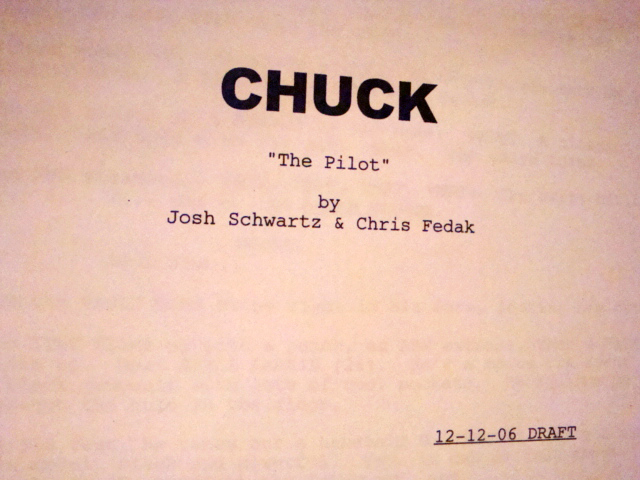
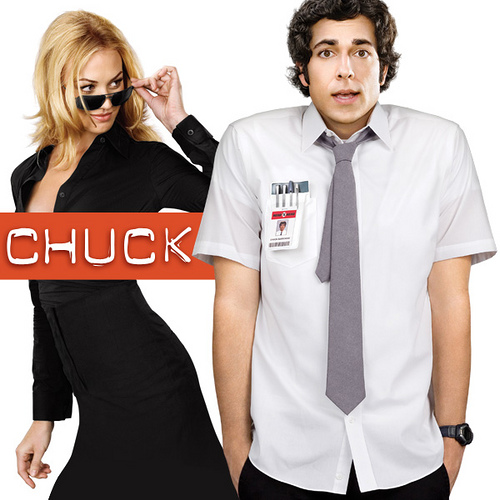
Chuck

Following a couple weeks of lackluster season finales, I’m contemplating shows that start out great and then go off the rails somewhere. Sometime it happens in a moment, like when a couple finally gets together and dissolves all of the show’s sexual tension, or sometimes it happens over time as the characters just run out of funny and interesting things to do. Sometimes you even know it’s going to happen before it happens, the way we know that Barney Stinson is going to get married. In a church.

Don’t get me wrong. Shows–and characters–have to evolve. But sometimes you look back on a pilot wistfully, longing for the way things used to be. Such is the case with Chuck.

Chuck really hit its stride in Season 2, with a finale so good that we were willing to eat at Subway just to resolve the cliffhanger. But you can see the seeds of that greatness in the pilot. It has it all.

We meet Chuck Bartowski as he and best friend Morgan Grimes are playing spy–attempting to sneak out a bedroom window to escape a birthday party Chuck’s sister Ellie is throwing for him. One look at these guys hanging half out a window and we know they’re total dorks. Somewhere around Season 3, Chuck (Zachary Levi) got hot, and that’s just weird. Even Morgan (Joshua Gomez) got better looking. It’s their awkwardness that makes them so loveable.

Chuck’s unease with women is illustrated nicely as he attempts to chat up women at the party, lamenting the loss of a girl who dumped him back in college. She dumped him for a guy named Bryce Larkin (Matt Bomer), who we meet in short, interspersed scenes. Despite Chuck’s assertion that “I think he’s an accountant now,” Bryce is covered in blood and running across rooftops doing somthing very un-accountant-like.  

Since you probably know the story, I’ll zip though it. Bryce emails Chuck a shitload of images encrypted with CIA secrets and they become seared into Chuck’s brain. A hot girl named Sarah comes into the store where Chuck works and asks him on a date. She’s really a super-spy trying to get the secrets back, assuming they’re sitting on a hard drive. When she and her NSA counterpart, Colonel John Casey (Adam Baldwin *drool*), realize that the secrets are in Chuck’s head, they use him to help disarm a bomb and save the day.

Here are the cool things to note. In saving said day, Chuck uses a combination of the intersect (the data in his head) and his own skills (knowledge of DOS, a particular model of laptop, and the existence of a certain computer virus). That’s what makes Chuck awesome. If the intersect ended up in someone else, this story could not have existed. (It gets even better when he flies a helicopter in Ep. 2.) Also, we’re never sure who are the “good” guys and who are the “bad” guys. Bryce is killed–apparently–by the CIA. Was he a good guy? Can Chuck trust the CIA? And what’s the relationships between the CIA and the NSA in this case? The question of who Chuck can trust lasts throughout the season, as we wonder at times whether Sarah or Casey is really on his side.

This pilot is also brilliant at giving us just what we need to know about each character, no matter how minor. We get a good sense of loving big sister Ellie and her boyfriend Awesome. The scenes at Buy More are hysterical, despite being slowed to a snail’s pace at one point while Chuck helps a dad film his daughter doing ballet. But we get a taste for Anna, Lester, Jeff, and for a moment at the end–Big Mike.

The pilot showed us that this show had heart, suspense, and tons of humor (e.g. Chuck singing “Vick-vi-vicki Vale” as Sarah enters. “It’s from Batman,” he says. She replies “Cuz that makes it better.”)

You know what it doesn’t have? Jeffster. As funny as that was once, maybe even twice, Jeffster got completely out of control. And one long-lost parent who’s really an underground spy, I can take. But not two. And, for all her talk about spies not falling in love with spies, that’s kinda all Sarah does. Sometimes shows run their course in a season or two and this one has done it. So let’s appreciate the early days.

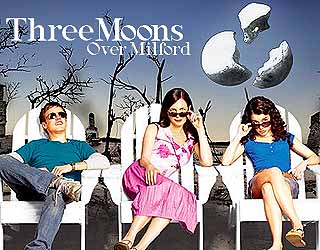
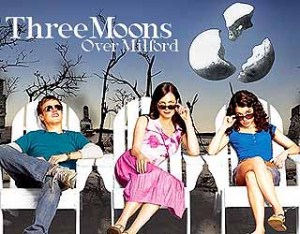
Three Moons Over Milford

Three Moons Over MilfordSince the world didn’t end last weekend, a surprisingly fun, light-hearted show about impending doom seems fitting this week. Three Moons Over Milford aired for all of 8 episodes on ABC Family in 2006. Although the pilot has a happy, shiny tone, I suspect the show was too quirky even for the network home of Kyle XY.

We first hear, via radio broadcast (a handy plot device for opening pilot episodes), about how people around the world are increasingly engaging in risky behaviors like skydiving and running with the bulls. Elizabeth McGovern, who has a whole Lauren Graham thing going on, trots out of her ridiculously cool, modern house and jogs around the town to give the viewer a once-over of Milford, VT, founded in 1738.

Milford looks for all the world like Stars Hollow, CT but despite its New England charm we get hints that things are amiss. An elderly man joyously rides a scooter, a woman waters her lawn in the nude, and a newlywed couple displays some fun-with-gender-swapping.

We get the set-up via the opening credits: A meteor struck the moon, splitting into three pieces now hovering precariously on the horizon, threatening to destroy the Earth at any moment. One interesting element of the episode is that, until the climax, we’re only show the moon(s) in reflections. Images of the three jigsaw piece chunks show up in a swimming pool, in puddles and in windows.

We get to know Laura Davis (McGovern) and her family, which looks like it would be perfect in a world with an intact moon. Only now, her white collar husband Carl (Henry Czerny) parks his Porshe in front of his yurt, where he is getting in touch with… something. It’s not quite clear, as his lifestyle seems to be a generic jumble of Eastern and new age mysticism. When Laura goes to see him, the two debate which one of them is “missing mankind’s last, greatest opportunity.”

Back story on the family is parcelled out little by little, but we learn the most when Laura goes to see a small-time lawyer about her daughter’s indiscretion with a open flame (more on that in a moment). The lawyer, Mark (Rob Boltin) is destined to be the love interest from the moment we meet him and this point is underscored when we learn that he harbors hatred for the Davis family. (Enemies in the pilot=making out by season finale.) It seems the Davises came to town to launch a company with the nondescript name Syndek in an ultra-modern glass building, bringing a more worldly type of citizen to this backwoods town and driving up the price of coffee (among other things, presumably).

Mark has his own problems. His overbearing mother tells him, “Sarah Louise called for you,” with a strain in her voice warning him against this person. We finally catch a glimpse of her at the very end of the episode. Her mysterious introduction serves as the hook to urge the viewer back for episode 2.

Laura’s teen daughter, Lydia (never-seen-before-or-since-but-not-half-bad Teresa Celentano) is dabbling in witchcraft. She and her friends gather in the school gym to take part in a worldwide ceremony to reunite the moons. Their mission ends in the aforementioned fire. Lydia talks like a Gilmore Girl. (Do you see where I’m going with this? According to the blogosphere, the similarities to Gilmore Girls only got stronger as the series went on.)

The son, Alex (Sam Murphy) is celebrating his 16th birthday and looking forward to owning car. In the meantime he’s lying about his age and hooking up with a neighbor in her 20s, Claire (Samantha Quan). Claire typifies the pervasive worldview. She has vowed to grab what/who she wants in life, but once she throws herself at Alex she keeps repeating, “This isn’t me.” It’s as though everyone is trying to reinvent themselves, and is unsure how, in light of the looming Armageddon.

It’s odd, when you think about it, that someone needed to make a show about a world that could end at any moment. Because, really, the world could end at any moment—whether you believe it will be by an act of the divine, nuclear holocaust or zombie apocalypse. Only a handful of people seemed inspired to act on the warnings of May 21, but let’s face it, the guy behind it seemed like a nut. If the moon was split in three (however physically improbable; I’d love to hear Sheldon Cooper’s take) you couldn’t help but consider the reality. Maybe the premise was too much for ABC Family’s demo to process.

That ’70s Show

That ’70s Show has recently started airing on TeenNick, introducing the decade when we didn’t know Vader was Luke’s father* to a generation that wasn’t born yet, so it’s due for a look. Also, star Laura Prepon has been cast in the forthcoming Are You There Vodka, It’s Me Chelsea, so in case you need a reminder who she is…

The official Episode 1.1, which aired in August 1998, is about Eric Foreman (Topher Grace) inheriting his parents’ Vista Cruiser. I’m convinced there was another first episode, an actual pilot, before this. Am I crazy? I remember the pilot as an episode about Donna’s (Laura Prepon) parents going out of town and a rivalry between Eric and Hyde (Danny Materson) for Donna’s affections. And Donna had a younger sister who was never seen again. It felt very pilot-y, like the writers didn’t quite have a handle on the characters yet. Even the opening sequence was a little different, possibly with a different version of the theme song. If anyone knows what in the world I’m talking about please leave a comment! Continue reading

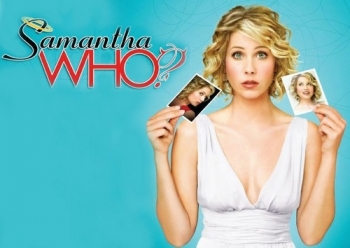
Samantha Who?

Samantha Who Christina ApplegateSamantha Who was a sit-com in which Christina Applegate played the eponymous character, but Jean Smart, who plays Samantha’s mother, steals the pilot. She opens the show with snarky hilarity not far removed from her character on The Oblongs. Samantha wakes up from a coma to find her mother, Regina, standing over her with a video camera, generating sympathy footage to win a spot on Extreme Makeover: Home Edition. “I don’t care if no one likes her. She’s my daughter,” she trills.

For a sit-com pilot, this one has quite a bit to accomplish. It has to fill us in on a good chunk of back story and essentially introduce us to two versions of the protagonist. It was also a show that built on itself, episode to episode, so the pilot had to start that momentum. It’s a comedy that’s part mystery, keeping viewers on their toes.

Samantha awakes from her coma with retrograde amnesia; she doesn’t remember anyone or anything. Overlook that cliched improbability and indulge in the fantasy the show offers–what would you think of your life if you could view it as a objective outsider? How would you fix what’s wrong with it? We already know that no one likes Samantha, thanks to Regina, but Samantha doesn’t. Her parents seem to at least be there for her, as does her boyfriend Todd (Barry Watson; Matt Camden is all grown up and smoking hot) and her self-described best friend Dena (Melissa McCarthy doing her usual spunky thing). But life is full of surprises for Samantha and, in turn, the audience.

Jennifer Esposito plays  BFF Andrea, a 180-degree switch from her character on Related (did anyone but me watch that show?), but her value as a friend is highly suspect. We first meet her as she and Regina trade punches in a hilarious scene back at the home of Samantha’s parents. The two of them are so evenly matched for understated bitchiness, they could have their own spin-off. Andrea also informs Sam that she hasn’t spoken to her parents in two years; we have to wonder if that’s by Sam’s choice or theirs.

Andrea invites Samantha out to a club and the secrets being to emerge. Each twist builds on the last. We find that Samantha has been cheating on Todd with a married man named Rene, that she actually ditched Dena as a friend back in the seventh grade, and that she can fire off scathing insults at lightening speed when provoked. Oh, and she’s an alcoholic. Martini in hand, she discovers an AA token in her purse–which says more about the kind of friend Andrea is than anything else–and bolts of to a 12-step meeting.

Barry Watson as Todd has a unique task to pull off in all this. He’s perfectly polite, but not at all affectionate with his supposed girlfriend. Their attempt at a kiss is hopelessly awkward. There are no tears of relief that his love has emerged from a coma alive and well; something is definitely off. Yet, he is fully willing to allow Samantha back into their home and demonstrates his attentiveness by reciting personal details about her like that she always sneezes three times. When Samantha asks smarmy Rene how many times she sneezes, he reacts with fear of catching something. So, we’re set up to root for Todd. However, we find out near the end that he broke up with Samantha just before her accident. It’s probably for good reason, based on what we’ve learned of her so far. That leaves us with our season-long question, will they get back together?

The show did well in its first season but viewership dropped off in the second because, really, how long can you believably sustain an amnesia story? By the end of the pilot Samantha has already had one flashback, from the day she and Todd met as she stole his double latte at a coffee shop. Pieces of memory like this are destined to continue episode after episode. The pilot leaves us wondering what else will pop up. It also goes out on a high note with a great Jean Smart moment.

Here’s a video of Jean Smart talking about the show.

Bewitched

The creator of Bewitched, Sol Saks, who passed away last week, wrote only the pilot before moving on to other things. The show would go on to run eight seasons and then live on in syndication, later spawning a best-forgotten movie in 2005. Shows from Charmed to Mad Men can be said to have roots in Bewitched. So old Sol did pretty well for himself with this one script.

Bewitched is the story of married life between a witch and her mortal husband, with ongoing meddling by her mother. The pilot falls back on the crutch of having a disembodied voice narrate the back story, rather than having it unfold naturally. In this case, the latter choice might have worked better, because it almost feels as if these two characters just woke up married. We first get to know the beautiful blond Samantha (Elizabeth Montgomery) and her nerdily handsome ad exec husband Darrin (Dick York) on their wedding night. Somehow, they’ve made it this far without him discovering that she is a witch, or apparently, meeting each other’s families or friends.

It’s not a particularly original premise. Saks admitted to taking inspiration from the play/movie “Bell Book and Candle.” Supernatural families were familiar small screen territory, with The Munsters and The Addams Family premiering the same year.

As Samantha primps in the bedroom of the honeymoon suite, we first see her use her powers to levitate a hair brush. It’s not a bad special effect for 1964. Samantha’s mother appears out of thin air to reprimand her for getting married and attempt to take her away. The mother, Endora (Agnes Morehead), establishes herself as a strong female character, but what else would you expect from a witch? The stereotype of the ugly old hag in a pointy black hat is acknowledged and tossed out with humor. Samantha demostrates equal strength by standing up to Endora, insisting on staying with her new hubby. These are real witches, the show seems to say. (But no recitation of the Wiccan rede.)

Any flicker of feminism is soon extinguished, however. Once Darrin adjusts–with the help of no more than a couple of drinks and the dismissal of his skeptical friends–to Samantha’s witchhood, he basically tells her it’s all good, so long as she learns to cook and keep house. Toward the end, Samantha hints that she will not be without the aid of magic in completing her domestic chores, so there’s the hook to keep the audience coming back. She apparently plans to keep her magic use under her non-pointy hat while her husband remains oblivious. Nice, healthy marriage. We know to expect lots of intereference from Endora, too.

The rest of the pilot plot revolves around a jealous bitch of an ex-girlfriend who invites the newlyweds over for dinner. Man, she’s a bitch. The irony of the non-witch being the evil one here isn’t subtle. Samantha takes her revenge, however, to Darrin’s disapproval. We can see Darrin isn’t going to approve of much. That’s okay, he’ll eventually be recast in one of TV history’s most well-known shark jumps.

Here are ten fun facts about Bewitched.

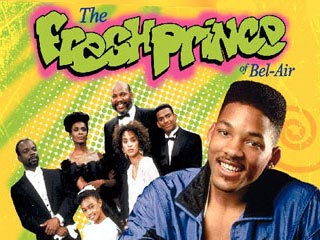
The Fresh Prince of Bel-Air

The Fresh Prince of Bel-air hardly needs a pilot to introduce its premise. It’s all right there in the theme song. C’mon, you know the words: “Now this is the story all about how/My life got flip-turned upside down…”

The pilot opens exactly where the intro leaves off, with the ridiculous-looking Fresh Prince, who we know today as alien-and-zombie-busting Will Smith, standing on the columned porch of his Uncle Phil’s giant house, fresh (no pun intended) from West Philadelphia. When the door is answered, Will mistakes the butler, Geoffrey, for his uncle. Has he never met this uncle before? But point taken–Will has never encountered the sort of wealth that employs “help” before.

The Fresh Prince debuted in 1990 but the 80s were still hanging around like a neon fog. The garish colors, the bad sweaters, and the shoulder pads–dear lord, the shoulder pads–are everywhere. The show goes to such lengths to contrast Will’s colorful, goofball ways with the austerity of Bel-air as to be ridiculous. Will can hardly get through a sentence without employing slang like “def” and “dope.” He’s claims to be “street,” as evidenced (I guess) by a Malcolm X poster in his room. But the contrast is more one of pop culture meets high culture than one of poverty meets wealth. Even if it is always sunny in Philadelphia, I just don’t see this cheerful, neon yellow-clad teenager busting a cap in anyone’s ass on its mean streets.

Members of the Banks family parade in one at a time, offering the audience a chance to digest each one. Uncle Phil (James Avery) is a no-nonsense lawyer who wears suits, apparently, just to hang around the house. Aunt Vivian (Janet Hubert Whitten) is gracious and warm. Oldest sibling Hilary (Karyn Parsons) breezes in demanding $300 for a new hat to wear on as Save-the-Ozone celebrity bus tour. Little sister Ashley (Tatyana Ali), clad in a private school uniform is sweet and adorable, and destined to be the only one Will can immediately connect with. (Total side note: Karyn Parsons and James Avery will be reunited on-screen this summer in the new Transformers movie.)

Carlton, played by Alfonso Ribiero is saved for last. He’s something of a vertically-challenged Ken doll, representing the polar opposite of Will. When Will looks into a mirror and imagines his reflection to resemble Carlton’s, a turning point in the episode is reached, and the show’s conflict introduced. Will will not let himself be turned into a Banks.

The rest of the episode revolves around a dinner party where Uncle Phil is entertaining colleagues. It’s suggested that he’s not such a bigshot as he wishes to be–it seems neighbor Ronald Regan has turned down his dinner invitation. Will takes the party by storm, donning the suit pants and jacket he was given in combination with the world’s most hideous tanktop and a hat that I’m pretty sure I got free with purchase at a Wendy’s in 1988. Although we’re supposed to be rooting for Will, it’s hard not to be embarrassed for him in a Michael Scott kind of way. Sparks fly, naturally, and Uncle Phil is furious.

The final scene takes a serious tone that one might expect from a “very special” episode. Will and Uncle Phil find some common ground in their admiration for Malcolm X and learn you can’t judge a book by its cover. It’s kind of sweet, and sets us up for lots of complications to last four seasons. After which the show was cancelled. Before being picked back up for two more seasons. So as ridiculous as it seems, the show certainly found an audience. We have to wait until episode 2 to meet Jazzy Jeff, though.

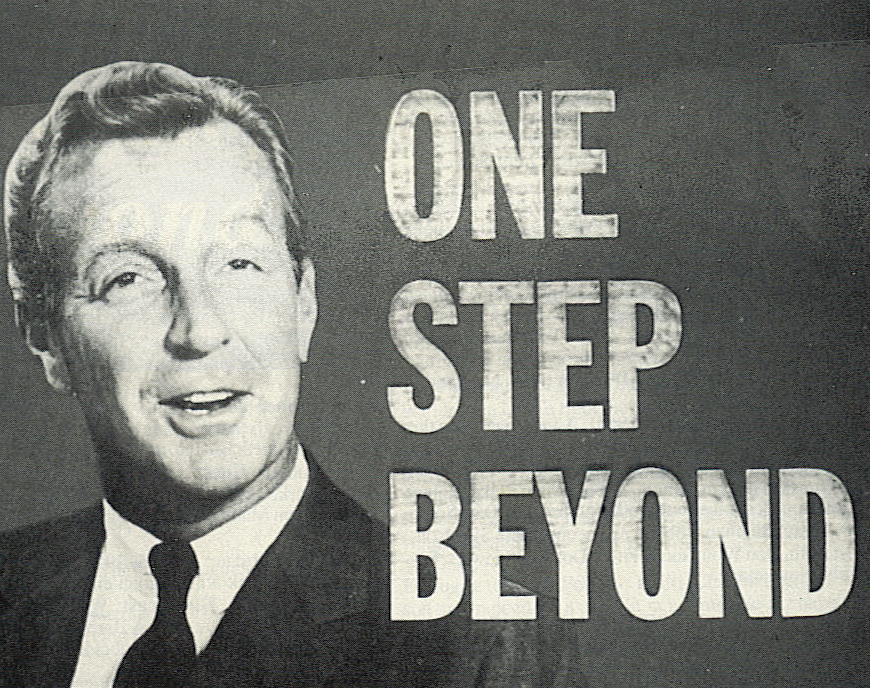
One Step Beyond

Shows like One Step Beyond and the better-remembered Twilight Zone are, in many ways, the entertainment ancestors of The X-Files, Fringe, and numerous other science fiction series featuring a mystery-of-the-week. So it’s informative to explore where sci-fi (or SyFy) television came from. Although the show doesn’t appear to be widely known, it had a reboot (The Next Step Beyond) in the 70s has been available on DVD since 2009.

One Step Beyond hit the airwaves in January 1959. In the episodic dramas of today we generally follow along with investigators as they try to solve the mystery at hand. Back then, we just had things laid out before us by a narrator. John Newland, who was a well-known actor and director at the time, claims that these stories are true. Whether we’re really meant to believe that is unclear. Newland introduces and concludes each one with measured gravitas. He’s not given to flashlight-under-the-chin mellowdrama. Each half-hour episode tells a single, stand-alone story, with different characters every time. It doesn’t matter much which order they are viewed in.

Episode 2 actually seems like it might have made a better pilot than Episode 1. (It’s possible it was the episode that sold the series.) Episode 2 is about the sinking of The Titanic, and various premonitions people–real or fictitious–had about it. With such a well-known and captivating event at its center, one would think this episode would have been idea for capturing an audience. That being said, I’m here to look at Episode 1, “The Bride Posessed.” The title itself is a bit of a spoiler, but it’s a fairly original tale.

We open with a rather cheap wedding reception in a tavern. The boisterous guests all seem to be friends of the groom, Matt (Skip Homeier), and we learn that the bride, Sally (Virginia Leith) is newly transplanted to California from Louisiana. There’s a bit of suspense about whether a certain wedding guest might get surly, but nothing comes of it. Perhaps this is an attempt to set the audience on edge for what’s coming.

As the couple drives away from their reception, Sally is asleep. When she wakes up, she begins directing Matt where to drive, giving explicit detail, even though she has supposedly never been here before. She becomes increasingly frantic to get to a particular location, eventually taking the car and leaving him stranded. Matt enlists the help of a policeman, who accompanies him to find Sally in an abandoned house. The officer explains that the previous resident recently committed suicide by jumping off of a nearby cliff, the name of which we heard Sally mention in the car. As things unfold, it becomes clear that the dead woman, Karen, has posessed Sally in order to report that she was, in fact, murdered.

We’ve seen stories of people who returned from the dead to solve their own murders, and stories of people posessed by demons, but this is a little different from either. Sally’s head doesn’t spin around; there is no blood or gore whatsoever. We never even meet the accused murderer. The story is primarily told from the point of view of the groom, watching his new wife thrash and scream with frustration when no one will listen to her. One exception is when we see though Sally’s eyes; in perhaps the most spine-tingling moment of the episode, she looks into a mirror and the reflection is that of Karen.

Resolution comes when the dead woman, through Sally, leads them to the murder weapon used to bash her head in. Sally falls asleep again and wakes up as herself. (One wonders what kind of anxiety this man is going to experience everytime his wife dozes off.)

Though it may not be suspensful or action-packed by today’s standards, “The Bride Posessed” hooks the viewer by asking them to wonder “what if?” That is really why we watch science fiction, is it not?

Breaking In, or Trying to Speak Geek

Some pilots want nothing more than to convey to the viewer what the creators imagine to be the unique style and tone of the show. Breaking In, which debuted last night on Fox, wants you to know it’s for geeks. They really, really want you to know it. I can just hear the pitch meeting: “It’s a show about smart geeks who work together to foil security systems and have a crazy boss. It’s like Chuck, meets Archer, meets The Office! With a dash of The Big Bang Theory!”

I won’t rehash the entire plot since there are any number of reviews out there. Basically, a smart but understated guy named Cameron (Brett Harrison of Reaper and The Loop) is not so much recruited by as coerced into working for a security company. The gang at the company, led by Christian Slater as Oz, pull off creative and highly challenging heists for a living.

Star Wars references seem to pop up in everything these days. How I Met Your Mother and Bones incorporate them really well, making you believe the characters think of Star Wars as part of their lives. (Marshall will cut a Thanksgiving turkey with a light saber one day.) In Breaking In, the character Cash (Alphonso McAuley) is introduced wearing a Han Solo costume. His first joke wraps up a nerd joke with a race joke–about how black guys don’t always have to play Lando. It would have been funnier if he just went around dressed as Han Solo with no explanation, leaving it for the audience to notice. (Does it matter what race he is? Meg played a freaking worm in Family Guy’s Star Wars universe.)

That bit is quickly followed by one in which Cash references Avatar then asserts that he speaks Klingon. We get it-you’re a geek!

As the New York Times points out, Christian Slater’s leering coercion of Bret Harrison looks an awful lot like the goings-on on Harrison’s previous geek-friendly show Reaper. Another more subtle geek reference, and one of the episode’s bright spots, was the appearance of the nearly-unrecognizable Michael Rosenbaum (Smallville’s Lex Luthor) as Dutch. He is hilariously doofy in his trailer trash-duds and monster-sized truck. When this show crashes and burns, he could have a future on Raising Hope.

It’s not that this pilot wasn’t entertaining or have it’s funny moments. It just seems like it’s trying way too hard to tell us what it is and what it is not, without allowing us to figure it out over a few episodes. It wants geeks to know they’re the intended audience, but it doesn’t know how to talk to them.

I feel pandered to. Raise your hand if you feel pandered to.

Birds of Prey

With excitement building for the Wonder Woman reboot this fall, I thought it would be a good time to take a look at some other DC Comics heroines, the ladies of 2002’s Birds of Prey.

In a nutshell, a blonde, a brunette and a redhead live together looking hot and fighting crime. The pilot is the story of how they got together. The show, or at least the pilot can be appreciated at face value, if the viewer has no previous knowledge of the characters. It could even be accused of ripping off Charmed, with its story of three powerful women joining forces and a suspicious cop on their trail. But there is ton of back story—at least 40 years worth of comic book lore.

Alfred, of Batman fame, narrates the opening. The story is set in New Gotham, and Batman has disappeared from its crime-ridden streets. The voiceover lends a storybook feeling, a bit like the tone of Pushing Daisies.

Barbara Gordon (Dina Meyer), formerly Batgirl, is confined to a wheelchair since The Joker shot her. She now lives in a clock tower—a set that looks like the same one Smallville used—surrounded by computers. By day she works as a school teacher. Living with her is Helena (Ashley Scott), the daughter of Batman and Catwoman. She was raised by her mother, killed by a henchman of The Joker while her daughter stood by, helpless. She has grown up to be The Huntress, a hero who runs across building tops by night, fighting crime while The Oracle oversees from her tower. In the comic world, The Huntress had completely different
origins, but did turn to heroism following the murder of her parents. (This according to The DC Comics Encyclopedia.)

As these two women experienced their personal tragedies, a third girl dreamt their pain. She is now teenage Dinah (Rachel Skarsten), and she has travelled to New Gotham to seek out the women from her dreams. On her way to find them, she witnesses a man being hit by a bus. She runs to his side and, when she touches him, she sees a vision of him being attacked by rats. Her power, it seems, is the ability to share people’s thoughts or fears. The comic book Dinah became The Black Canary, though that name isn’t mentioned in the pilot.

The man’s death sparks the women’s investigation into a series of related murders disguised as suicides, which leads them to some dockyards and the lair of the killer. Among the three of them they get to combine supernatural, or metahuman powers of an X-man with the high tech gadgetry of Batman.

As the women investigate these deaths, the police are also on the case. Detective Jesse Reese (Shemar Moore) is one officer who believes that something bigger is happening beneat the surface. He’s the “the truth is out there” character of the show. Sums up what may be the message-of-show with the awkwardly worded adage, “Myths are just the truth a few generations later.”

Another significant introduction in this pilot is that of Helena’s psychiatrist, one Harleen Quinzel (Mia Sara – remember her, Sloane Peterson from Ferris Bueller’s Day Off?), whose name reveals that she’s an enemy-in-waiting.

With its roots in death and destruction, this pilot promises a fairly dark show. There are small doses of humor, with lines like, “This place is supposed to be a secret. That’s the whole point of a secret lair.” Barbara and Helena argue about lighter things, too, like being out of groceries. There’s also a quick Superman/Smallville reference: “There’s been some really weird stuff with meteor showers.”

This pilot does a nice job of tying together the episode plot with a longer-term plot, when Harleen interacts with the episode villain at the end. There’s both resolution and reason to keep watching.

UPDATE 2/17/2012: In case you’re a big fan of the Black Canary character, you may like to know that Katie Cassidy has been cast to play her in the forthcoming Green Arrow series on The CW. And, in case you haven’t been paying attention, that Wonder Woman reboot never happened, but I’ve since blogged about the pilot of the 1970s series.